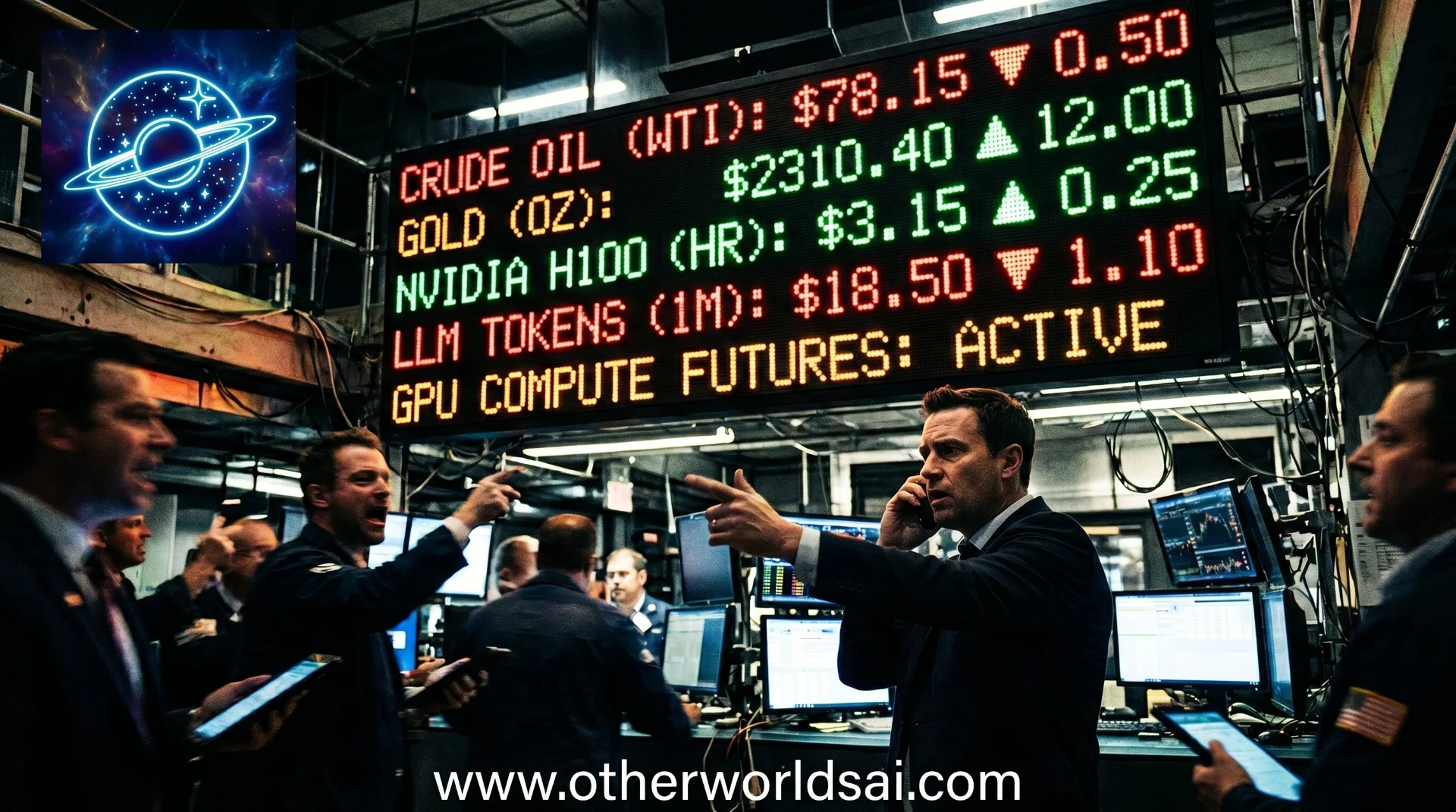

The Next Great Commodity Market: Why AI Token Futures Could Reshape Global Finance:
The New Oil? Why Financial Exchanges Are Racing to Trade AI Tokens:
For decades, the commodities that powered the global economy had familiar names — crude oil, natural gas, gold, copper, wheat. The infrastructure built around trading these resources — futures contracts, derivatives markets, spot pricing indices — became the backbone of how businesses managed risk and investors captured opportunity.
Now, a new commodity is emerging that could reshape that entire ecosystem: AI compute tokens.
Just as oil powers engines and gold stores value, LLM tokens power the intelligence economy. Every query sent to an AI model, every line of code generated, every document summarized — all of it is metered in tokens. And as businesses from Fortune 500 enterprises to scrappy AI startups increasingly depend on AI API access to run their core operations, the cost of those tokens has become a genuine financial risk — one that the world's most sophisticated financial exchanges are now racing to hedge.
The AI token futures market is no longer a speculative idea — it is actively being built. China's Shanghai Futures Exchange is designing a derivatives market specifically tied to AI token pricing. Meanwhile, in the United States, both CME Group — the world's largest derivatives marketplace — and the Intercontinental Exchange (ICE), owner of the New York Stock Exchange, have separately announced plans to launch futures contracts for GPU compute. The commodity age of AI has arrived.
Why AI Tokens Are the New Oil: The Case for a Compute Commodities Market:
To understand why financial exchanges are rushing to build AI token futures, it helps to understand what tokens actually are and why their pricing matters. In the context of large language models, a token is a chunk of text — roughly three-quarters of a word in English. Every interaction with an AI model — every prompt sent and every response received — is broken down into tokens, and that token count is the primary basis on which AI companies charge for their services.
The numbers involved are already enormous and growing fast. OpenAI, for example, currently charges $5 per million input tokens and $30 per million output tokens for API access to its latest GPT-5.5 model. Amazon's Bedrock platform similarly offers per-token pricing across a range of models.
For a large enterprise running thousands of AI-powered workflows daily, token costs can quickly run into millions of dollars per month — a budget line that is both significant and highly volatile depending on model pricing changes, usage patterns, and the competitive dynamics between AI providers.
This is precisely the kind of price risk that derivatives markets were invented to manage. Just as an airline buys jet fuel futures to protect against oil price spikes, a company that depends heavily on AI API access has a genuine financial interest in locking in future token prices. And just as commodity producers — oil companies, miners, farmers — use futures to guarantee revenue stability, AI infrastructure providers and data center operators have symmetric incentives to sell forward contracts. The economic logic of an AI token futures market is, in this sense, straightforward.
Shanghai's Move: China Builds a Global AI Derivatives Exchange:
China's Shanghai Futures Exchange is moving aggressively to position itself at the center of the emerging AI compute economy. According to Reuters, the exchange is currently designing a derivatives market specifically tied to AI token pricing — a product that would allow businesses, investors, and data center operators to hedge against the future cost of AI compute in a structured, regulated market environment.
The timing of this initiative is deliberate and strategically significant. China has made AI infrastructure development a national priority, pouring state and private capital into data centers, domestic chip development, and AI model research. By establishing a regulated derivatives market for AI tokens before the West does, Shanghai could position itself as the global pricing benchmark for compute —
a role analogous to how the London Metal Exchange sets reference prices for copper or how NYMEX anchors global oil trading. Control over the reference price for AI compute would carry enormous economic and geopolitical weight in a world that increasingly runs on intelligence.
For global enterprises and investors, the emergence of a Chinese AI futures market creates both opportunities and complications. On one hand, a liquid, regulated market for AI compute derivatives would be genuinely useful for any business with significant AI exposure. On the other hand, the geopolitical dimensions of AI infrastructure — export controls, data sovereignty concerns, the ongoing semiconductor competition between the US and China — mean that participation in Shanghai-based AI futures markets will carry its own set of regulatory and reputational considerations for Western firms.
CME Group and ICE: Western Exchanges Enter the GPU Futures Race:
While Shanghai targets AI tokens directly, the leading Western exchanges are approaching the same opportunity through the GPU compute layer. CME Group — the Chicago-based exchange that is home to futures contracts for everything from crude oil to Treasury bonds — has announced a partnership with Silicon Data to launch the first compute futures contracts tied to GPU rental pricing. Separately, the Intercontinental Exchange (ICE), which owns the New York Stock Exchange among other major markets, has announced a collaboration with Ornn to launch GPU compute futures contracts of its own.
The infrastructure for GPU spot pricing is already maturing, which makes a futures market the logical next step. According to data from AI Mining Co., which tracks daily GPU rental pricing across 28 marketplaces and cloud providers, median rental prices for Nvidia H100 GPUs ranged from $1.40 to $4.27 per hour across 13 marketplaces,
while average prices for H200 GPUs ranged from $2.34 to $5.00 per hour across 10 marketplaces. Over just the past week, average H100 prices swung between $2.79 and $3.33 per hour — a range wide enough to materially impact the economics of any business running large-scale AI workloads.
That price volatility is the commercial engine behind futures market demand. A company planning to train a large model six months from now cannot know today whether GPU rental costs will be $2.50 or $4.50 per hour — a difference that could mean millions of dollars in budget variance. A regulated GPU compute futures contract would let that company lock in a price today, just as a homebuilder locks in lumber prices or an airline locks in jet fuel costs. The product is not exotic — it is a fundamental risk management tool whose time has come.
The AI Infrastructure Buildout: Why Capital Is Flooding Into Compute:
The rush to build AI token and GPU futures markets is inseparable from the unprecedented wave of capital flooding into AI infrastructure. Cloud service providers, private equity firms, sovereign wealth funds, and infrastructure specialists have collectively poured hundreds of billions of dollars into building data centers over the past two years, betting that demand for compute will continue to surge as AI adoption expands across every sector of the global economy.
A new category of competitor — the neocloud company — is adding another layer of complexity to this market. These emerging players are building specialized AI compute infrastructure designed to compete with hyperscalers like AWS, Google Cloud, and Oracle, often by focusing on specific workloads. Some are specializing in AI inference — the process of running a trained model to generate responses — while others are targeting model training or fine-tuning.
The proliferation of providers is, paradoxically, one of the factors making futures markets more valuable: when there are many suppliers and buyers of a commodity, transparent price discovery and forward contracts become essential coordination mechanisms.

Meta's Next Big Bet: This New App Lets You Build Games Simply by Typing a Prompt
The scale of capital at risk in this buildout is precisely why sophisticated financial instruments are needed. A data center operator that has committed to building $5 billion in GPU capacity over the next three years has enormous exposure to the future price of compute. If GPU rental rates collapse because supply outpaces demand, that operator faces devastating returns on invested capital. Futures contracts allow both sides of this market — compute buyers and compute sellers — to manage that price risk systematically, reducing the likelihood of the boom-bust cycles that have historically plagued commodity-driven infrastructure investments.
Tokens as a Financial Asset: What an AI Derivatives Market Would Actually Look Like:
Designing a functional derivatives market for AI tokens is a more complex engineering problem than it might initially appear. Unlike oil, which is a physical commodity with established quality standards and delivery mechanisms, AI tokens are heterogeneous — a token processed by GPT-5.5 is not the same as a token processed by Claude Opus 4.8 or Google Gemini, even though they share the same name. Any futures contract would need to establish clear reference models, quality standards, and settlement mechanisms that account for this variability.
The most likely initial structure would index futures contracts to the token pricing of specific benchmark models or model tiers. Just as oil futures are differentiated by grade (Brent vs. WTI) and natural gas futures reference specific delivery hubs, AI token futures might initially be structured around pricing tiers — frontier model tokens, mid-tier model tokens, open-source inference tokens — rather than individual model versions.
This would give the contracts enough standardization to be liquid while still capturing the economically meaningful price differentials between different capability levels. For enterprise buyers of AI services, the practical benefits of a mature AI token futures market would be substantial. Chief financial officers at companies with significant AI API budgets could lock in token costs for future quarters, making AI spending more predictable and budget-able.
For AI companies themselves, futures markets would enable more sophisticated revenue planning and potentially allow them to offer long-term fixed-price contracts to enterprise customers — a product that many large organizations would strongly prefer over the current variable-rate API pricing model.
What This Means for the Future of AI Economics and Enterprise Strategy:
The emergence of AI token and compute futures markets signals a fundamental maturation in how the world thinks about artificial intelligence as an economic input. When a resource becomes important enough that the world's leading financial exchanges compete to build derivative products around it, that resource has crossed a threshold — it is no longer a discretionary technology purchase but a core factor of production whose price risk must be actively managed.
For enterprise technology leaders, this shift has immediate strategic implications. The companies that develop sophisticated AI cost management capabilities — understanding their token consumption patterns, modeling price sensitivity, and eventually using futures or forward contracts to hedge compute costs — will have a structural advantage over competitors that treat AI spending as an unmanaged variable cost.
In the same way that sophisticated energy procurement became a competitive differentiator in manufacturing during the 1980s and 1990s, AI compute procurement strategy is poised to become a core enterprise competency.
Support our research
Independent analysis fueled by you.
For investors, the buildout of AI derivatives markets opens entirely new categories of exposure and strategy. Hedge funds and quant firms that have built expertise in commodity trading will find that many of their analytical frameworks — supply and demand modeling, storage economics, contango and backwardation dynamics — translate surprisingly well to AI compute markets. The players who move earliest to build this expertise will likely capture outsized returns as these markets find their price discovery equilibrium.
Final Takeaway: The Commoditization of Intelligence Is Underway:
The race to build AI token futures markets — from Shanghai to Chicago to New York — is not a peripheral financial story. It is a signal that the global economy has collectively decided that AI compute is a commodity, as fundamental to future economic activity as electricity, bandwidth, or fuel. The infrastructure being built today to trade that commodity will shape how AI is priced, consumed, and competed over for decades to come.
Just as the development of oil futures markets in the 1980s transformed how energy was priced, financed, and traded globally, the emergence of GPU compute futures and AI token derivatives will transform the economics of artificial intelligence. The businesses, investors, and policymakers who understand this shift earliest will be best positioned to navigate — and profit from — the intelligent economy that is being built around us.
The question is no longer whether AI tokens will be traded like commodities. The exchanges are already being designed. The question is who will set the benchmark price — and what that means for the future of global AI competition.
Stay tuned for ongoing coverage of AI infrastructure markets, GPU compute pricing, enterprise AI cost management, and the evolution of AI derivatives and futures trading.
Category: AI Infrastructure | Financial Markets | Futures Trading | Enterprise AI Costs