
What the Rise of Local AI Coding Models Reveals About the Future of Business Tech:
THE 7 BEST LOCAL AI CODING MODELS IN 2026 — AND WHAT THEY REVEAL ABOUT THE FUTURE OF PRIVATE AI DEVELOPMENT:
Local LLMs are no longer experiments. In 2026, developers are running production-grade coding agents on consumer GPUs — privately, cheaply, and without a cloud subscription in sight.
1: Why Local Coding Models Are Having Their Breakout Moment:
Something significant has shifted in the AI development landscape. Local large language models have crossed a threshold — they are no longer a hobbyist experiment or a privacy compromise. In 2026, they are a legitimate alternative to hosted coding assistants for serious development work.
The GGUF quantization format — which compresses large models into sizes that consumer GPUs can actually handle — has been the technical unlock. Developers with 16GB to 24GB of VRAM are now running 27B to 33B parameter models on their own machines, connecting them to editors, terminals, and coding agent frameworks, and getting output quality that competes meaningfully with Claude Code, Gemini, and other cloud-hosted assistants.
The r/LocalLLaMA community on Reddit captures the shift clearly: it is full of developers running local coding agents, testing GGUF models, building OpenAI-compatible local servers, and deploying these models in real agentic workflows — not just one-off demos.
The drivers behind this shift are worth understanding, because they are the same forces reshaping enterprise AI adoption:
• Privacy — code stays on your machine; no API logs, no data sharing, no compliance risk.
• Cost — no per-token billing, no subscription tiers, no usage caps on local inference.
• Latency — local inference eliminates round-trip network delay for code completion workflows.
• Control — fine-tune, modify, and deploy the model on your own terms
16GB: Min VRAM to run top local coding models
7 Models: Production-grade options available locally in 2026
$0/token: Inference cost on your own hardware
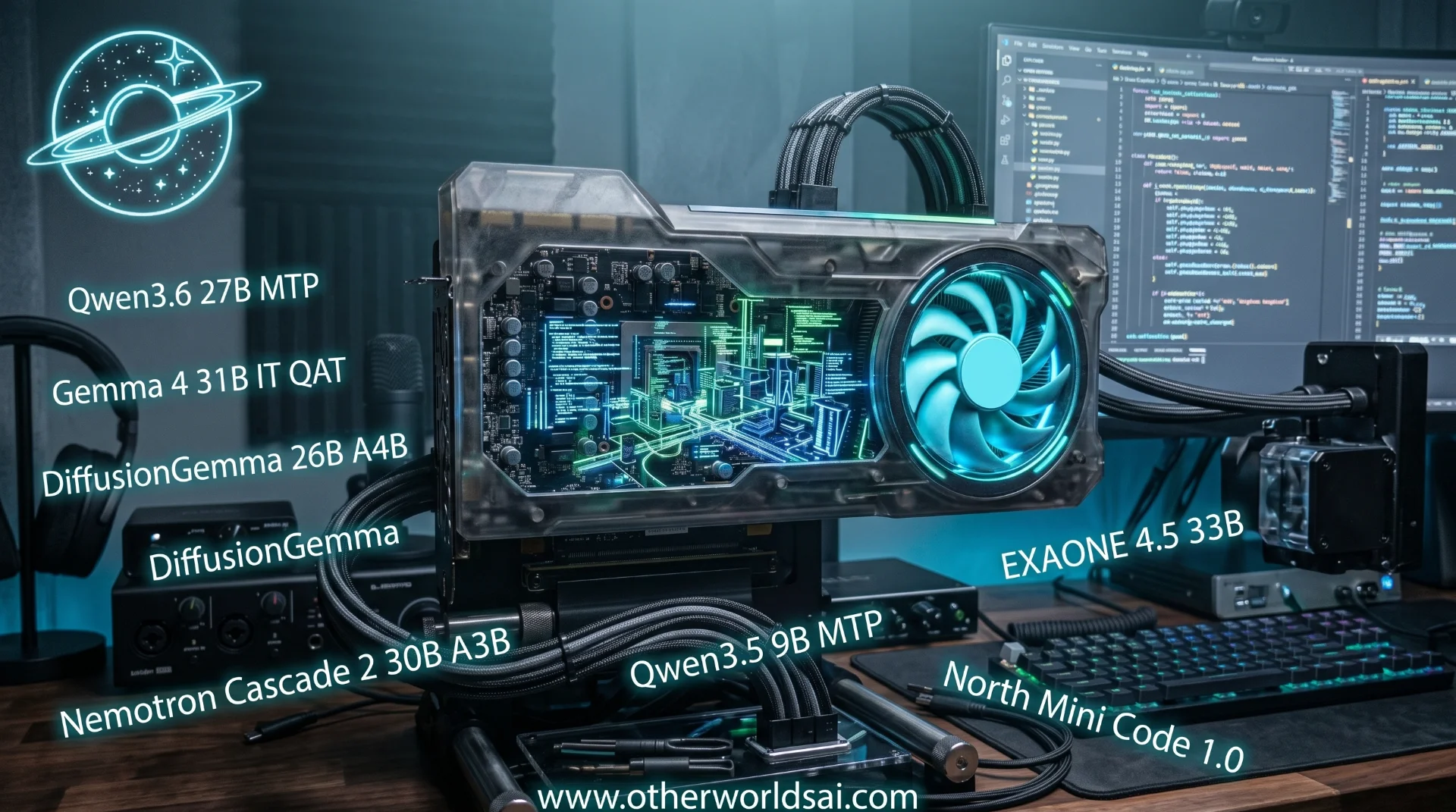
2: The 7 Best Local Coding Models Running in 2026:
These are not theoretical benchmarks. These are models the developer community is actively deploying in real coding workflows — tested across local inference setups, agentic frameworks, and everyday development tasks.
1:Qwen3.6 27B MTP: 27B parameters | Active: Full dense | Min VRAM: 16–24GB VRAM (4-bit GGUF)Best all-round local coding model in 2026:
Qwen3.6 27B MTP stands out as the consensus favorite in the local AI community right now — and for good reason. With 4-bit GGUF quantization, it fits on consumer 16GB to 24GB VRAM GPUs while retaining impressive coding and reasoning capability.
What makes Qwen models consistently strong for coding is their architecture: they combine reasoning, instruction following, multilingual understanding, tool use, and long-context support in a single package. That translates directly into capability for local coding assistants, repository chat, multi-file debugging, shell command generation, and agentic workflows.
The r/LocalLLaMA community has been extensively testing Qwen3.6 27B MTP for local agentic coding, faster inference with llama.cpp, and OpenAI-compatible local servers — and the results are consistently positive. For developers who want one model that covers most coding use cases locally, this is the starting point.
2:Gemma 4 31B IT QAT:31B parameters | Active: Full dense (QAT compressed) | Min VRAM: 20–24GB VRAM:Best multimodal local coding model:
Google's open Gemma series has always punched above its weight for local inference, and Gemma 4 31B IT QAT takes that further with quantization-aware training — a technique that builds compression into the training process itself rather than applying it as an afterthought. The result is a 4-bit model that retains more capability than standard post-training quantization.
The key differentiator for Gemma 4 31B is multimodality. Unlike pure text models, it can process screenshots, UI layouts, documentation images, and architecture diagrams alongside code — which covers a much wider range of real developer workflows. Benchmark results on LiveCodeBench and Codeforces confirm it competes seriously at the top of the local model category.
For developers who regularly work with visual assets — whether debugging UI issues from screenshots, reading architecture diagrams, or referencing PDF documentation — Gemma 4 31B IT QAT delivers a capability combination that text-only models simply cannot match.
3: DiffusionGemma 26B A4B:26B total / ~3.8B active | Active: ~3.8B (MoE-style) | Min VRAM: 12–16GB VRAM: Fastest architecture — parallel token generation:
DiffusionGemma 26B A4B is the most architecturally interesting model on this list. Rather than generating code token-by-token in the standard autoregressive pattern, it uses a block-diffusion approach — denoising blocks of tokens in parallel, which unlocks significant speed improvements for structured generation tasks like code.
From an efficiency standpoint, the model is compelling: 26B total parameters, but only roughly 3.8B active during inference. This Mixture of Experts-style architecture means you get reasoning quality closer to a large model without paying the full inference cost of a dense 26B model.
DiffusionGemma's parallel token generation approach could redefine speed expectations for local coding assistants — generating structured code outputs faster than traditional autoregressive models at comparable quality.
4:Nemotron Cascade 2 30B A3B: 30B total / ~3B active | Active: ~3B (MoE) | Min VRAM: 12–16GB VRAM: Best reasoning and agentic coding model — IMO & IOI 2025 level:
NVIDIA's Nemotron Cascade 2 30B A3B follows the same efficient MoE architecture pattern — 30B total parameters, roughly 3B active — but positions itself explicitly as a reasoning model rather than a coding autocomplete tool. That is a meaningful distinction for developers.
NVIDIA claims performance at gold-medal level on the International Mathematical Olympiad (IMO) 2025 and International Olympiad in Informatics (IOI) 2025 — which, while benchmark claims should always be treated critically, signals a model that handles multi-step logical reasoning with unusual competence.
For developers, reasoning depth matters because modern software development is not just writing functions. It involves debugging multi-layered systems, planning refactors, reviewing code for edge cases, and working through complex implementation decisions. Nemotron Cascade 2 has both thinking and instruct modes, supporting both structured reasoning chains and standard instruction following.
5: Qwen3.5 9B MTP: 9B parameters | Active: Full dense | Min VRAM: 8–12GB VRAM
Best lightweight local coding model — fastest setup:
Qwen3.5 9B MTP is the entry point on this list — and it earns its place by being the most accessible local coding model for developers who don't have a 24GB VRAM workstation. At 9B parameters, it runs on GPUs that are genuinely consumer-grade, and with GGUF quantization it loads and runs fast.
It will not compete with the 27B or 31B models on complex multi-step reasoning tasks. But for daily coding workflows — small scripts, debugging assistance, code explanation, shell command generation, and quick local assistant integrations — Qwen3.5 9B MTP is more than adequate. It is also the most practical model for developers who are new to local LLMs and want to validate the setup before investing in higher-VRAM hardware.
6: EXAONE 4.5 33B: 33B parameters | Active: Full dense | Min VRAM: 24GB VRAM
Best for enterprise workflows — multimodal + document understanding:
LG AI Research's EXAONE 4.5 33B is the most enterprise-oriented model on this list. As an open-weight multimodal model, it handles text and visual inputs — making it well suited to the real-world complexity of enterprise development environments where coding is just one part of the workflow.
Modern development work regularly involves reading documentation PDFs, interpreting screenshots of errors or UI issues, understanding architecture diagrams, and working with messy project files alongside code. EXAONE 4.5 33B addresses that full scope. For teams in regulated industries where code cannot leave the corporate network, this combination of capability and local deployability makes it particularly valuable.
Meta's Next Big Bet: This New App Lets You Build Games Simply by Typing a Prompt
7: North Mini Code 1.0:30B total / ~3B active | Active: ~3B (MoE) | Min VRAM: 12–16GB VRAM:Most focused — built exclusively for code generation and agentic engineering:
Cohere's North Mini Code 1.0 is notable for what it is not: it is not a general-purpose chatbot that can also write code. It is built exclusively for code generation, agentic software engineering, and terminal-based development tasks. That specificity makes it more effective for the use cases it targets.
With a 30B-A3B MoE architecture (30B parameters, ~3B active), it carries stronger reasoning capacity than its inference cost suggests. For developers who want a local model specifically optimized for repository edits, command-line assistance, code review, and coding-agent workflows — rather than a general assistant that happens to code — North Mini Code 1.0 is purpose-built for the job.
3: Quick-Select Guide — Which Model Fits Your Setup:
Hardware and use case determine the right model more than benchmark rankings alone. Here is a practical comparison to help you match the right model to your local setup.
Model: :Params (Active): Min VRAM: :Best For: :Standout Trait
Qwen3.6 27B MTP: 27B (dense) : 16–24GB : All-round local coding: Best overall balance
Gemma 4 31B IT QAT: 31B (dense): 20–24GB: Multimodal + coding: Visual + code combined
DiffusionGemma 26B A4B: 26B (~3.8B): 12–16GB: Speed-critical tasks: Block diffusion
parallel gen
Nemotron Cascade 2 30B: 12–16GB: Reasoning + agentic: IMO/IOI 2025 gold level
Qwen3.5 9B MTP 9B (dense): 8–12GB: Entry-level / daily: Fastest, lowest VRAM
EXAONE 4.5 33B(dense): 24GB: Enterprise + docs: PDF, screenshot, diagram input
North Mini Code 1.030B (~3B): 12–16GB: Code-only workflows:Purpose-built for agentic coding
4: The Architecture Shift That Makes This Possible — MoE, GGUF, and Efficient Inference
Running a 30B model on a consumer GPU would have been considered impossible two years ago. Two architectural developments made it real: Mixture of Experts routing and GGUF quantization.
Four of the seven models on this list use Mixture of Experts (MoE) architecture — where only a fraction of the model's total parameters are active during any given inference pass. Nemotron Cascade 2 and North Mini Code 1.0 both have roughly 30B total parameters but activate only around 3B per token. DiffusionGemma runs ~3.8B active from 26B total. This means inference cost scales with active parameters, not total model size.
GGUF quantization compounds this advantage by compressing model weights from 16-bit or 32-bit floating point to 4-bit integer representations — reducing memory footprint by 75% or more with relatively modest quality degradation. Combined with MoE efficiency, this is why a developer can run what is effectively a 30B-class model on a 12GB to 16GB GPU in 2026.
MoE architecture + GGUF quantization is the combination that brought production-grade AI coding to consumer hardware. Understanding this matters for anyone evaluating AI infrastructure — cloud or local.
DiffusionGemma takes a different approach entirely — block-diffusion parallel generation — which represents a third architectural trajectory for local inference speed. If it proves out at scale, it could redefine expectations for how fast local code generation can be.
5: Local AI vs. Cloud AI for Coding — When to Use Which:
Local models are not replacing hosted AI coding assistants for every developer — but the gap is closing, and the decision matrix is more nuanced than it was 12 months ago. Here is when local wins, and when cloud still makes sense.
**Go Local When**......
1.Code contains proprietary IP or trade secrets:
-
You have 16GB+ VRAM and want zero token costs:
-
Compliance requires data not leaving your environment.
-
You want to fine-tune on your own codebase.
-
You're building offline or air-gapped development tools.
** Stay Cloud When**......
-
You need frontier-level reasoning (Claude Opus, GPT-5)
-
Your tasks require real-time web access or tool integration.
-
You're on a MacBook or low-VRAM machine without a dedicated GPU.
-
Speed of iteration matters more than privacy.
-
You need the absolute highest context windows (1M+ tokens)
6: From Local Models to Business AI — What This Shift Means for Your Operation:
The rise of local coding models reveals something important about where AI is heading: control, cost efficiency, and context matter more than raw model size. These are the same principles that should guide every business's AI deployment strategy — not just developer tooling.
What the local model movement demonstrates at a technical level is that the right model for a specific task — optimized, tuned, and deployed close to the workload — consistently outperforms a generic frontier model at lower cost and with better performance characteristics. That is not just a developer insight. It is the core principle behind intelligent enterprise AI orchestration.
For businesses, the parallel is direct:
• Routing matters more than model size. Just as MoE models activate only the parameters needed for a task, smart business AI routes each workflow to the right model — not the most expensive one.
Support our research
Independent analysis fueled by you.
• Data privacy is non-negotiable at scale. The same reason developers choose local models — keeping sensitive code off external servers — applies directly to businesses handling customer data, financial records, and operational IP.
• Cost efficiency compounds. Eliminating per-token costs at the infrastructure level, whether through local deployment or intelligent cloud routing, creates margin advantages that grow with usage volume.
Move Over Nvidia: Anthropic and Samsung Team Up to Break the AI Chip Monopoly
• Purpose-built beats general-purpose. North Mini Code 1.0 is better at coding than a general assistant because it was built for coding. Business AI works the same way — workflows trained on your operational context outperform generic prompts.
Local models win by being specific, efficient, and controlled. Agent+ brings those same principles to business AI — intelligent routing, workflow-level context, and automation that doesn't require the most expensive model for every task.
Otherworlds AI's Agent+ Business AI Platform operationalizes exactly this approach. Rather than connecting your business to a single hosted model and hoping it handles every task well, Agent+ delivers multi-model orchestration built on your operational data — routing each workflow to the right capability at the right cost, with Google Opal-powered automated triggers that act on real business events without requiring manual intervention.
The developers building local coding agents in 2026 aren't doing it because cloud AI is bad. They're doing it because they understand that control, efficiency, and specificity produce better outcomes than defaulting to the most powerful general-purpose option available. Your business AI strategy should reflect the same logic.
See how Agent+ brings intelligent AI orchestration to your business workflows. Visit otherworldsai.com to explore the platform and start deploying AI that's built around your operation — not around a generic model.