
Cowboy Space Raises $275M to Build Its Own Rockets and Launch the World's First Purpose-Built Orbital AI Data Centers:
Tired of Data Center Power Delays? Cowboy Space Just Raised $275M to Move AI to Low Earth Orbit.
With rocket capacity too scarce and expensive for orbital data center ambitions, Robinhood co-founder Baiju Bhatt is doing what no one else has tried: building the rocket himself — and betting that space-based AI compute is the next frontier of the data center market
The race to build AI compute infrastructure has officially left the atmosphere. As the demand for AI data center capacity continues to outpace what terrestrial construction can deliver, a new class of space infrastructure startup has emerged with a bold proposition: put the data centers in orbit. But there is a fundamental problem standing between ambition and execution — there are not enough rockets to get there.
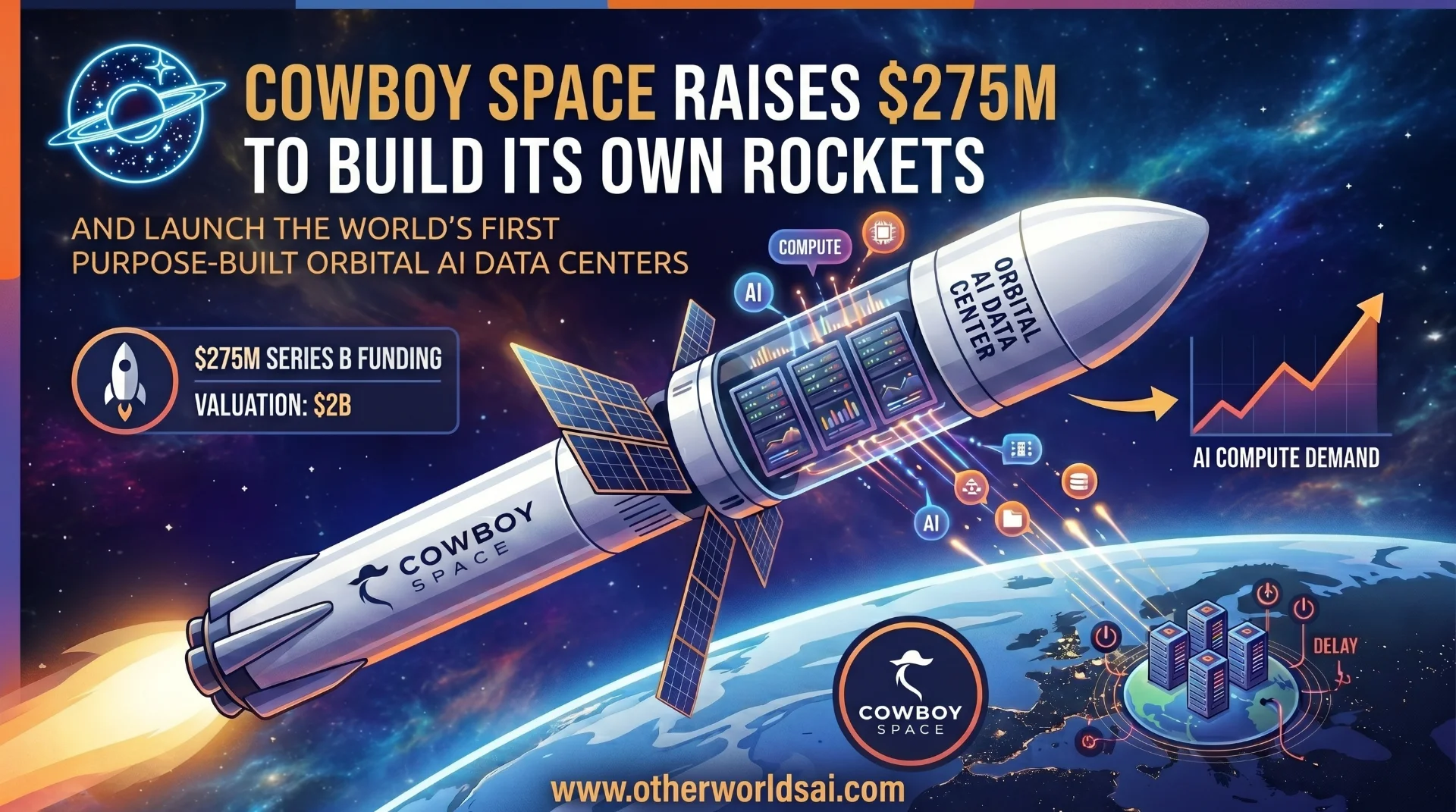
Cowboy Space Corporation, founded by Robinhood co-founder Baiju Bhatt, has a characteristically audacious answer to that problem. If the rocket market cannot support an orbital data center business at scale, Cowboy Space will build its own rockets. The company announced a $275 million Series B funding round this week at a post-money valuation of $2 billion — capital it intends to use to make that happen.
The Rocket Bottleneck: Why Space-Based AI Compute Needs Its Own Launch Infrastructure:
The core problem facing every orbital data center startup is not compute, power, or cooling — it is launch capacity. The demand for space-based AI compute infrastructure is growing, but the number of commercially available heavy-lift rockets capable of delivering large orbital data center satellites into low Earth orbit is severely constrained.
SpaceX's Falcon 9 is the dominant workhorse, but SpaceX's own internal satellite business — Starlink — takes priority on launch manifests. Starship, which would dramatically increase payload capacity to orbit, is still in development and may not be commercially available for years after it becomes operational.
Blue Origin's New Glenn — the other heavy-lift contender — failed to deliver a satellite during its third launch in April 2026, leaving the market without a reliable second option. Smaller rockets from Rocket Lab and other providers lack the payload capacity required for the kind of large-scale GPU-equipped orbital satellites that a meaningful space data center would require. A number of startups — including Stoke Space, Firefly Aerospace, and Relativity Space — have been working toward operational systems for years and have yet to reach consistent commercial delivery.
The result is a market-wide bottleneck that is reshaping business models. Google's Suncatcher project has targeted the mid-2030s as its operational window. Starcloud is narrowing its focus to edge processing tasks for space-based sensors — a more achievable near-term use case that sidesteps the heavy-lift problem. Bhatt explored both approaches and concluded that neither was sufficient to build a genuinely scalable orbital AI infrastructure business with unit economics that could compete with ground-based alternatives.
"There's a lot of new rockets that are coming online," he told TechCrunch, "but as we look three, four years out, it's still very, very scarce."
Cowboy Space's Solution: A Purpose-Built Rocket for Orbital AI Data Centers:
Bhatt's response to the launch bottleneck is to bring the rocket in-house — a decision he describes as logical, even as he acknowledges it is also, by any conventional measure, extraordinarily difficult. Only a handful of private companies in the Western world — primarily SpaceX, Rocket Lab, and Arianespace — are consistently and reliably launching commercial rockets. Cowboy Space is proposing to join that group, targeting its first orbital launch before the end of 2028.
The design philosophy behind Cowboy Space's rocket is what makes it genuinely distinctive in the launch vehicle market. Rather than building a general-purpose rocket capable of carrying a wide range of payloads — the approach taken by SpaceX, Rocket Lab, and others — Cowboy Space is engineering a purpose-built orbital launch vehicle designed around a single payload type: its own AI data center satellites.
The company plans to build its data centers directly into the second stage of the rocket itself — a concept that echoes the architecture of Explorer 1, the first U.S. satellite, which was constructed as the final stage of the Jupiter-C rocket and packed with scientific instruments.
Each satellite is designed to carry approximately 800 GPUs and generate 1 megawatt of power, with a target mass of 20,000 to 25,000 kilograms. That places Cowboy Space's rocket in a class slightly more powerful than the Falcon 9 — the current commercial launch standard — while remaining smaller than Starship. The booster is eventually intended to be fully reusable, bringing the per-launch economics closer to what is needed for a commercially competitive low Earth orbit data center business.
The company is also building its own rocket engine — the single most complex and expensive component of any launch vehicle. To execute on this, Cowboy Space has recruited veterans from the top tier of the commercial space industry, including Warren Lamont, a former propulsion engineer at Blue Origin, and Tyler Grinnell, a former launch director at SpaceX.
The company is still working through the development of manufacturing, testing, and launch facilities — the infrastructure backbone that every rocket program requires before it can put hardware in the sky.
The $275M Series B: Investors Back the Case for Space-Based AI Infrastructure:
The $275 million Series B round — led by Index Ventures, an early backer — reflects a serious institutional conviction that the market for orbital AI compute infrastructure is real and approaching. Breakthrough Energy Ventures, Construct Capital, IVP, and SAIC also participated in the round, bringing the company's total capital raised to over $355 million.
The post-money valuation of $2 billion places Cowboy Space among the most highly valued space infrastructure startups in the current market, alongside other well-funded ventures betting on the convergence of AI compute demand and commercial space development. The investment thesis rests on a straightforward but consequential observation about the trajectory of AI infrastructure demand.
Terrestrial AI data center construction is constrained by power grid availability, land access, water supply for cooling, and regulatory timelines. As AI compute demand continues to accelerate — driven by the proliferation of large language models, agentic AI systems, and AI-powered enterprise workflows — the limitations of ground-based infrastructure become increasingly acute. Space offers essentially unlimited solar power, natural vacuum cooling, and no land-use constraints.
"I see the demand for AI getting more and more acute," Bhatt said, "and I see the options on Earth getting more and more limited."
The size of the prize, Bhatt argues, is large enough to support multiple successful players. "The prize here, and the size of this market, is big enough that there's room for many players to succeed." This is not a winner-take-all market — the demand for AI GPU cloud infrastructure is expected to grow for decades, and no single provider, terrestrial or orbital, will be able to satisfy it alone.
The Origin Story: From Solar Power Startup to Orbital AI Compute Provider:
Cowboy Space's current form is the product of a series of logical pivots, each driven by the practical realities of execution rather than a change in founding conviction. Bhatt — who co-founded the online stock trading platform Robinhood before launching this venture in 2024 —
originally started the company under the name Aetherflux, with a mission to harvest solar energy in space and beam it back to Earth. The concept was compelling: space-based solar power offers continuous, unobstructed sunlight without the day-night cycle limitations that affect terrestrial solar installations.
The pivot to orbital data centers emerged from a recognition that the electricity Aetherflux would generate in orbit could be used directly in space — eliminating the technically complex and efficiency-reducing step of beaming it to Earth. An orbital AI data center could consume that power in situ, running GPU workloads in low Earth orbit and transmitting only the results of computation back to Earth — a fraction of the data volume that would otherwise need to travel through a power-beaming system.
The rocket development program emerged from the same logic applied to the launch market. After extensive conversations with existing launch providers — SpaceX, Blue Origin, and others — Bhatt concluded that no external provider could offer the launch cadence, payload specifications, or pricing structure necessary to make an orbital data center business economically viable at scale within the timeframe the AI compute market demands. Building the rocket became the only path to controlling the unit economics of the entire stack — from launch to orbit to compute delivery.
The Competitive Landscape: Taking On SpaceX and Blue Origin:
In pursuing its own rocket program, Cowboy Space is entering direct competition with the two most advanced and best-funded launch vehicle operators in the world: SpaceX and Blue Origin. This is not a position any startup takes lightly.
SpaceX has achieved what no other private company in history has managed — a fully reusable orbital rocket (Falcon 9) operating at commercial scale, with Starship under active development as the next generation of heavy-lift capability. Blue Origin, despite years of delays with New Glenn, has significantly deeper resources than any new entrant.
Cowboy Space's competitive argument rests on focus rather than breadth. By designing a rocket optimized exclusively for its own orbital data center satellites — rather than a general-purpose launch vehicle that must accommodate a wide range of customer payloads — the company argues it can achieve design simplicity, faster iteration, and better cost-per-kilogram-to-orbit economics for its specific use case. Purpose-built systems, the argument goes, will outperform general-purpose systems in the markets they are designed for.
Whether that advantage is sufficient to overcome the capital, talent, and timeline challenges of building a new rocket from scratch remains the central open question. The history of commercial space launch startups is filled with companies that underestimated the difficulty and timeline of reaching operational launch capability.
Cowboy Space's $275 million gives it more runway than most, and its team of SpaceX and Blue Origin veterans provides credible execution capability. But the road from today's development milestones to a first orbital launch before the end of 2028 is long, technically demanding, and unforgiving of schedule slippage.
The Bottom Line: A $2 Billion Bet That AI Will Eventually Compute From Orbit:
Cowboy Space Corporation is making one of the most ambitious bets in the current wave of AI infrastructure investment. Its thesis — that orbital AI compute infrastructure will become a necessary complement to terrestrial AI data center capacity, and that the only way to build it at meaningful scale is to control the entire stack from rocket engine to GPU cluster — is logically coherent and well-supported by the structural dynamics of the AI compute demand curve.
The risks are proportional to the ambition. Building a new orbital rocket is one of the hardest engineering challenges in existence. Doing so while simultaneously developing novel space-based data center architecture, recruiting from a thin talent pool, and competing against SpaceX for launch market position — all within a four-year timeline — demands near-perfect execution.
But if Bhatt and his team can deliver, Cowboy Space will not just be a space infrastructure company. It will be the company that proved low Earth orbit AI data centers are not a science fiction concept — they are the next chapter of the global AI compute market.
Support our research
Independent analysis fueled by you.