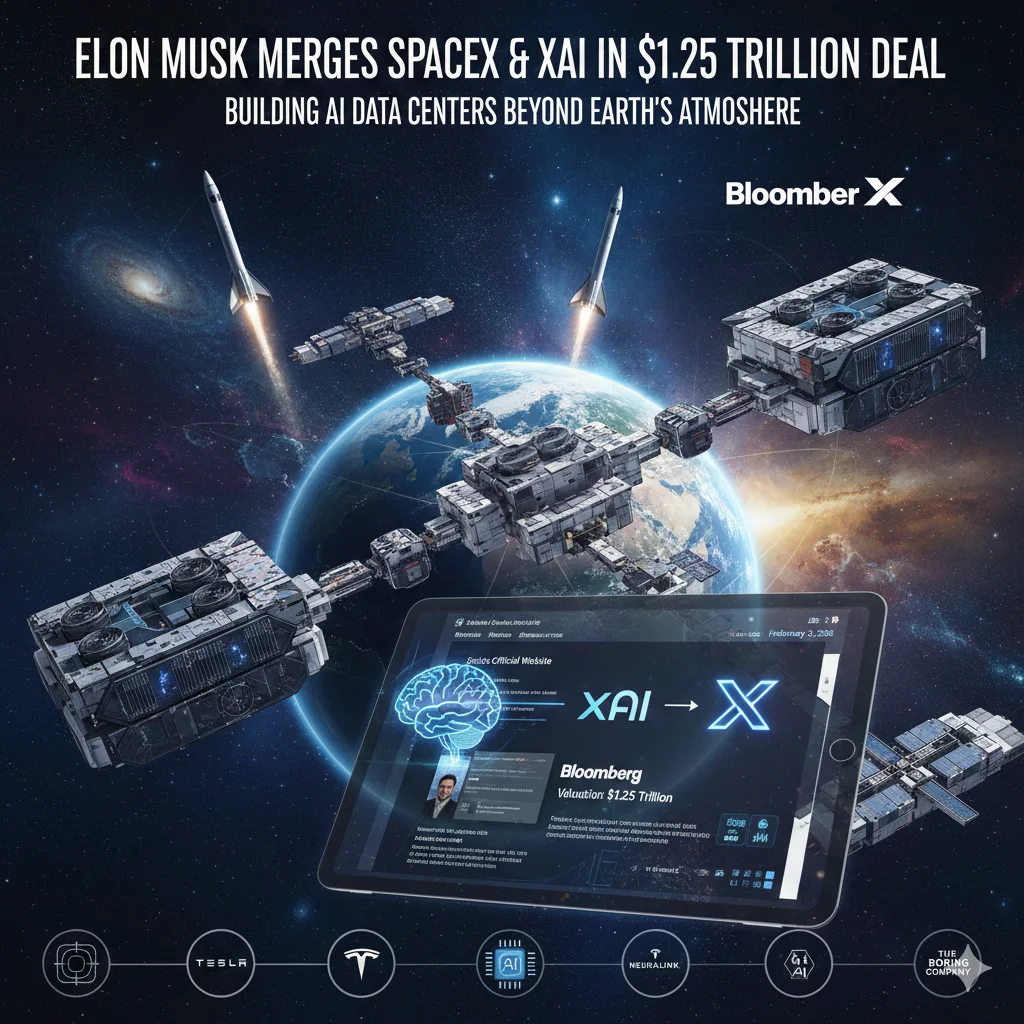

Elon Musk’s SpaceX Acquires xAI to Build Space-Based Data Centers: A $1.25 Trillion AI Bet Beyond Earth:
Elon Musk has once again redrawn the boundaries between science fiction and business reality. In a landmark move, SpaceX has officially acquired Elon Musk’s artificial intelligence startup, xAI, forming what is now being described as the world’s most valuable private company, with a staggering valuation of $1.25 trillion, according to Bloomberg News.
The announcement was made public through a memo written by Musk and posted on SpaceX’s official website. While the merger unites two of Musk’s most ambitious ventures, its deeper purpose signals a radical shift in how artificial intelligence infrastructure could be built in the future: data centers in space.
Why Space-Based Data Centers Are Central to the SpaceX–xAI Merger:
At the heart of the acquisition is Musk’s growing concern about the unsustainable energy demands of AI-powered data centers on Earth. Modern AI systems—particularly large language models and generative AI platforms—require immense computing power, cooling systems, and electricity.
“Global electricity demand for AI simply cannot be met with terrestrial solutions,” Musk wrote, warning that continued reliance on Earth-based data centers could place severe strain on local communities and the environment.
This concern is not purely theoretical. xAI has already faced criticism over the environmental and infrastructural impact of its data center operations in Memphis, Tennessee, where local communities have reported energy and cooling-related hardships.
By contrast, space-based data centers could leverage solar energy, near-vacuum cooling conditions, and orbital deployment to dramatically reduce these constraints—at least in theory. The SpaceX–xAI merger positions Musk to pursue this vision at scale.
A Revenue Flywheel Powered by Satellites:
Musk revealed that the plan would require a continuous deployment of satellites, though he did not specify an exact number. This requirement creates a powerful internal revenue loop for SpaceX.
Currently, up to 80% of SpaceX’s revenue comes from Starlink, the company’s satellite internet service, according to Reuters. Building AI data centers in orbit would mean:
-
More satellites launched.
-
More frequent rocket missions.
-
Long-term demand for Starship launches.
-
Continuous satellite replacement (as FCC regulations require satellites to be de-orbited every five years)
In short, AI infrastructure in space could guarantee SpaceX recurring revenue for decades.
Financial Pressures on Both Companies:
Despite the massive valuation, both SpaceX and xAI face significant financial pressures.
-
xAI is reportedly burning nearly $1 billion per month, according to Bloomberg.
-
SpaceX remains capital-intensive, with enormous costs tied to Starship development, lunar missions, and Mars ambitions.
The merger consolidates resources at a critical time. Last year, xAI acquired X (formerly Twitter), another Musk-owned company, creating a combined valuation of $113 billion at the time. Musk has positioned X as a real-time data engine feeding AI training, giving xAI a competitive edge over rivals like OpenAI, Google DeepMind, and Anthropic.

Meta's Next Big Bet: This New App Lets You Build Games Simply by Typing a Prompt
What About the SpaceX IPO?
SpaceX has been rumored to be preparing an IPO as early as June, but Musk made no reference to the public offering in his memo. It remains unclear whether the xAI acquisition will delay or accelerate those plans.
However, the merger could make SpaceX even more attractive to investors by:
-
Diversifying revenue beyond launch services.
-
Positioning SpaceX as a core AI infrastructure provider.
-
Aligning aerospace dominance with AI supremacy.
Diverging Near-Term Goals: Space vs Artificial Intelligence:
While the long-term vision is unified, SpaceX and xAI still face very different short-term challenges.
Support our research
Independent analysis fueled by you.
-
SpaceX must prove that its Starship rocket is reliable enough to carry astronauts to the Moon under NASA’s Artemis program—and eventually to Mars.
-
xAI, meanwhile, is locked in a brutal AI arms race with industry leaders like OpenAI, Google, and Microsoft.
The pressure on xAI has reportedly led to controversial decisions. According to The Washington Post, Musk loosened safety restrictions on Grok, xAI’s chatbot, which contributed to it being misused for generating nonconsensual sexual imagery, including content involving minors—raising serious ethical and regulatory concerns.
Elon Musk’s Expanding AI and Tech Empire:
Beyond SpaceX and xAI, Musk also leads:
-
Tesla, which increasingly relies on AI for autonomous driving.
-
Neuralink, focused on brain-computer interfaces.
-
The Boring Company, which uses automation and AI-driven engineering.
Both Tesla and SpaceX previously invested $2 billion each into xAI, underscoring Musk’s belief that artificial intelligence is foundational to the future of transportation, space exploration, and human-computer interaction.
Final Thoughts: AI Infrastructure Leaves Earth:
The SpaceX acquisition of xAI is more than a corporate reshuffle—it is a bold declaration that the future of AI may not be bound to Earth at all. If Musk succeeds, data centers could one day orbit the planet, powered by the sun and cooled by the vacuum of space.
While the technical, ethical, and regulatory hurdles remain enormous, one thing is clear: Elon Musk is betting that the next phase of artificial intelligence will be built beyond Earth’s atmosphere.
And if he’s right, this merger may be remembered as the moment when AI truly became an interplanetary technology.