
For years, robots have been amazing at what they're told to do.
Weld a car door? No problem. Pick up a specific item on an assembly line? Easy. But ask a robot to "clean the kitchen" or "sort the laundry," and you'd usually get a blank stare (or a very confused arm movement). That's because these tasks require something far more complex: thinking and reasoning across multiple steps.
Well, get ready for a paradigm shift. Google DeepMind has just unveiled Gemini Robotics 1.5 and Gemini Robotics-ER 1.5, two new AI models that are giving robots an unprecedented intelligence boost. Simply put, our future robotic companions are about to get a lot smarter – and a lot more helpful.
The Leap from "Do This" to "Figure It Out"-
Earlier this year, DeepMind gave us the first taste of Gemini Robotics, an AI tailored for machines. It allowed robots to handle basic physical tasks and simple reasoning. But the 1.5 models? They're in a different league entirely. They enable robots to tackle "long-horizon" tasks, meaning they can plan, execute, and reason through a series of actions over an extended period. This is the difference between a robot moving a single object and a robot performing a complex, multi-step chore.
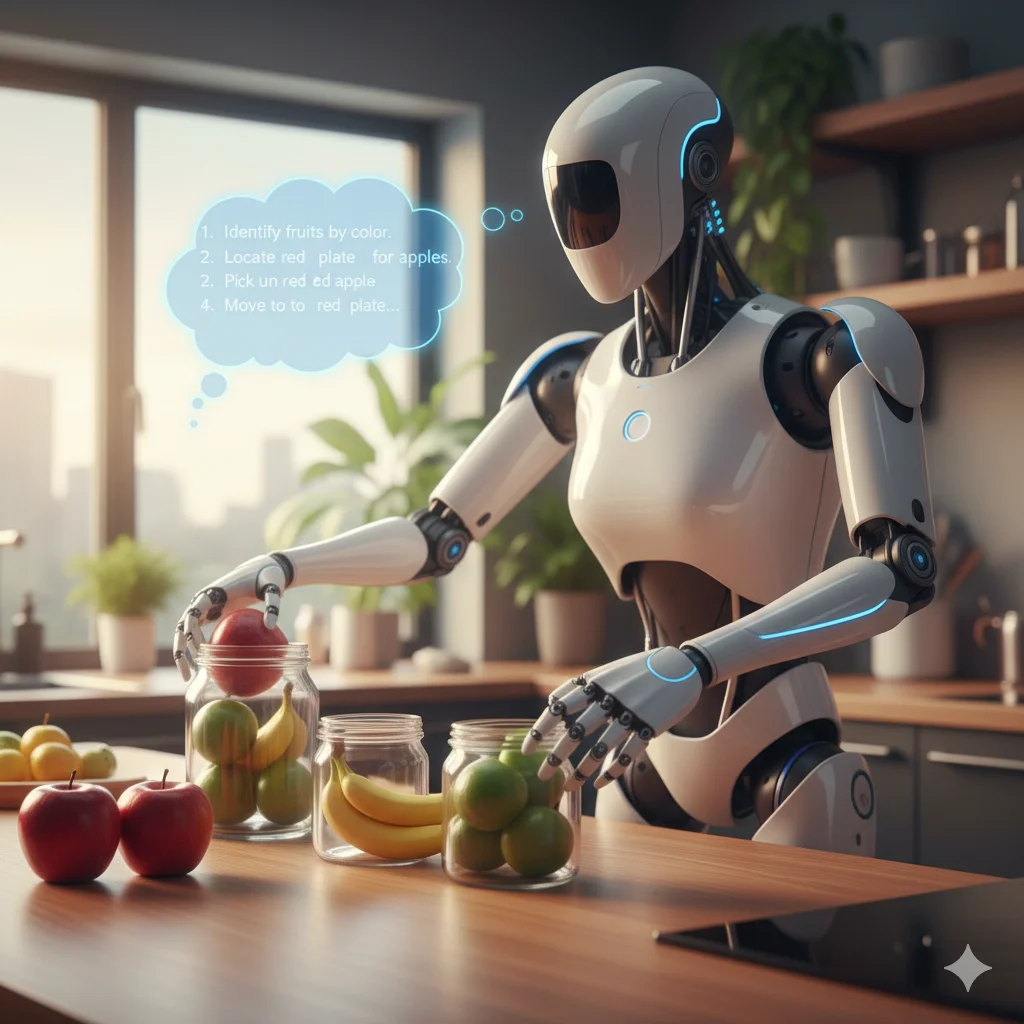
Imagine the simple act of sorting fruit. Previously, a robot might understand "place this banana in the basket." Now, with Gemini Robotics 1.5, that same robot can sort multiple pieces of fruit into containers by color.
In a recent demonstration, DeepMind’s Aloha 2 robot, a two-armed marvel, effortlessly sorted a banana, an apple, and a lime onto plates of the correct color. What was truly impressive, however, wasn't just the task completion, but the robot's ability to explain its own reasoning in natural language. It described what it was doing and why. "We Enable It to Think."
Jie Tan, a senior research scientist at DeepMind, perfectly encapsulated this breakthrough: "We enable it to think. It can perceive the environment, think step-by-step, and then finish this multistep task. Although this example seems very simple, the idea behind it is really powerful."
This isn't just a party trick for fruit. It signals a profound leap in robotic capabilities:
-
Spatial Awareness: Robots can now truly understand their physical environment and locate objects within it.
-
Object Recognition: They can identify different items and grasp their properties, like color, shape, and even texture.
-
Multistep Reasoning: The ability to plan and execute complex sequences of actions, breaking down a big goal into smaller, manageable steps.
Communication: Crucially, they can articulate their decision-making process, making their actions more transparent and understandable to humans.
Beyond the Assembly Line: Robots That Adapt:
While sorting fruit might seem basic, the underlying technology has colossal implications. It means robots are moving beyond predictable, repetitive tasks towards machines that can understand context, adapt to changing situations, and genuinely reason about their actions.
Think about the impact this will have:
-
Home Assistance: Robots could truly help with chores, understand nuanced instructions, and adapt if you move an item.
-
Warehouse Logistics: They could sort complex inventories, navigate dynamic environments, and explain issues.
-
Industrial Automation: Machines that can troubleshoot minor problems or adapt to variations in materials without constant human intervention.
Google DeepMind's Gemini Robotics 1.5 is bridging the gap between artificial intelligence and practical, real-world robotics. We are on the cusp of a future where robots don't just act on command; they think, reason, and even communicate their thought processes while they act.
The era of truly intelligent robotic assistance is no longer science fiction.
Support our research
Independent analysis fueled by you.