
Claude Gets a Brain Upgrade: Anthropic Swallows Seattle’s Elite Computer-Use Startup:
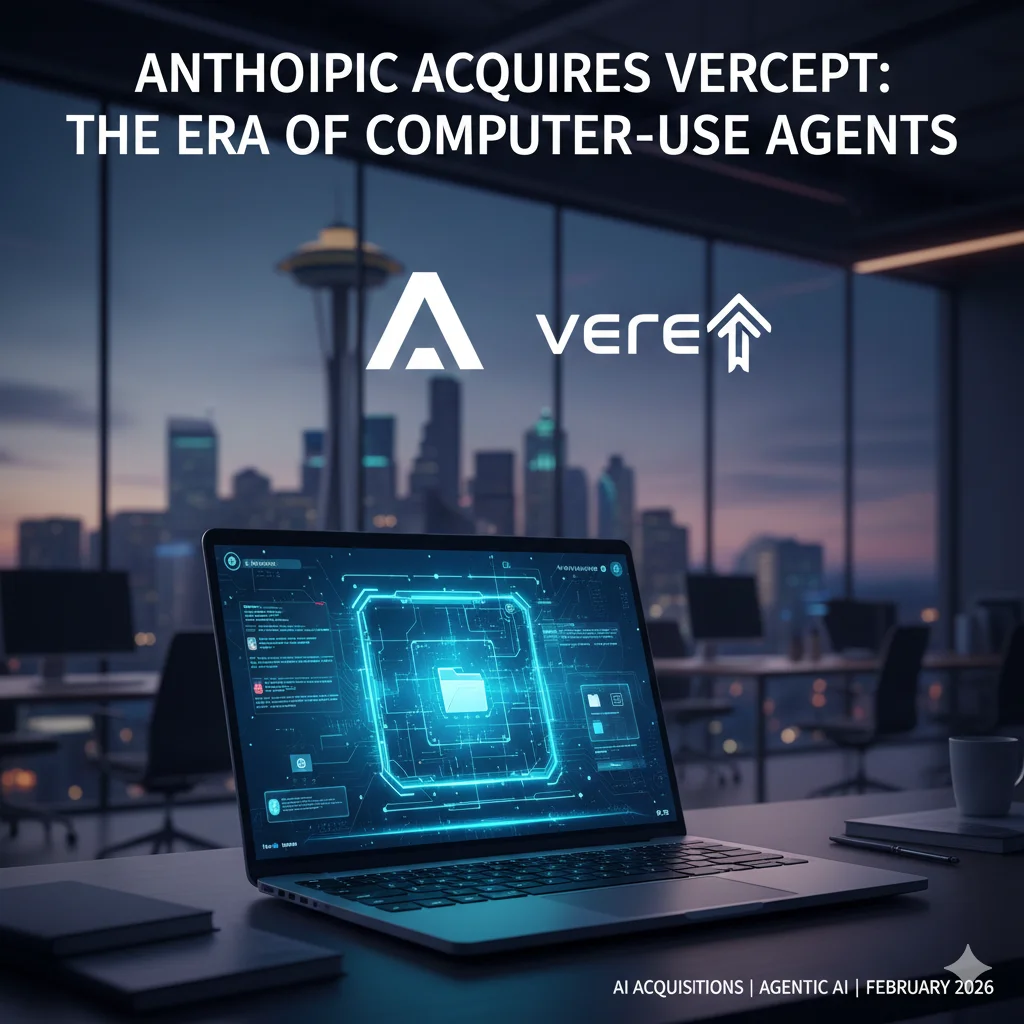
Anthropic Acquires Vercept: Inside the AI Startup Deal Reshaping the Future of Computer-Use Agents:
Introduction: Anthropic's Latest Power Move in Agentic AI:
The AI arms race is accelerating — and Anthropic just made its next calculated move. The company behind Claude has acquired Vercept, a Seattle-based AI startup that was quietly building some of the most sophisticated computer-use agent technology in the industry.
The acquisition, announced on Wednesday, signals Anthropic's deepening commitment to agentic AI — systems that don't just answer questions but autonomously take action in the real world, operating software, navigating interfaces, and completing complex tasks on behalf of users.
This is not Anthropic's first acqui-hire move in recent months. The company previously acquired Bun, a coding agent engine, in December to help scale Claude Code. The Vercept deal follows a similar logic: bring in elite research talent and proven technology to accelerate a roadmap that is quickly becoming one of the most consequential in AI. With the AI agent platform space heating up, Anthropic is making sure it has the best minds in the game.
What Is Vercept: The Startup That Reimagined the Personal Computer:
Vercept wasn't just another AI startup — it was one of the most intriguing companies working on the intersection of AI agents and personal computing. Founded by a team with deep roots in Seattle's legendary tech ecosystem, Vercept built Vy, a cloud-based computer-use agent capable of operating a remote Apple MacBook. In simple terms, Vy was an AI that could actually use a computer — clicking, typing, navigating apps, and completing tasks — entirely on its own.
The implications of that technology are enormous. Vercept was part of a growing class of companies reimagining what the personal computer looks like in the age of AI agents. Rather than humans sitting at desks clicking through software, the vision is one where autonomous AI agents handle complex digital workflows — scheduling, research, data entry, software operation — freeing humans to focus on higher-order thinking and decision-making. With Vercept's technology, that future just got closer.
As part of the acquisition terms, Anthropic is shuttering Vercept's product on March 25, 2026.
The Team Behind Vercept: Seattle's AI Elite:
Part of what made Vercept so attractive to Anthropic was the extraordinary caliber of its founding team. The startup was a graduate of A12, Seattle's AI-focused startup incubator that grew out of the storied Allen Institute for AI. Several of Vercept's co-founders were previously researchers at the Allen Institute, giving the company a deeply academic and research-driven foundation — exactly the kind of intellectual pedigree that Anthropic prizes.
CEO Kiana Ehsani led the company from its founding and will be joining Anthropic. Co-founders Luca Weihs and Ross Girshick are also joining Claude's maker. Their backgrounds in computer vision, embodied AI, and machine learning research make them a powerful addition to Anthropic's growing roster of world-class researchers.
One name notably absent from the Anthropic roster is co-founder Matt Deitke. Deitke made headlines last year when he became one of the AI researchers who negotiated a staggering $250 million salary from Meta to join its newly formed Superintelligence Lab. On the day of the Vercept acquisition announcement, Deitke took to X to congratulate his former colleagues — a gracious send-off from one of the AI world's most sought-after talents.
Funding and Star-Studded Backers: $50 Million and Silicon Valley's Best:
In a LinkedIn post announcing the acquisition, CEO Kiana Ehsani revealed that Vercept had raised a total of $50 million — including a $16 million seed round announced in January of last year. Lead investor Seth Bannon of A12 was credited as a key backer and board member who helped shape the startup's early direction.
The angel investor list reads like a who's who of Silicon Valley royalty. Among Vercept's backers were former Google CEO Eric Schmidt, Google DeepMind chief scientist Jeff Dean, Cruise founder Kyle Vogt, and Dropbox co-founder Arash Ferdowsi. The presence of these names speaks volumes about the confidence the industry's best minds had in Vercept's mission and team.
Despite this impressive war chest and high-profile support, the company ultimately found that joining forces with Anthropic offered the most direct path to impact. As Ehsani articulated in her LinkedIn post: "The choices were clear: we could build independently and work toward the same vision as two separate versions of it, or join forces with an incredible team and accelerate that vision into reality. The decision became an easy choice."
Investor Drama: A Public Spat That Reveals the Stakes:
Not everyone involved in Vercept's story is celebrating. Co-founder and prominent Seattle tech figure Oren Etzioni — founding leader of the Allen Institute for AI, University of Washington professor, and well-known VC — was conspicuously vocal about his disappointment. On LinkedIn, Etzioni wrote: "After a little bit more than a year, Vercept is throwing in the towel and giving their customers 30 days to get off the platform. Sad. A fantastic team is joining Anthropic. I wish them the very best!"
The drama didn't stop at disappointment — it escalated into a full public confrontation. Etzioni accused lead investor Seth Bannon of being 'partly responsible' for Vercept not hiring the right business talent. Bannon fired back, condemning Etzioni's remarks as disparaging toward the founders' achievement: "You disparaged the heroic work of the founders for achieving an outcome most could only dream of," Bannon wrote. The exchange grew heated, with accusations of lying and legal threats flying between the two investors.
While investor spats can veer into theater, the underlying tension here reflects something real and important. The AI startup landscape is extraordinarily high-stakes. A company with $50 million raised, elite researchers, and a genuinely differentiated product being absorbed into a larger player after just over a year is — depending on your perspective — either a smart strategic win or a missed opportunity for something bigger.
Etzioni himself captured that ambiguity: "I'm pleased to have gotten a positive return but obviously disappointed that after just a little over a year with so much traction, and such a fantastic team, we're basically throwing in the towel."
What This Means for Anthropic and the Future of Claude:
For Anthropic, the Vercept acquisition is a clear acceleration of its agentic AI ambitions. Claude is already one of the most capable AI models in the world, but the frontier of computer-use AI and autonomous agent workflows represents the next major leap. Vercept's expertise in building agents that can actually operate computers — navigating real software environments, executing multi-step tasks, and working autonomously in the cloud — maps directly onto where Claude needs to go.
The timing is also strategically sharp. With Meta's Superintelligence Lab.
The integration of Vercept's computer-use agent technology into Anthropic's platform could meaningfully expand what Claude is capable of doing for enterprise and developer users. Imagine a version of Claude that doesn't just answer a question about a spreadsheet — it opens the spreadsheet, analyzes it, makes the edits, and sends the result. That's the agentic AI future Anthropic is building toward, and Vercept just brought it closer.
The Bigger Picture: AI Acquisitions and the Agent Economy:
The Vercept deal is part of a broader wave of AI consolidation that is reshaping the tech landscape. As the AI agent platform space matures, larger players are increasingly turning to acqui-hires to rapidly absorb talent and technology from promising startups. This is the new R&D model for AI: build a strong foundation, then strategically bring in specialized teams who've already done the hard work of solving specific pieces of the puzzle.
Seattle, in particular, is emerging as a hotbed for this kind of talent. The Allen Institute for AI and its affiliated incubator A12 have quietly become one of the most productive pipelines for world-class AI research talent in the United States. The Vercept story — from Allen Institute researchers to a $50 million startup to an Anthropic acquisition — is likely a template that will repeat itself many times in the years ahead.
For the broader AI ecosystem, the lesson is clear: the race to build the most capable agentic AI systems is on. Companies that can combine frontier model intelligence with robust computer-use capabilities, autonomous task execution, and real-world software integration will define the next era of AI. With Vercept's team and technology now inside Anthropic, the company is better positioned than ever to compete for that future.
Conclusion: A New Chapter in Agentic AI:
The acquisition of Vercept is more than a talent grab — it's a statement of direction. Anthropic is building toward a world where Claude doesn't just converse but acts — operating computers, managing workflows, and completing complex digital tasks autonomously. The team from Vercept, who spent years solving exactly these kinds of problems, are now core to that mission.
For the founders joining Anthropic, the path ahead is clear and exciting. For investors like Etzioni who feel the story ended too soon, the frustration is understandable. But in the fast-moving world of AI startup acquisitions, outcomes like this are increasingly the norm rather than the exception. The best AI talent in the world has never been more valuable — or more contested.
One thing is certain: the era of AI agents that can truly use computers is arriving faster than most expected. And with the minds behind Vercept now working inside Anthropic, Claude is about to get a whole lot more capable.
Support our research
Independent analysis fueled by you.