
$215 Billion in One Year: How Nvidia Became the Indispensable Mint of the AI Era:
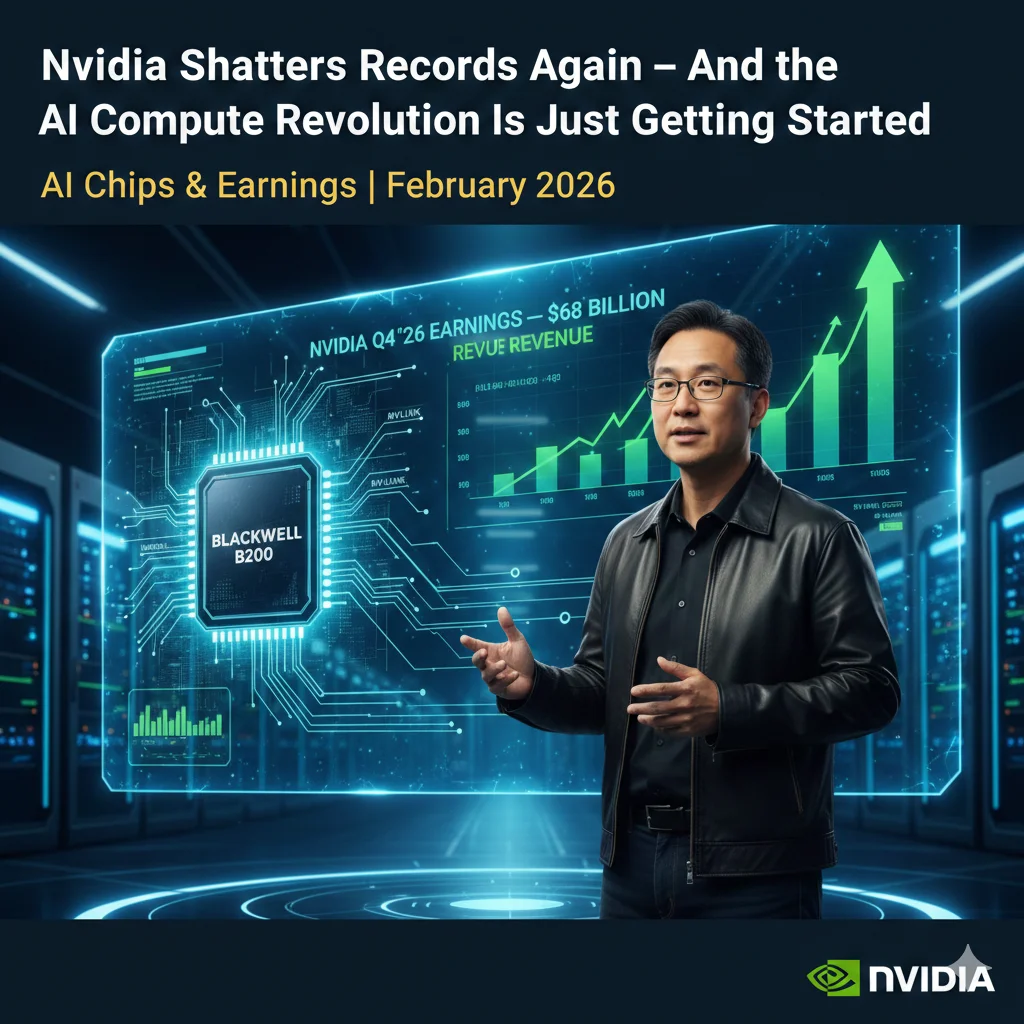
Nvidia Shatters Records Again — And the AI Compute Revolution Is Just Getting Started AI Chips & Earnings:
Introduction: The World's Most Valuable Chip Company Just Got More Valuable
When the world's most valuable company reports record profits, the world pays attention. Nvidia delivered yet another blockbuster quarter on Wednesday, confirming what many in the AI industry already knew: the appetite for AI compute is not slowing down — it is accelerating beyond anything Wall Street or Silicon Valley anticipated. With $68 billion in quarterly revenue, up a staggering 73% year-over-year, Nvidia has once again redefined what's possible for a semiconductor company riding the AI wave.
The numbers are historic, but the story behind them is even more compelling. From record-breaking data center revenues and a surging networking business, to bold commentary on AI's inflection point and a pending partnership with OpenAI, Nvidia's latest earnings call painted a vivid picture of where the AI industry is headed — and why the company at the center of it all shows no signs of slowing down.
The Numbers: A Record Quarter Defined by Data Center Dominance:
Nvidia's revenue performance in its most recent quarter wasn't just impressive— it was record-setting. The company posted $68 billion in total revenue for the quarter and $215 billion for the full fiscal year, with the overwhelming majority of growth driven by an insatiable global demand for AI compute infrastructure.
The data center business remains the undisputed engine of Nvidia's growth. Of the $68 billion in quarterly revenue, $62 billion came directly from the data center segment — a figure that underscores just how thoroughly Nvidia has become the infrastructure backbone of the AI era. Breaking that down further, $51 billion came from compute revenue — predominantly GPUs — while $11 billion was generated from networking products like NVLink, the company's high-speed interconnect technology that allows GPUs to communicate at massive scale.
This detailed revenue breakdown reflects a maturing and expanding product portfolio. Nvidia is no longer just selling individual GPUs — it is selling entire AI infrastructure ecosystems, from the chips that run the models to the networking fabric that ties them together at scale. For hyperscalers, cloud providers, and enterprises building out AI capacity, Nvidia's full-stack offering has become effectively indispensable.
Jensen Huang on Demand: 'Completely Exponential'
Few executives speak about AI with more authority or conviction than Nvidia CEO Jensen Huang, and his comments on Wednesday's analyst call did not disappoint. Addressing the extraordinary demand environment for AI compute, Huang was characteristically direct: "The demand for tokens in the world has gone completely exponential." It was a statement that encapsulates the current moment in AI better than perhaps any earnings metric.
Huang went even further, pointing to a remarkable signal of just how tight the AI compute supply remains. "I think we're all seeing that, to the point where even our six-year-old GPUs in the cloud are completely consumed and the pricing is going up," he said. The fact that aging, six-year-old GPUs are fully utilized and commanding rising prices speaks volumes about the scale of unmet demand in the global AI infrastructure market. When older hardware is maxed out and getting more expensive, it's not a supply blip — it's a structural shortage driven by relentless AI adoption.
This demand backdrop sets the stage for Nvidia's continued dominance in the AI chip market. With its next-generation Blackwell architecture ramping, and enterprise, sovereign, and hyperscaler customers all competing for allocation, Nvidia's pricing power and revenue trajectory look remarkably durable for the foreseeable future.
The China Question: Export Restrictions, Competition, and a Warning Shot:
One of the most closely watched aspects of Nvidia's earnings continues to be its China exposure — and Wednesday's call brought important clarity. Despite the recent partial lifting of U.S. export restrictions, Nvidia reported zero revenue from chip exports to China in the most recent quarter. CFO Colette Kress explained that while small amounts of H200 products for China-based customers had received U.S. government approval, those shipments had not yet generated any revenue, and the company expressed uncertainty about whether future imports into China would ultimately be permitted.
But perhaps more striking than the revenue absence was Kress's candid acknowledgment of the competitive threat emerging from China's domestic chip industry. In an apparent reference to Moore Threads' IPO in December, Kress noted that Chinese competitors — bolstered by recent public listings and fresh capital — "have the potential to disrupt the structure of the global AI industry over the long term." It was a rare and notably direct warning from a company that typically speaks with confidence about its competitive moat.
The China dynamic remains one of the most complex and consequential variables in Nvidia's long-term story. On one hand, the world's second-largest economy represents an enormous potential market for AI chips. On the other, the combination of export controls, geopolitical uncertainty, and a rapidly maturing domestic Chinese chip industry creates a landscape Nvidia must navigate with both strategic patience and heightened vigilance.
OpenAI, Anthropic, and xAI: Nvidia's Partnership Ecosystem Expands:
Beyond the revenue figures, one of the most anticipated topics on Wednesday's call was Nvidia's pending investment in OpenAI. Huang confirmed that discussions are ongoing, saying: "We continue to work with OpenAI toward a partnership agreement. We believe we are close." Reports have pegged the potential investment at $30 billion — a figure that, if confirmed, would represent one of the largest single investments in AI history and cement Nvidia's role not just as a hardware supplier but as a strategic financial stakeholder in the AI ecosystem.
Huang also referenced a broader constellation of AI partnerships that positions Nvidia at the center of the industry's most important relationships. Alongside OpenAI, he highlighted deepening collaborations with Anthropic, Meta, and Elon Musk's xAI — effectively name-dropping the full spectrum of major AI labs that depend on Nvidia's hardware. These aren't just customer relationships; they are strategic alliances that create powerful network effects around Nvidia's platform.
It is worth noting, however, that Nvidia's own SEC filings on Wednesday included a significant caveat. The company emphasized that there was "no assurance" that the OpenAI investment would ultimately take place — a reminder that even the most anticipated deals in tech can fall through, and that investors should temper their expectations accordingly until a formal agreement is announced.
Capex and Compute: Nvidia's Answer to Big Tech's Trillion-Dollar Bet:
**One of the defining narratives of the current AI era **is the extraordinary level of capital expenditure being committed by the world's largest technology companies. Microsoft, Google, Amazon, and Meta are collectively spending hundreds of billions of dollars on AI infrastructure — and questions have mounted about whether those investments will ultimately generate returns commensurate with their scale. Huang addressed those concerns head-on, with characteristic conviction.
"In this new world of AI, compute is revenue," Huang declared. "Without compute, there's no way to generate tokens. Without tokens, there's no way to grow revenues." It is a formula that reframes how investors and analysts should think about data center spending. Rather than treating capex as a cost center, Huang is arguing that in the AI era, compute capacity is the direct precursor to revenue generation — making every dollar spent on AI infrastructure a direct investment in future earnings.
Huang went further, declaring that the AI industry has reached a pivotal moment. "We've reached the inflection point and we're generating profitable tokens that are productive for customers and profitable for the cloud service providers," he said. This 'inflection point' framing is significant — it suggests that AI workloads have crossed the threshold from experimental and costly to operationally productive and economically sustainable. If Huang is right, the massive capex commitments of the past two years are about to start paying off in a big way.
Conclusion: Nvidia's Record Quarter Is a Mirror for the AI Era:
Nvidia's latest earnings report is more than a financial milestone — it is a real-time barometer of where the AI industry stands in early 2026. Record revenues, insatiable demand, aging GPUs still running at full capacity, a pending mega-investment in OpenAI, and a CEO declaring that compute is the new revenue engine: every element of this story points in the same direction. The AI infrastructure buildout is real, it is accelerating, and Nvidia remains the company most positioned to benefit from it.
The road ahead is not without complexity. China's emerging domestic chip competitors, unresolved export policy uncertainty, and the sheer scale of capital being deployed across the industry all introduce risks that thoughtful investors must weigh. But for now, the data tells a clear story: demand for AI compute is completely exponential, and Nvidia — for better or worse — is the engine powering that exponential curve.
In the race to build the AI future, chips are the currency. And Nvidia is still the mint.
Support our research
Independent analysis fueled by you.