
Is This the Dawn of the Tokenpocalypse?
The 'Tokenpocalypse' Is Here: Why the Era of Cheap AI Is Suddenly Ending:
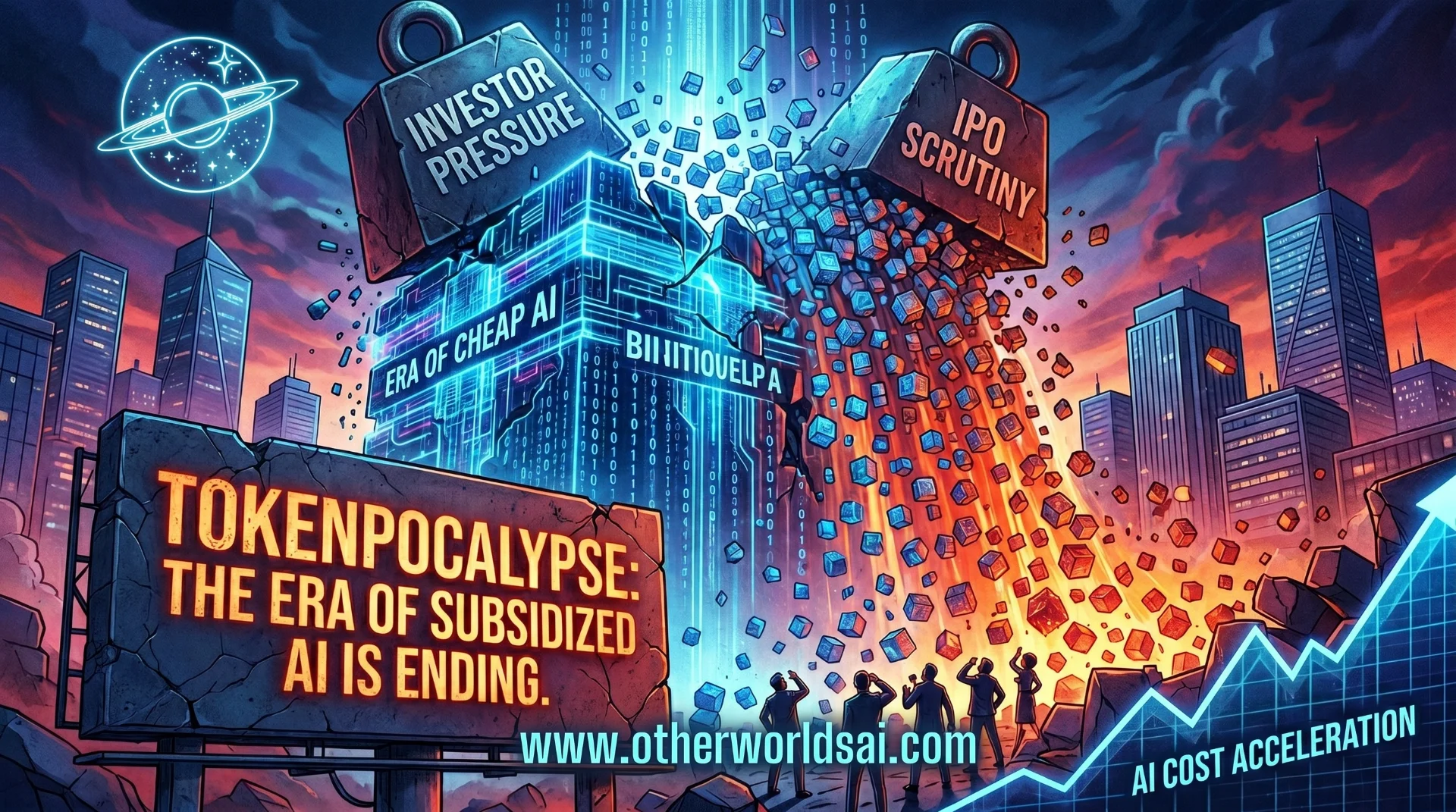
GitHub Copilot's pricing overhaul just lit the fuse. As AI companies race toward IPOs and investors demand profitability, the era of subsidized AI is ending — and businesses that built on cheap tokens are about to feel the squeeze.
The Word That's Taking Over Silicon Valley: Tokenpocalypse
A new word has entered the enterprise technology vocabulary, and it is not a reassuring one. When Microsoft announced sweeping pricing changes for GitHub Copilot — shifting developers from predictable flat-rate billing to a per-token consumption model — the backlash inside companies was swift enough that one Reddit user reported their organization had coined a name for the moment: the Tokenpocalypse.
The phrase is darkly comic, but the underlying concern it captures is entirely serious. On the latest episode of TechCrunch's Equity podcast, hosts Anthony Ha, Kirsten Korosec, and Sean O'Kane unpacked what this pricing inflection point means — not just for GitHub Copilot users, but for the entire AI industry as major labs prepare for public market scrutiny, investor pressure, and the unavoidable reckoning with AI cost sustainability.
The central question driving the conversation is one that every enterprise AI buyer, startup founder, and AI investor should be sitting with right now: can AI companies collapse the cost of delivering intelligence fast enough to meet what customers are actually willing to pay? And if they cannot, what does that mean for the industry's growth trajectory, its upcoming IPOs, and the businesses that have already built their workflows around AI tools priced at yesterday's subsidized rates?
$20/mo: ChatGPT Plus at launch — set without a real cost model.
6 Months: Rise and fall cycle of 'tokenmaxxxing' trend.
~$0 : Perceived cost to users — vs. enormous real infrastructure spend.
?x : Token risk factors expected in Anthropic's S-1 filing.
The GitHub Copilot Pivot That Started the Conversation:
Microsoft's decision to restructure GitHub Copilot's pricing model is significant beyond its immediate impact on developer teams. By moving toward consumption-based billing — where businesses pay per token generated rather than a flat monthly fee per seat — Microsoft is signaling that the era of absorbing AI infrastructure costs as a customer acquisition strategy is drawing to a close.
For development teams that had integrated Copilot deeply into their daily workflows, the shift introduces a new and uncomfortable variable: unpredictable monthly spend. Code generation is inherently token-intensive. A single complex refactoring task or a lengthy documentation generation run can consume tokens at a rate that bears little resemblance to what a flat monthly subscription implied. Developers who were told AI would make them more productive are now discovering that the more productively they use AI, the higher their bill climbs.
"This whole ecosystem is heavily, heavily subsidized by investor money. And so stuff that seems like it has no cost is, in fact, incredibly expensive. And now we're going to get to a point where more of that cost is going to get passed on to the end consumer." — Sean O'Kane
The structural dynamic O'Kane identifies is the defining tension of the current AI moment. The perceived cost of AI to end users — the $20-a-month subscription, the free tier, the enterprise flat rate — has never reflected the true cost of the underlying compute, inference, and infrastructure required to deliver those services. The gap between perceived cost and real cost has been funded by venture capital, by hyperscaler loss leaders, and by an implicit industry bet that scale would eventually close the gap. What the Tokenpocalypse suggests is that patience for that bet is thinning.
The Rise and Fall of Tokenmaxxxing: A Six-Month Arc:
Among the most telling observations in the Equity podcast conversation is Kirsten Korosec's account of how rapidly sentiment around token consumption has shifted. Tokenmaxxxing — the practice of crafting prompts specifically designed to elicit the longest, most detailed, most token-heavy AI responses possible, on the theory that more output equals more value — was, briefly, a real enterprise strategy. Teams were optimizing their workflows to extract maximum output from their AI subscriptions.
That strategy has inverted almost completely within six months. Companies that were tokenmaxxxing their way through AI subscriptions are now actively looking for ways to reduce token consumption. Internal usage caps are being put in place. Prompt engineering has shifted from maximizing output volume to minimizing it. The economic incentive structure that shaped AI usage patterns has reversed direction in half a year.
"The whole tokenmaxxxing thing has become a thing, peaked, and now is seen disfavorably, within six months. The scale of this, the whole pricing mechanism, was put in place before business models were really shaped and solidified around AI labs." — Kirsten Korosec.
This rapid reversal is not just a curiosity — it is a signal about the maturity of enterprise AI adoption. The initial phase of any transformative technology is characterized by exploration without economic discipline. Teams experiment broadly, usage scales faster than expected, and the bill arrives before anyone has built the governance infrastructure to manage it. The tokenmaxxxing arc is a compressed version of that classic technology adoption pattern — and the speed of the compression reflects just how fast AI has moved into production enterprise environments.
The Uber Parallel: Can AI Companies Squeeze Pennies Like a Platform?
The most revealing case study discussed in the Equity conversation is Uber — both as an example of how AI spend can spiral unexpectedly and as a historical analogy for how platform economics can eventually reach profitability through painful transformation.
On the AI spend side, the Uber data point is sobering. The company went from aggressive AI adoption to budget overruns to internal caps on AI usage within the span of roughly six weeks — a timeline that illustrates how quickly even large, sophisticated technology organizations can lose control of AI cost exposure when usage scales faster than financial governance.
But the more philosophically interesting dimension of the Uber comparison is the profitability trajectory. Ha points out that the bull case for AI economics — that cost-to-serve will eventually decline as scale increases, much as Uber eventually reached profitability after years of losses — is not wrong, but it requires acknowledging what that journey actually entailed.
Uber did not simply grow its way to profitability. It transformed its business model repeatedly: adding new revenue lines, expanding internationally, launching Uber Eats, and, critically, restructuring its relationship with drivers in ways that drew significant criticism.
"For Uber to do that, it had to really transform itself as a company in a lot of ways. What Uber was at the beginning and what it is now, all the different areas of business that it's had to expand into, the different ways that customers and drivers have gotten squeezed — those are things that had to happen to get to the point where it could be a profitable company." — Anthony Ha, TechCrunch Equity
The question this raises for AI labs is pointed: who are the drivers? In Uber's model, cost compression was partly achieved by externalizing costs onto a relatively captive group of workers. AI labs face a different cost structure. Their core costs are compute, energy, and engineering talent — none of which offer an equivalent 'squeeze' vector. As O'Kane observed, AI infrastructure costs feel more fixed and less compressible than the variable labor costs that Uber was able to restructure. Whether that assessment proves correct as hardware efficiency improves is one of the most important open questions in technology economics.
IPO Season and the Token Risk Factor Problem:
The conversation takes on additional urgency in the context of AI lab IPOs, most prominently Anthropic's anticipated S-1 filing. Public market investors will scrutinize AI companies' unit economics with a precision that venture capital often forgoes. And the token economics of AI services present a risk disclosure challenge that is genuinely novel.
The fundamental problem, as Korosec articulates it, is that the risk factors are moving faster than the filings. An S-1 is a point-in-time document that must capture, for the benefit of prospective public investors, the material risks facing the business. In a stable industry, those risks are reasonably predictable: competitive pressure, regulatory exposure, key-person dependency, and so on. In the AI industry in 2026, the risk landscape is shifting week to week.
The $20-per-month ChatGPT Plus price point is instructive here. O'Kane's observation that this number was not the product of rigorous financial modeling — that it was, essentially, a marketing decision — highlights a structural vulnerability that AI companies must now reconcile with public market expectations.
The pricing structures that attracted tens of millions of subscribers were set before anyone had a clear model for what sustainable AI economics look like. Repricing at scale, or restructuring to consumption-based models as Microsoft has done with Copilot, carries customer retention and reputational risk that must now be disclosed to prospective shareholders.
"How many token-related risk factors do we think are going to be in Anthropic's S-1? This is a big question... How do you even write these risks in, because they are evolving before our eyes, and day by day?" — Sean O'Kane & Kirsten Korosec, TechCrunch Equity

Meta's Next Big Bet: This New App Lets You Build Games Simply by Typing a Prompt
There is also a regulatory dimension layered into this moment. The same week as Microsoft's Copilot pricing announcement, President Trump signed an executive order creating a government review mechanism for powerful AI models — a narrow but symbolically significant step that signals regulatory attention is increasing. For AI companies preparing public filings, the intersection of rapidly evolving pricing economics and an emerging regulatory framework creates a disclosure environment with very few historical precedents to draw from.
What Enterprise AI Buyers Should Do Right Now:
For businesses that have built operational workflows on AI tools priced under the old subsidy model, the Tokenpocalypse is not a hypothetical future event — it is already arriving. The strategic response is not panic, but it does require immediate, concrete action across several dimensions.
AI spend governance needs to become a first-class operational discipline. The Uber example — where a sophisticated technology company blew through its AI budget within weeks and had to impose emergency caps — illustrates that even well-resourced organizations are unprepared for the cost behavior of AI at scale. Every business using AI tools at meaningful volume should have a live view of token consumption by team, by use case, and by provider, and should have defined thresholds and approval processes before those thresholds are breached.
Prompt engineering should shift from output maximization to output efficiency. The tokenmaxxxing instinct — prompt for the longest, most comprehensive response — is now economically counterproductive. The new discipline is precision prompting: designing inputs that elicit exactly the needed output at minimum token cost, without sacrificing the quality that makes AI useful.
Vendor pricing risk should be explicitly evaluated in AI vendor selection. A flat-rate subscription that looks attractive today may convert to consumption-based pricing as the vendor seeks to close its own economics gap. Contracts should be examined for repricing terms, and vendor roadmaps should be assessed for signals of pricing model evolution. Diversification across AI providers reduces exposure to any single vendor's repricing decisions.
Private AI infrastructure — such as the proprietary, on-premises model deployments offered by vendors like Otherworlds AI — deserves fresh consideration in this environment. A business that operates its own AI models on its own infrastructure has complete visibility and control over its AI cost structure, is insulated from vendor repricing decisions, and owns the IP generated. The total cost of ownership comparison between SaaS AI subscriptions and private deployment is shifting as public AI pricing increases.
Looking Ahead: Three Scenarios for AI Economics in 2026 and Beyond:
Scenario one is the optimistic path: AI hardware efficiency improves rapidly, inference costs decline faster than pricing pressure builds, and the labs find a stable equilibrium between what it costs to deliver intelligence and what businesses will pay for it. In this scenario, the Tokenpocalypse is a short-term adjustment, not a structural break, and AI adoption continues its upward trajectory as pricing normalizes at sustainable levels.
Scenario two is the consolidation path: the cost compression required for AI sustainability is achieved, but only by the largest players with the deepest infrastructure investments. Smaller AI labs that cannot achieve the scale economics needed to close the cost gap are acquired or shut down, and the AI services market consolidates around a small number of hyperscale providers. Enterprise buyers get predictable pricing from dominant vendors, but at the cost of diversity and competitive pressure.
Scenario three is the bifurcation path: public AI services stabilize at higher prices that reflect real costs, while the market for private, on-premises AI deployment grows rapidly as organizations that need cost certainty, data privacy, and IP control migrate away from cloud AI services. In this scenario, the Tokenpocalypse accelerates the build-out of a parallel AI infrastructure market that operates entirely outside the token economy.
Which scenario prevails — or which combination of all three plays out — will define the structure of the AI industry for the decade ahead. What is certain is that the subsidy era is ending, the reckoning is already underway, and the businesses and investors who take these signals seriously today will be better positioned for whatever form the AI economy ultimately takes.
Conclusion: The Tokenpocalypse Is Not the End — It Is the Beginning:
The word Tokenpocalypse is hyperbolic by design — it is a Reddit coinage, after all, not a policy document. But the anxiety it captures is real, and it deserves to be taken seriously by everyone with exposure to the AI industry: as a buyer, a builder, an investor, or a policymaker.
What the GitHub Copilot pricing shift, the Uber budget overrun, the tokenmaxxxing reversal, and the coming wave of AI IPO filings collectively signal is an industry arriving at a necessary moment of financial maturity. The phase of building AI products without clear cost models, of pricing subscriptions as marketing decisions rather than economic ones, of subsidizing adoption with investor capital — that phase is ending. What replaces it will be harder, more disciplined, and ultimately more durable.
For the companies that navigate this transition thoughtfully, the Tokenpocalypse is not a catastrophe. It is the moment when AI economics become real — and when the businesses and products built on genuine value creation separate from those built on subsidized illusions.
Source: Reporting by Anthony Ha, Kirsten Korosec & Sean O'Kane | June 2026
Support our research
Independent analysis fueled by you.