
The artificial intelligence landscape witnessed a dramatic showdown as OpenAI and Anthropic
engaged in an unprecedented race to dominate the agentic AI coding market.
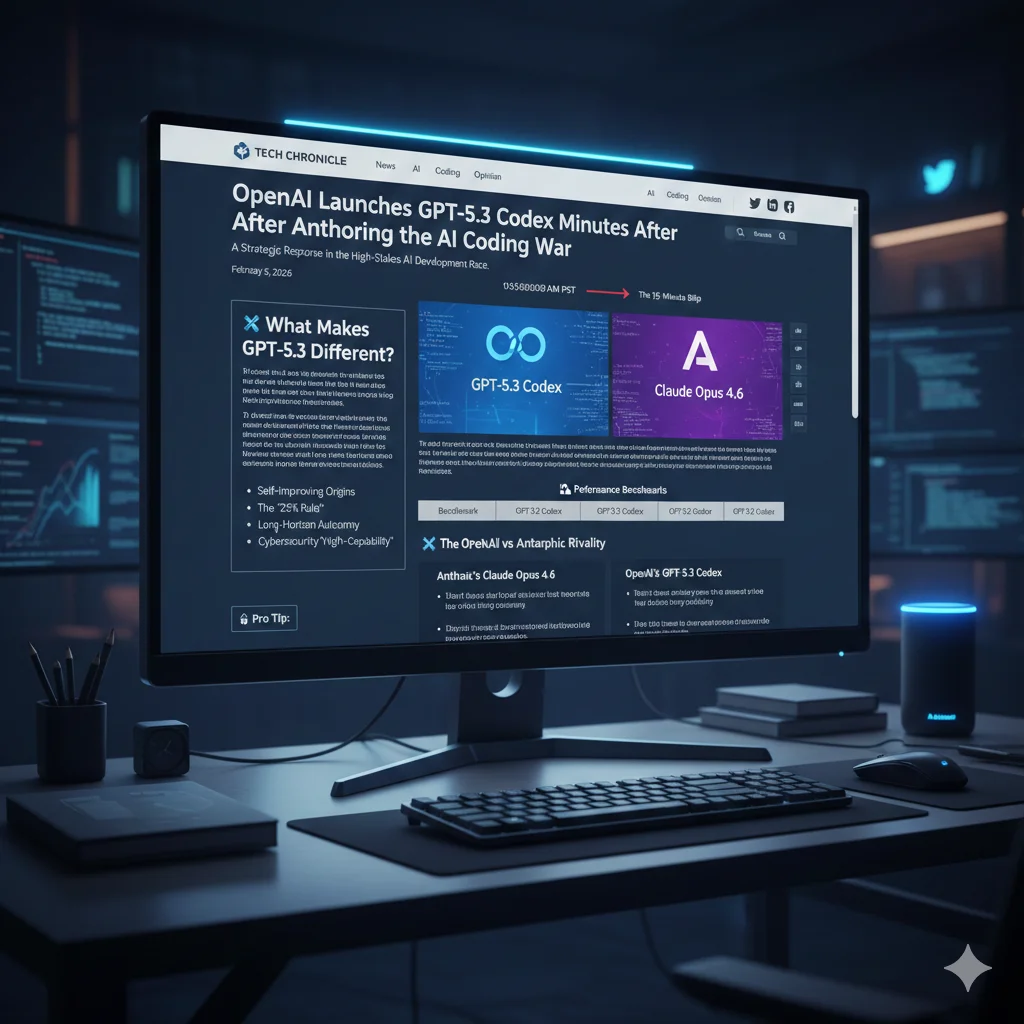
Just minutes after Anthropic unveiled its latest AI coding assistant, OpenAI responded with the groundbreaking release of GPT-5.3 Codex, a revolutionary AI model designed to transform software development forever.
The AI Arms Race Reaches New Heights:
The near-simultaneous product launches underscore an intensifying AI arms race between two tech giants competing for supremacy in AI-powered software development. This high-stakes battle represents more than just corporate rivalry—it signals a fundamental shift in how artificial intelligence will shape the future of coding, development workflows, and digital automation.
With GPT-5.3 Codex, OpenAI is making a bold statement: the era of AI coding assistants that merely suggest code snippets is over. The future belongs to autonomous AI agents capable of performing complex software engineering tasks independently, from initial planning to final deployment.
A Strategic Response in the High-Stakes AI Development Race:
On Monday morning, OpenAI introduced its agentic coding platform, positioning it as a next-generation tool for writing, reviewing, and debugging code. Within hours, the company escalated its ambitions by launching GPT-5.3 Codex, an advanced AI model that dramatically expands the capabilities of traditional coding assistants.
The timing of this launch speaks volumes about the competitive dynamics in the generative AI industry. Both OpenAI and Anthropic had reportedly coordinated to announce their respective AI coding tools at precisely 10:00 a.m. PST.
However, in a strategic move, Anthropic released its product 15 minutes early, attempting to capture the media spotlight first. OpenAI's rapid counter-launch with GPT-5.3 Codex demonstrates just how competitive the AI model market has become, with companies vying for market dominance in the lucrative enterprise AI sector.
From Code Generator to Fully Autonomous AI Development Agent:
GPT-5.3 Codex represents a quantum leap in AI capabilities. According to OpenAI's technical documentation, the model transforms basic code generation into comprehensive autonomous software development. This advanced AI system can now function as a complete digital worker, handling tasks that previously required experienced software engineers.
Key Capabilities of GPT-5.3 Codex:
-
Strategic Project Planning: The AI agent can analyze requirements, break down complex projects into manageable tasks, and create detailed development roadmaps—essential features for enterprise software development.
-
Large-Scale Codebase Management: Unlike basic AI coding assistants, GPT-5.3 Codex can write, refactor, and maintain large codebases spanning thousands of lines of code, making it suitable for real-world application development.
-
Automated Testing and Debugging: The model independently runs comprehensive tests, identifies bugs, analyzes error logs, and implements fixes—streamlining the software quality assurance process.
-
Development Workflow Automation: GPT-5.3 Codex manages file systems, coordinates dependencies, handles version control operations, and orchestrates complex development pipelines.
-
Multi-Day Project Iteration: Perhaps most impressively, this agentic AI can work on projects continuously over extended periods, making autonomous decisions and adapting to changing requirements without constant human supervision.
OpenAI claims these autonomous coding capabilities enable the model to create highly functional applications, complex games, and enterprise-grade software solutions from scratch
—a breakthrough that could revolutionize startup development and accelerate innovation across industries.
Performance Improvements and Self-Improving AI Technology:
Beyond expanded functionality, GPT-5.3 Codex delivers significant performance enhancements that address critical pain points in AI-assisted development. OpenAI reports the model operates 25% faster than its predecessor GPT-5.2, providing real-time responsiveness essential for productive software engineering workflows.
However, the most fascinating aspect of GPT-5.3 Codex is OpenAI's claim that it represents the first self-improving AI model in production use. Engineers reportedly used early versions of GPT-5.3 Codex to debug its own code, evaluate system performance, and optimize algorithms—a milestone in recursive AI development.
This self-referential AI approach could dramatically accelerate future machine learning model development cycles. By enabling AI systems to assist in refining their own architectures, neural networks, and training processes, OpenAI is moving closer to artificial general intelligence (AGI) concepts that were once purely theoretical.
Why Agentic AI Coding Matters for the Future of Software Development:
The emergence of agentic coding AI marks a paradigm shift in the software development industry. Traditional AI coding tools like GitHub Copilot provide autocomplete suggestions and code snippets. In contrast, agentic AI models reason through problems, plan multi-step solutions, execute complex tasks, and adapt to unexpected challenges with minimal human intervention.
Business Impact and Market Implications:
-
Startup Acceleration: Agentic coding tools dramatically lower barriers to entry for entrepreneurs building sophisticated software products, potentially democratizing app development and fostering innovation.
-
Enterprise Productivity: Large organizations can leverage autonomous AI agents to accelerate deployment cycles, reduce development costs, and improve overall developer productivity—translating to significant competitive advantages.
-
Developer Augmentation: Rather than replacing programmers, these AI tools can handle routine tasks, allowing human developers to focus on creative problem-solving, architecture decisions, and strategic technical leadership.
However, the rapid advancement of autonomous AI systems also raises critical questions about job displacement in the tech industry, AI governance and oversight requirements, long-term reliability of AI-generated code, and cybersecurity implications—areas where both OpenAI and Anthropic claim to be investing substantial resources.
OpenAI vs Anthropic: The Defining AI Rivalry of Our Era:
The synchronized launches make one conclusion inescapable: the OpenAI vs Anthropic rivalry is emerging as the defining competitive dynamic of the AI era. Both companies are racing to lead the future of AI-powered software development, enterprise automation, and agentic AI systems—with billions of dollars in market capitalization at stake.
GPT-5.3 Codex positions OpenAI as a frontrunner in building AI that transcends traditional assistance models, creating digital workers capable of independently executing sophisticated technical tasks. As machine learning models continue evolving toward greater autonomy, the boundary between human-led and AI-led software development will blur further.
For developers, businesses, and technology leaders watching this AI arms race unfold, the message is clear: agentic AI coding is no longer science fiction—it's the new reality of software development.
Support our research
Independent analysis fueled by you.