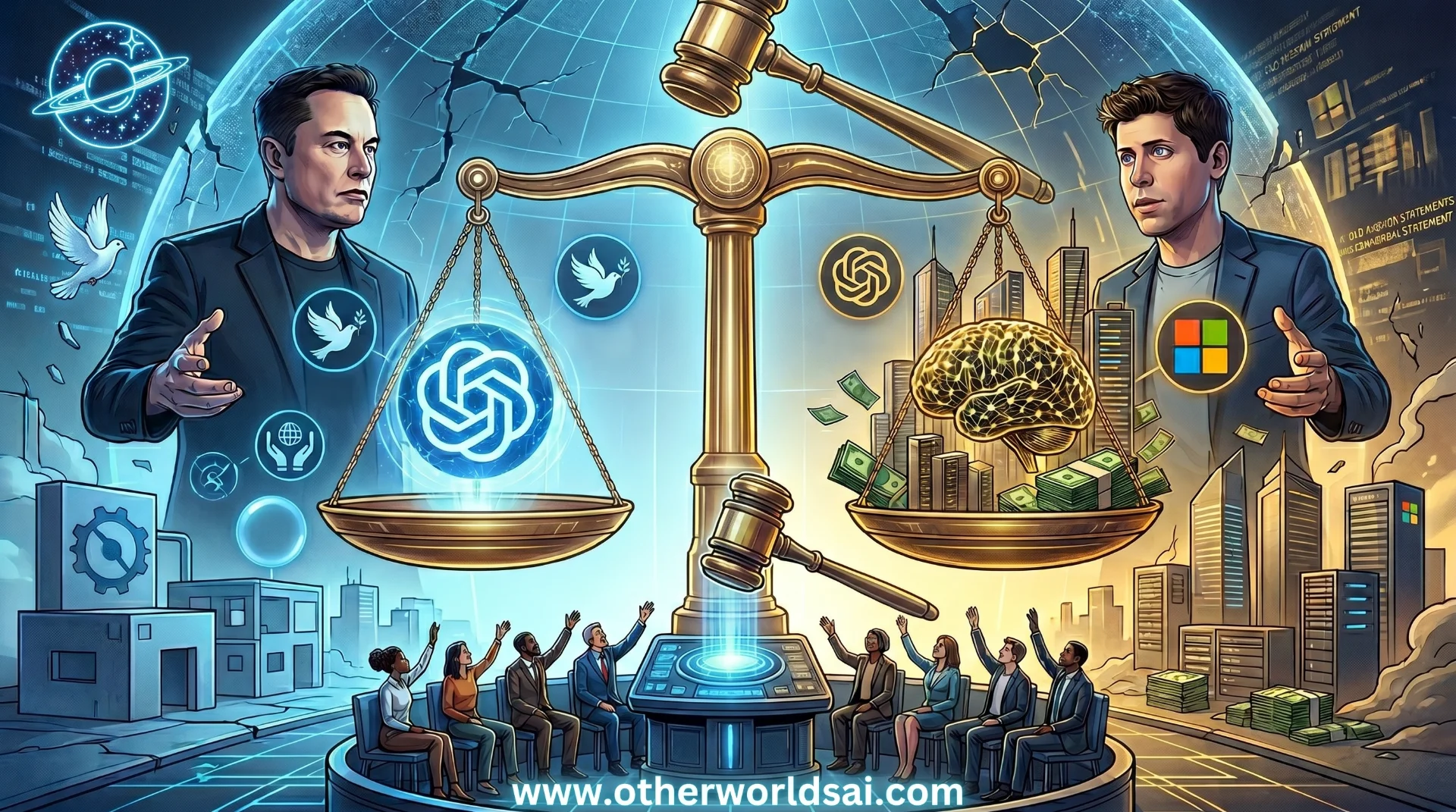

The End of OpenAI? Nine Jurors to Decide the Fate of Sam Altman’s AI Empire.
Elon Musk vs. OpenAI: What the Jury Will Actually Decide:
Introduction: The Trial That Could Redefine Artificial Intelligence:
Nine California jurors are now weighing a decision that could permanently reshape the future of artificial intelligence. At the center of the courtroom battle is a question that extends far beyond Silicon Valley personalities and billion-dollar valuations: Can an organization founded to protect humanity from unchecked AI become one of the most commercially powerful companies in the world without betraying its original mission?
The lawsuit filed by Elon Musk against Sam Altman, Greg Brockman, Microsoft, and OpenAI has evolved into one of the most consequential legal battles in modern tech history. What began as a dispute between former collaborators has now become a landmark test of AI governance, nonprofit accountability, and the limits of commercial ambition in emerging technologies.
Although the courtroom drama has revisited years of internal conflict — including Musk’s departure from OpenAI in 2018 and Altman’s dramatic firing and reinstatement in 2023 — the jury’s task is surprisingly narrow. Jurors are being asked to determine whether OpenAI’s leadership violated legal obligations tied to Musk’s donations and whether Microsoft knowingly participated in transforming a nonprofit AI laboratory into a commercial empire.
The Three Core Charges Against OpenAI & Microsoft:
Charge #1: Breach of Charitable Trust:
Musk’s legal team argues that his donations were made under a clear understanding: OpenAI would remain focused on charitable AI development designed to benefit humanity, not private investors.
According to the plaintiffs, the organization crossed a critical line when Microsoft invested billions into OpenAI’s commercial operations. Musk’s attorneys claim the partnership fundamentally altered OpenAI’s priorities, shifting its focus from AI safety and open collaboration toward profit generation and market dominance.
The centerpiece of Musk’s argument is the 2023 Microsoft investment deal. His attorneys insist that this agreement marked the first major commercial arrangement occurring within the relevant legal timeline and directly enabled investors and executives to accumulate extraordinary wealth through AI products derived from OpenAI’s nonprofit foundation.
“That deal enriched investors through commercial AI products at the expense of the charitable mission Musk supported.”
OpenAI’s defense, however, paints a very different picture. Witnesses connected to Musk himself — including financial adviser Jared Birchall, chief of staff Sam Teller, and adviser Shivon Zilis — reportedly testified that no formal restrictions were ever attached to Musk’s donations.
The defense also introduced financial evidence showing that Musk’s contributions had already been fully spent by 2020, years before the alleged misconduct occurred. OpenAI argues that its current corporate structure still supports the nonprofit mission and that offering products like ChatGPT freely to millions of users is itself evidence of public benefit.
Charge #2: Unjust Enrichment:
The second claim focuses on whether OpenAI insiders personally profited from resources that were originally donated for charitable purposes.
Musk’s legal team argues that billions of dollars in equity value flowed to OpenAI executives, researchers, and corporate partners while the nonprofit entity itself became increasingly symbolic rather than operational.
Plaintiffs point specifically to the enormous financial stakes associated with OpenAI’s commercial arm. They argue that the nonprofit foundation no longer exercises meaningful oversight and that Musk’s donations ultimately helped create immense private wealth rather than advancing a purely humanitarian mission.
OpenAI rejects that characterization entirely. The company argues that compensation through stock and equity incentives was always necessary to recruit elite AI researchers capable of building advanced artificial intelligence systems.
Defense attorneys also emphasize that the nonprofit board still formally governs the company structure. Following the internal leadership crisis of 2023, OpenAI claims governance systems were strengthened to preserve mission oversight while still enabling large-scale technological development.
Charge #3: Microsoft’s Alleged Role:
The third claim examines whether Microsoft knowingly assisted OpenAI in violating its nonprofit obligations.
Much of this argument revolves around the dramatic events of November 2023 — often referred to during the trial as “the blip” — when Sam Altman was unexpectedly removed as CEO before being rapidly reinstated.
Musk’s lawyers argue that Microsoft played a decisive role in restoring Altman’s leadership and reshaping OpenAI’s board. They also highlighted contractual provisions reportedly granting Microsoft significant influence over major OpenAI decisions. According to the plaintiffs, these arrangements demonstrate that commercial interests effectively gained control over an organization originally intended to remain independent and mission-driven.
Microsoft’s defense has been direct and consistent. Company executives testified that they never received evidence of special restrictions tied to Musk’s donations and never exercised veto powers over OpenAI operations despite having certain contractual rights. Microsoft further argues that its cloud infrastructure and financial backing were essential to OpenAI’s breakthroughs. Without large-scale computing resources, the company contends, modern AI systems like ChatGPT would not have been possible.
OpenAI’s Three Major Defenses:
Defense #1: Statute of Limitations:
OpenAI argues that Musk waited too long to file his lawsuit. Defense attorneys claim the alleged violations were publicly visible years before the case was filed in 2024. They point to internal documents, public blog posts, corporate restructuring announcements, and even Musk’s own public criticisms of OpenAI as evidence that he was aware — or should have been aware — of the company’s evolving structure long before the legal deadlines expired.
Defense #2: Unreasonable Delay (Laches).
Another major defense centers on timing and motive. OpenAI argues that Musk only pursued litigation after ChatGPT became a global success and OpenAI emerged as the dominant force in generative AI.
Defense attorneys suggest the lawsuit reflects frustration over OpenAI’s commercial success rather than genuine concern about nonprofit governance.
Anthropic’s Surprise Double Launch Directly Targets OpenAI and Google’s AI Dominance
They also argue that dismantling or restructuring OpenAI years after its transformation would create enormous instability across the technology industry.
Support our research
Independent analysis fueled by you.
Defense #3: Unclean Hands:
The “unclean hands” doctrine may be one of OpenAI’s most aggressive defenses. The company argues Musk himself engaged in conduct inconsistent with the principles he now claims to defend.
During the trial, attorneys presented allegations that Musk was simultaneously developing competing AI initiatives within Tesla while still associated with OpenAI. Additional testimony suggested he attempted to gain greater control over OpenAI’s future structure before eventually departing the organization.
“Mr. Musk abandoned OpenAI for dead in 2018.”
— Bill Savitt, OpenAI’s lead attorney
The defense also scrutinized Musk’s internal relationships and recruitment efforts, arguing that his actions undermined the credibility of his claims regarding nonprofit integrity and transparency.
What Happens If Musk Wins?
The Potential Consequences for OpenAI:
A victory for Musk could trigger one of the most disruptive legal outcomes in Silicon Valley history.
Legal analysts believe the court could potentially force OpenAI to restructure its corporate model, limit commercial operations, or impose strict oversight mechanisms on its relationship with investors and partners.
The implications would extend far beyond a single company. A ruling against OpenAI could fundamentally reshape how AI labs balance nonprofit missions with commercial financing. Companies developing advanced AI systems may face increased scrutiny regarding governance structures, investor influence, and public accountability.
Key Witnesses & Defining Testimony:
Inside the Courtroom:
Several witnesses close to Musk delivered testimony that may have strengthened OpenAI’s defense. Jared Birchall, Sam Teller, and Shivon Zilis reportedly failed to identify explicit conditions attached to Musk’s donations.
Meanwhile, Sam Altman defended OpenAI’s mission by arguing that making ChatGPT widely accessible fulfills the organization’s original purpose of benefiting humanity through AI. Perhaps most significantly, OpenAI’s forensic accountant introduced documentation allegedly showing that Musk’s financial contributions had already been exhausted years before the disputed commercial arrangements emerged.
Microsoft executives also testified that they never knowingly participated in violating any charitable obligations and never exercised undue control over OpenAI’s governance.

Meta's Next Big Bet: This New App Lets You Build Games Simply by Typing a Prompt
Bottom Line: Why This Trial Matters:
The Future of AI Governance:
This lawsuit is about far more than personal rivalries between technology billionaires. At its core, the Musk vs. OpenAI trial asks whether organizations building humanity’s most powerful technologies can remain genuinely accountable to the public while simultaneously pursuing enormous commercial growth.
The verdict could establish a defining precedent for the AI industry. If the jury sides with Musk, future AI companies may face stricter legal obligations tied to public-interest missions and nonprofit governance.
If OpenAI prevails, the decision may validate hybrid models that combine nonprofit oversight with aggressive commercial expansion.
Either way, the outcome will shape the structure, governance, and ethical expectations of artificial intelligence development for years to come.
📅 Trial Coverage · 2026 🏛️ California Civil Court: ⏱️ 10 min read