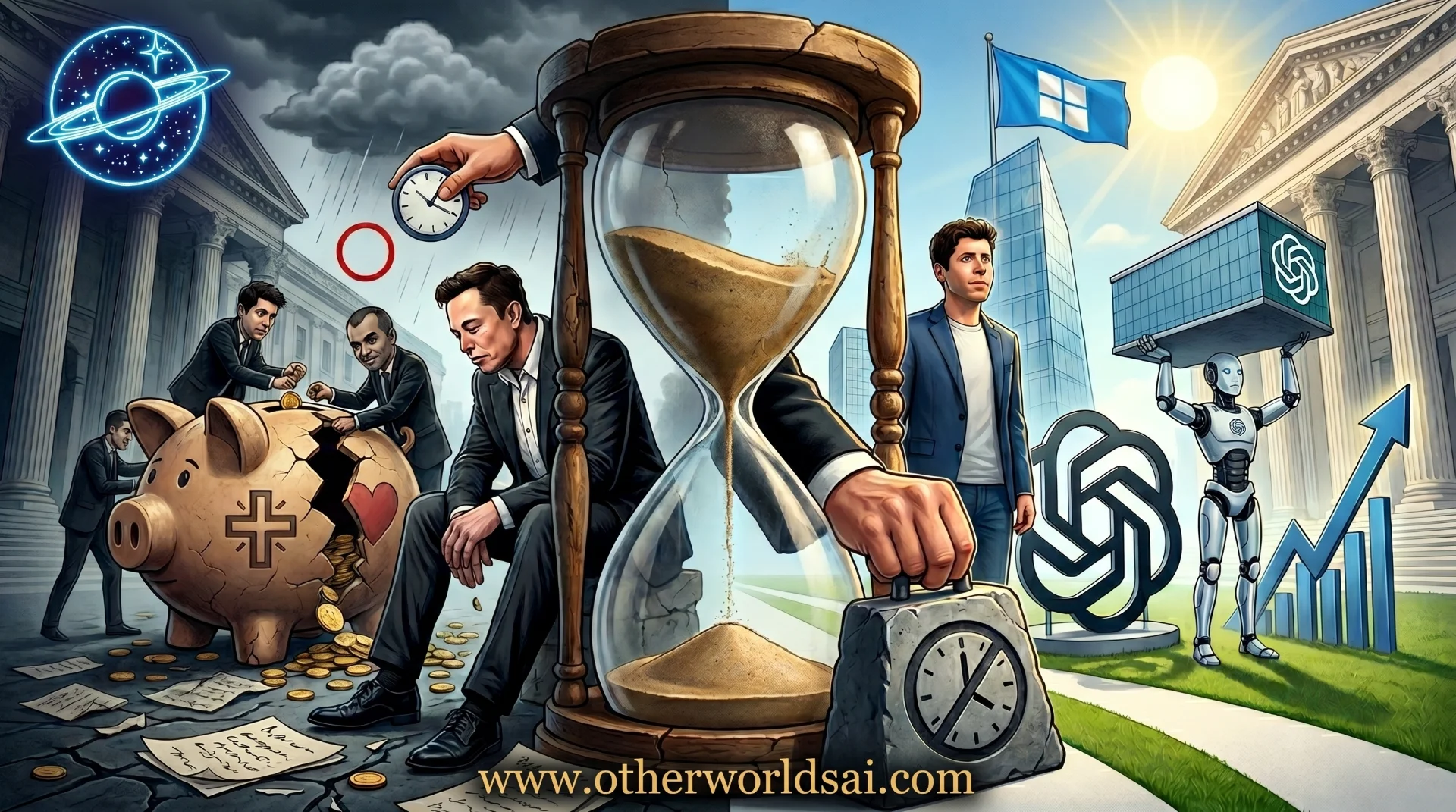

Elon Musk has lost his lawsuit against Sam Altman and OpenAI:
The $135 Billion AI Battle Ends: Why Elon Musk Just Lost to Sam Altman.
The High-Stakes AI Court Battle Comes to an Explosive End:
After months of legal drama, courtroom testimony, and intense scrutiny from the tech industry, Elon Musk has officially lost his lawsuit against Sam Altman, Greg Brockman, OpenAI, and Microsoft. A unanimous verdict delivered by nine California jurors concluded that Musk’s claims were filed too late under California law, effectively ending one of the most closely watched legal battles in artificial intelligence history.
The case was never just about money. It was about the future direction of OpenAI, the ethics of artificial intelligence development, and the question of whether one of the world’s most influential AI companies abandoned its founding mission in pursuit of profit. The ruling now removes a major cloud hanging over OpenAI as the company continues expanding aggressively and reportedly moves closer toward a future IPO.
Musk’s Central Allegation Against OpenAI:
At the heart of Musk’s lawsuit was a powerful accusation: that OpenAI’s leadership transformed what was originally founded as a nonprofit research organization into a profit-driven enterprise benefiting a small group of executives and investors. Musk argued that Sam Altman and Greg Brockman betrayed the original principles behind OpenAI by creating a for-profit affiliate and entering into deep partnerships with Microsoft. According to Musk, OpenAI’s evolution represented nothing less than the “stealing of a charity.”
The lawsuit accused OpenAI executives of enriching themselves while abandoning the mission that originally attracted Musk’s support and funding. Musk also claimed Microsoft knowingly assisted OpenAI in breaching its charitable obligations through its multibillion-dollar investments and strategic partnerships.
The legal battle became one of Silicon Valley’s most dramatic corporate disputes, blending personal rivalries, ideological disagreements, and the enormous financial stakes surrounding artificial intelligence.
Why The Jury Rejected Musk’s Claims:
Despite the explosive allegations, the trial ultimately came down to technical legal deadlines rather than proving whether OpenAI morally betrayed its founding principles. OpenAI’s legal team successfully argued that Musk waited too long to bring his claims to court. Their defense relied heavily on California’s statute of limitations laws, which place strict deadlines on when lawsuits can be filed. According to the defense:
The first claim needed to be filed before August 5, 2021.
The second claim required filing before August 5, 2022.
The third claim had a deadline of November 14, 2021.
Jurors ultimately agreed that any alleged harm Musk suffered occurred before those deadlines expired. Because of that conclusion, the jury did not need to fully resolve many of the broader ethical questions surrounding OpenAI’s transformation.
The speed of the jury’s decision was especially striking. Deliberations reportedly lasted less than two hours before the unanimous verdict was returned.
Judge Yvonne Gonzalez Rogers Responds:
Following the verdict, Judge Yvonne Gonzalez Rogers indicated that the evidence supporting OpenAI’s procedural defense was overwhelming.
“There was a substantial amount of evidence to support the jury’s finding,” she stated after the ruling. She further noted that she had even been prepared to dismiss the case immediately because of the strength of the statute-of-limitations argument.
Her comments signaled that the court viewed the timing issue as fatal to Musk’s case regardless of the larger philosophical debates about OpenAI’s evolution.
OpenAI Celebrates Major Legal Victory:
OpenAI’s legal team responded aggressively after the verdict, portraying the lawsuit as an attempt by Musk to damage a rising competitor in the AI race. Lead attorney Bill Savitt delivered one of the most memorable statements of the trial after the decision was announced.
“It did not take the jury two hours to conclude that Mr. Musk’s lawsuit is nothing more than an after-the-fact contrivance that bears no relationship to reality,” Savitt said. He went even further, calling the lawsuit:
“A hypocritical attempt to sabotage a competitor.”
The strong language reflected the increasingly hostile relationship between Musk and OpenAI — a relationship that has deteriorated dramatically since Musk co-founded the organization years earlier.
Microsoft Also Emerges Victorious:
Microsoft, which had been accused of aiding and abetting OpenAI’s alleged misconduct, also welcomed the ruling.
The company maintained throughout the case that its partnership with OpenAI was lawful, transparent, and focused on accelerating the benefits of artificial intelligence globally.
After the verdict, a Microsoft spokesperson reiterated the company’s commitment to advancing AI technologies with OpenAI for businesses, consumers, and organizations worldwide.
The ruling protects one of the most important strategic alliances in modern technology — Microsoft’s deep integration with OpenAI across cloud infrastructure, enterprise AI products, and consumer platforms.
The $135 Billion Question:
One of the most dramatic moments during the proceedings involved the discussion of potential damages Musk claimed he suffered.
Anthropic’s Surprise Double Launch Directly Targets OpenAI and Google’s AI Dominance
Musk’s legal team argued that OpenAI and Microsoft generated massive financial gains through actions that allegedly violated the organization’s original nonprofit commitments. Economic expert Dr. C. Paul Wazzan estimated those wrongful gains at between:
- $78.8 billion.
- and $135 billion.
However, Judge Rogers appeared highly skeptical of those calculations.
During court discussions, she criticized the analysis presented by Musk’s team, stating that it seemed disconnected from the actual facts of the case. “Your analysis seems to be devoid of connection to the underlying facts,” she told Wazzan directly during proceedings.
That criticism further weakened Musk’s broader attempt to frame his support for OpenAI as comparable to a financial investment in a traditional startup.
Support our research
Independent analysis fueled by you.
Musk Refuses to Back Down:
Despite losing the trial, Elon Musk quickly signaled that the legal fight is far from over.
In a post on X following the verdict, Musk framed the loss as merely procedural rather than substantive.
“There is no question to anyone following the case in detail that Altman & Brockman did in fact enrich themselves by stealing a charity,” Musk wrote.
He added:
“The only question is WHEN they did it!”
Musk also confirmed plans to appeal the decision to the Ninth Circuit Court of Appeals, arguing that the case raises dangerous precedents regarding charitable organizations in America.
According to Musk, allowing nonprofit founders to allegedly convert charitable missions into private wealth-generating entities could damage public trust in philanthropy nationwide.
His lead attorney, Marc Toberoff, summarized the next step in a single word: “Appeal.”
What This Means for OpenAI’s Future:
The verdict removes one of the biggest legal threats facing OpenAI at a crucial moment in the company’s history.
Had Musk prevailed, the lawsuit could have forced major structural changes to OpenAI’s corporate organization and potentially disrupted its partnership with Microsoft. Instead, the ruling clears a significant obstacle as OpenAI continues:
-
Expanding commercial AI products.
-
Scaling enterprise partnerships.
-
Competing against rivals like Anthropic, Google DeepMind, and xAI.
-
Exploring a possible future IPO.
For investors and partners, the decision provides much-needed legal certainty around OpenAI’s current business structure.
The Larger Battle Over AI Ethics Continues:
Even though Musk lost in court, the broader debate he raised is unlikely to disappear. The case reignited important questions across Silicon Valley:
Can nonprofit AI organizations remain mission-focused after attracting massive investment?
-
Should advanced AI research prioritize public benefit over shareholder returns?
-
How should society regulate companies building increasingly powerful AI systems?
Those questions remain unresolved and are becoming even more urgent as AI technologies reshape economies, governments, and global competition.
The courtroom battle may have ended, but the ideological war over the future of artificial intelligence is only intensifying.
Final Thoughts:
The lawsuit between Elon Musk and OpenAI will likely be remembered as one of the defining legal clashes of the AI era. While Musk failed to convince jurors that his claims were filed within the legal deadlines, the trial exposed deep fractures within the AI industry and highlighted the enormous stakes surrounding control of advanced artificial intelligence.
For OpenAI, the ruling represents stability, momentum, and a clear path forward. For Musk, it marks a major legal defeat — but not necessarily the end of the fight. And for the rest of the tech world, the trial served as a powerful reminder that the future of AI is no longer just a technological race.
It is now a battle over power, governance, money, and the very purpose of artificial intelligence itself.