
MUSK v. ALTMAN IS JUST GETTING STARTED:
Inside the Oakland Courtroom: Musk Clashes With Judge and OpenAI Lawyers Over "Looting" Allegations:
INTRODUCTION: The Trial That Could Reshape the AI Industry:
Did you know you can't steal a charity? Don't worry — Elon Musk will remind you. The most high-stakes courtroom drama in Silicon Valley history officially entered full swing this week as Elon Musk spent the better part of three days on the witness stand in his lawsuit against OpenAI. Emails, private texts, and his own tweets are surfacing as evidence, the judge has already reprimanded both sides, and there are plenty more witnesses still to come.
This trial is not just about two powerful men clashing over money — it is about who controls the future of artificial intelligence, and whether the most transformative technology ever built can be steered by profit motives alone.
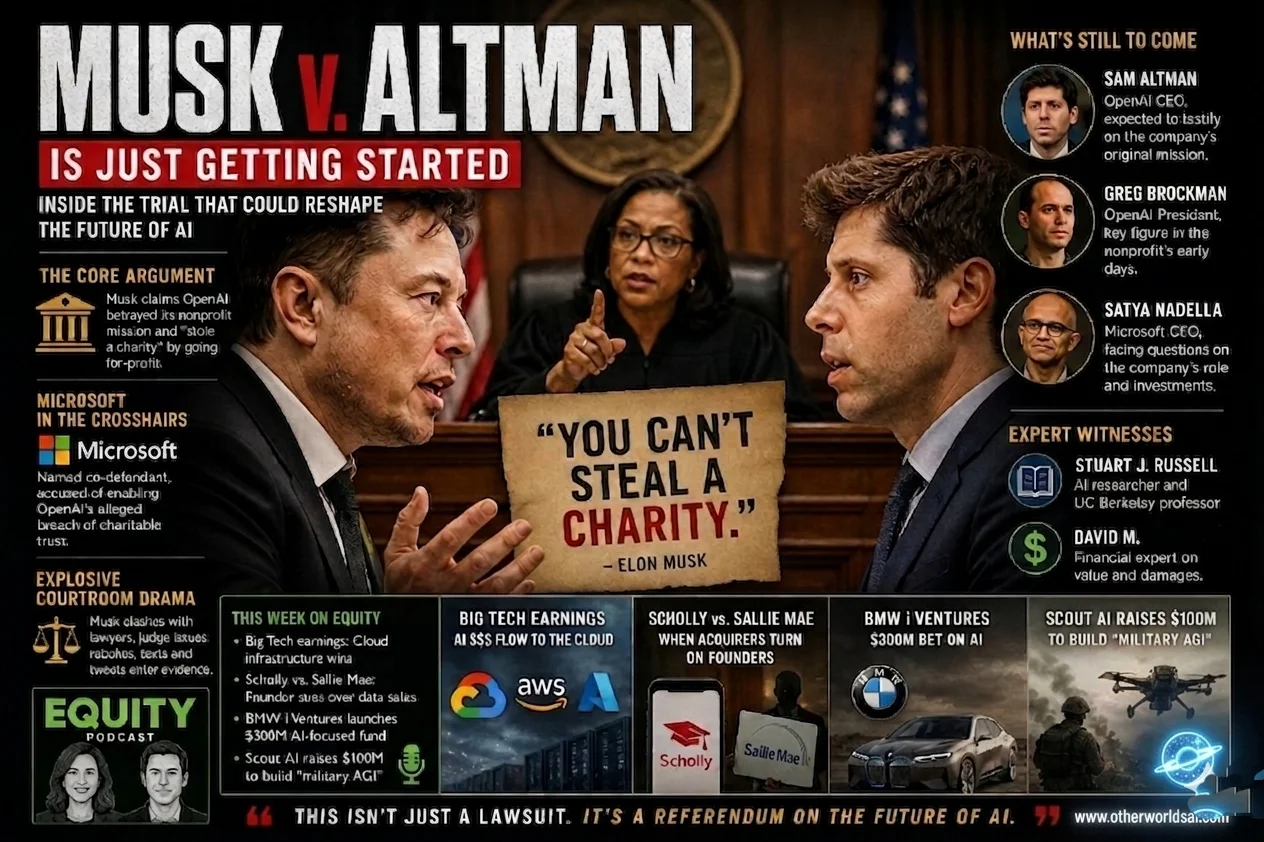
The Core Argument — "You Can't Steal a Charity"
Elon Musk's central argument in his lawsuit against OpenAI is deceptively simple. By converting from a nonprofit to a for-profit model, CEO Sam Altman betrayed the foundational mission that Musk signed up to fund — building advanced AI "for the benefit of humanity," free from the distortions of profit motive. As Musk has been reminding the courtroom repeatedly: "You can't steal a charity."
His attorney Steve Molo put it even more bluntly in his opening statement:
"Ladies and gentlemen, we are here today because the defendants in this case stole a charity." Musk is not simply seeking damages. He wants a rollback of OpenAI's for-profit conversion, Sam Altman's removal as a director of the nonprofit board, and demands that Altman, OpenAI President Greg Brockman, and financial backer Microsoft "disgorge" tens of billions of dollars in what his legal team calls "ill-gotten gains."
Three Days on the Stand — What Happened in Court:
Musk took the witness stand on April 28, 2026, at the federal courthouse in Oakland, California — and the proceedings were immediately combustible. Over three days, Musk clashed repeatedly with OpenAI's lead attorney William Savitt, accusing him of lying and asking improper "leading questions." Savitt, in turn, expressed frustration to the judge that getting straight answers from Musk was nearly impossible.
Judge Yvonne Gonzalez Rogers was forced to intervene on multiple occasions — first reprimanding Savitt for interrupting Musk's answers, then confronting Musk directly and reminding the jury that he is not a lawyer and has "not taken a class in evidence." Musk retorted that he has "technically" taken "law 101," drawing laughter from the courtroom.
Among the most significant moments of Musk's testimony was his accusation that OpenAI's leaders were "looting the nonprofit" — language that escalated the already charged atmosphere. Also introduced as evidence were texts between Musk and Altman from the early years of OpenAI, in which Altman assured Musk that users other than Microsoft would continue to access its models. OpenAI's defense has leaned heavily on the argument that Musk "didn't get his way" at the company, quit, and then watched his former co-founders succeed without him.
The Microsoft Angle — A Defendant in the Shadows:
One of the less-discussed but critically important dimensions of this case is the role of Microsoft. The tech giant is named as a co-defendant, with Musk's legal team arguing that Microsoft enabled OpenAI's alleged breach of charitable trust through its massive financial investments and commercial partnerships with the company's for-profit subsidiary.
Microsoft's own attorney Russell Cohen fought back during Musk's cross-examination, pointing to a 2020 post on X in which Musk himself wrote that "OpenAI is essentially captured by Microsoft" — arguing this proves Musk was aware of the Microsoft relationship years before he filed his lawsuit, potentially exceeding the statute of limitations.
Cohen also introduced texts between Altman and Musk where Altman explicitly promised that non-Microsoft users would retain access to OpenAI's models. For Microsoft CEO Satya Nadella, who is expected to testify, this trial represents an unwanted spotlight on one of the company's most consequential strategic bets.
What's Still to Come — Altman, Brockman, and Nadella Take the Stand:
The courtroom drama is far from over. Sam Altman is expected to testify, along with OpenAI President Greg Brockman and Microsoft CEO Satya Nadella, as well as key researchers and engineers from OpenAI's founding years. Expert witnesses for Musk include Stuart J. Russell, the renowned AI researcher and UC Berkeley professor, and David M. — a financial expert whose testimony could shape the jury's understanding of how much value was created — and allegedly diverted — through the for-profit conversion.
Altman's own testimony will be the centerpiece of the coming days. He was conspicuously absent from the courtroom during much of Musk's testimony, though he did make a virtual appearance at an Amazon Web Services event during the trial's opening proceedings — a visual that Musk's legal team will likely attempt to use to their advantage. What Altman says under oath about the original intent behind OpenAI, and the decision to create a for-profit entity, could determine the outcome of the entire case.
The Equity Podcast Breakdown — Deals, Defense Tech, and Big Tech Earnings:
Beyond the courthouse drama, TechCrunch's Equity podcast hosts Kirsten Korosec and Sean O'Kane broke down the week's biggest tech and business stories alongside the trial coverage. The week's earnings reports from Big Tech painted a clear picture of where enterprise AI spending is actually landing — and the answer is CLOUD INFRASTRUCTURE.
Google Cloud surpassed $20 billion in revenue but acknowledged that growth was capacity-constrained. Amazon Web Services posted surging numbers alongside rising capital spending commitments. And Microsoft's Satya Nadella confirmed the company is ready to capitalize on its expanded OpenAI partnership. The common thread: enterprises are spending aggressively on AI, but the companies capturing that spending most reliably right now are the cloud platforms hosting the infrastructure — not necessarily the AI model makers themselves.
Scholly vs. Sallie Mae — When an Acquirer Turns on a Founder:
One of the week's most striking startup stories had nothing to do with AI. The founder of Scholly — the scholarship-matching app famously backed on Shark Tank — filed suit against acquirer Sallie Mae after the student loan giant allegedly began selling Scholly's user data to ad networks and universities following the acquisition. The case raises uncomfortable questions about what founders can realistically expect when they sell to a large financial institution, and what protections student users have when their data changes hands as part of a corporate transaction.
Anthropic’s Surprise Double Launch Directly Targets OpenAI and Google’s AI Dominance
BMW i Ventures and Scout AI — Defense Tech Finds Its Footing:
Two funding stories from the week rounded out Equity's coverage of where venture capital is flowing in 2026. BMW i Ventures announced a new $300 million fund with a deliberate focus on AI — a signal that the automotive giant sees artificial intelligence as central to its next decade of innovation, not just a feature to bolt onto existing products.
Meanwhile, defense tech startup Scout AI closed a $100 million raise to train what it is calling "military AGI" — using vision-language-action (VLA) models to build autonomous systems for battlefield decision-making. The startup's founders gave TechCrunch a rare look inside its training bootcamp, revealing an approach to AI development that is as disciplined and rigorous as the military customers it is designed to serve.
Whether "military AGI" becomes the defining phrase of the defense tech boom or a PR overclaim remains to be seen — but the $100 million bet suggests investors are taking it seriously.
Support our research
Independent analysis fueled by you.
CONCLUSION: A Trial That Is Just Getting Started:
The Musk v. Altman trial is not just a legal dispute between two billionaires. It is a referendum on what kind of entity is fit to build the most powerful technology in human history — and whether the promises made in the early idealistic days of AI development carry any legal or moral weight when billions of dollars are at stake.
As Musk keeps saying, you can't steal a charity. Whether a jury agrees is a question that will take weeks more testimony to answer.