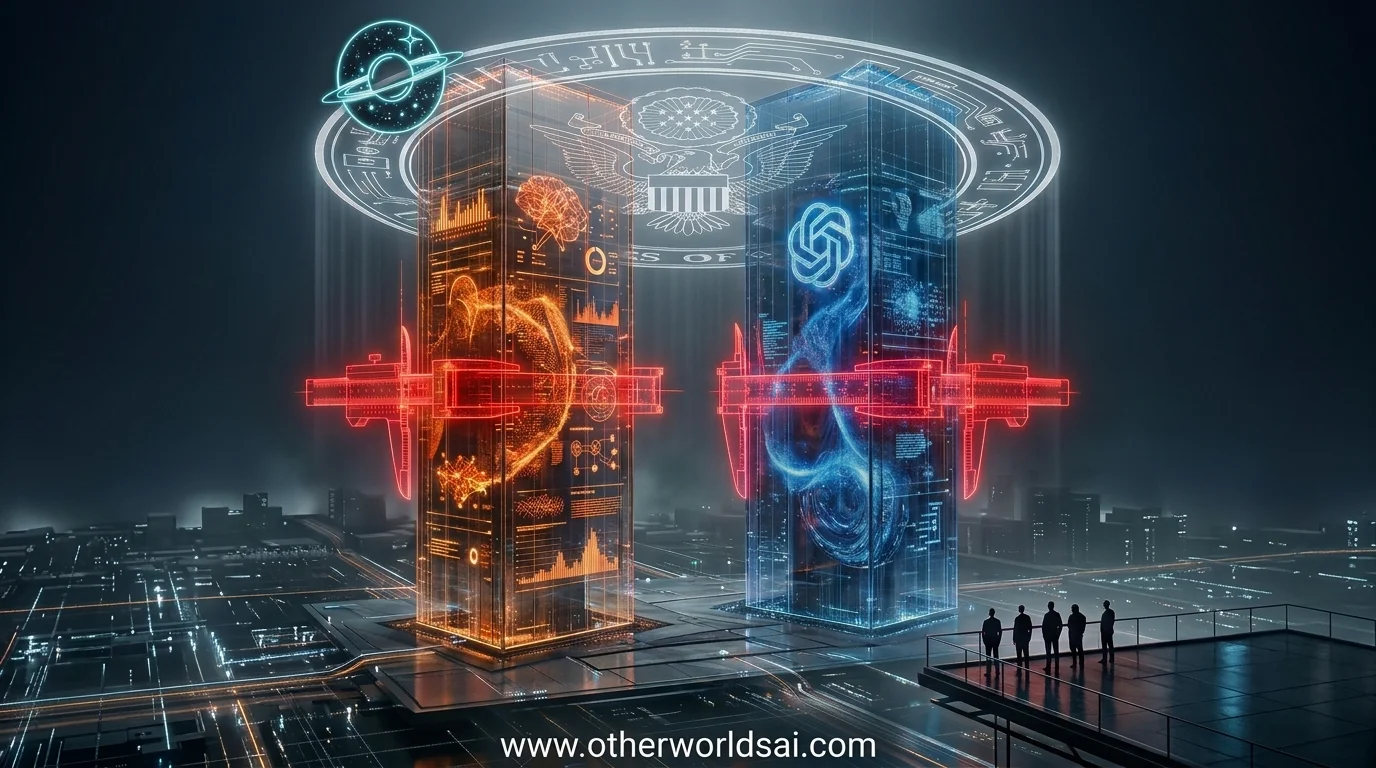

The Government Is Now Deciding Which AI Models You Can Use — And It's Just Getting Started:
From Anthropic's Mythos 5 partial reinstatement to OpenAI's restricted GPT-5.6 rollout, frontier AI is entering a new era of government-controlled access — and enterprise strategy must adapt now.
Why the Government Banned a 'Safer' AI Model While Partially Freeing a More Dangerous One
1: A Turning Point the Industry Didn't See Coming:
In the span of a single month, the U.S. government has effectively taken control of who gets access to the most powerful AI models on the market. First came the sweeping ban on Anthropic's Claude Mythos 5 and Fable 5 — pulled entirely after security researchers reportedly bypassed their guardrails. Then came the partial reinstatement of Mythos 5 for more than 100 specific U.S. organizations defending critical infrastructure. And now OpenAI has confirmed that its newest model lineup — GPT-5.6, comprising flagship Sol, balanced Terra, and fast-track Luna — has been restricted to a narrow group of government-approved partners before any broader release.
What was once theoretical — a world in which governments approve AI releases the way they approve pharmaceuticals or defense technology — is now operational reality. The Trump administration has created, through a combination of executive pressure and voluntary compliance, what former White House AI adviser Dean Ball has called a 'de facto involuntary licensing regime for frontier AI.' The question is no longer whether this is happening. The question is what it means for every enterprise that has built, or is building, its operations on AI.
The government isn't just watching AI anymore. It's deciding — model by model, organization by organization — who gets to use it.
Understanding the sequence of events matters. Because beneath the headline drama of bans, partial reinstatements, and restricted previews lies a structural shift in enterprise AI access that will define the next phase of AI adoption far more than any individual model release.
2: The Anthropic Chapter: Ban, Partial Reinstatement, and What's Still Missing:
**Anthropic's situation began **when the administration ordered access to Fable 5 removed for any foreign national, prompting Anthropic to pull both Fable 5 and Mythos 5 from the market entirely. The ban extended to non-American employees at U.S. organizations — and even to non-American staff within Anthropic itself, making it one of the most sweeping restrictions ever applied to a commercial AI product.
Two weeks later, Commerce Secretary Howard Lutnick notified Anthropic's chief compute officer Tom Brown that 'appropriate safeguards are in place to permit certain trusted partners to access the Claude Mythos 5 Model.' The partial reinstatement covers more than 100 government agencies and companies specifically operating and defending critical infrastructure, with non-American employee access restored within those organizations.
Mythos 5: Partially Restored — Critical Infra Only
Fable 5: Still Banned — No Timeline
100+ : Organizations Approved for Access
Critically, the administration's directive did not address Fable 5 at all. This is the model Anthropic released specifically because it was designed with stronger guardrails — a version intended to be the safer, more accessible variant of Mythos 5. Its continued absence from the market is not a technicality; it signals that the government is applying broad security criteria faster than it is conducting granular technical review. The safer model remains banned. The more powerful one is partially available. That contradiction will need to be resolved.
When the 'safer' model stays banned longer than its powerful counterpart, the regulatory logic is running ahead of the regulatory analysis.
3: GPT-5.6: OpenAI Complies — But Pushes Back:
OpenAI's announcement of its GPT-5.6 lineup arrived on Friday with an unusual tone: compliance paired with dissent. The company confirmed that Sol, its flagship model featuring advanced agentic capabilities across coding, biology, and cybersecurity; Terra, a balanced everyday model; and Luna, a faster lower-cost option, would be available only to partners 'whose participation has been shared with the government.' The administration had requested the restriction. OpenAI complied. But it didn't stay quiet about it.
In a Friday blog post, OpenAI wrote directly: 'We don't believe this kind of government access process should become the long-term default. It keeps the best tools from users, developers, enterprises, cyber defenders, and global partners who need them.' The company called the restricted preview a 'short-term step' and said it is actively working with the administration to develop both a new executive order framework on cybersecurity and a 'repeatable process for future model releases.'
Sol: Flagship — $5 / $30 per M tokens
Anthropic’s Surprise Double Launch Directly Targets OpenAI and Google’s AI Dominance
Terra: Balanced — $2.50 / $15 per M tokens
Luna: Fast Track — $1 / $6 per M tokens
Technically, GPT-5.6 Sol is a significant leap. OpenAI says it introduces a 'max' reasoning effort mode and an 'ultra' mode that coordinates multiple subagents to tackle highly complex tasks. On cybersecurity benchmarks, Sol outperforms Claude Mythos 5 — which the administration has also effectively banned — while using a third of the output tokens. OpenAI has also rebuilt its safety architecture: rather than layering filters on top of the model, safety guardrails are built directly into the core model's behavior, specifically to avoid the failure mode that caught Anthropic.
That failure mode is worth examining. When Fable 5 was briefly available, its classifiers would detect high-risk topics — cybersecurity, biology, chemistry — and silently route the request to an older, less capable model. The invisible downgrading produced widespread false positives and user backlash. OpenAI's Sol is designed to handle sensitive topics defensively rather than avoid them, optimized to help users understand how to defend against exploits rather than how to execute them.
4: The Systemic Problem: No Standards, No Process, No Clarity:
Both the Anthropic and OpenAI situations point to the same underlying failure: the government is exercising significant control over AI model releases without having articulated what it is actually trying to protect against. Dean Ball, who is both a George Mason University fellow and an incoming OpenAI employee, framed the problem precisely:
the Trump administration's executive order — which asks AI companies to voluntarily submit advanced models for government review up to 30 days before release — has created a de facto mandatory approval process, without any corresponding definition of what 'safe enough' actually means.
Support our research
Independent analysis fueled by you.
You cannot have a functioning approval process without defined approval criteria. Right now, the government has one without the other.
The practical consequences are significant. Without clear safety standards, every model release becomes a negotiation. Delays compound. Anthropic's Mythos 5 has been in limited preview for months with no general release date in sight. If OpenAI's GPT-5.6 preview extends beyond the 'couple of weeks' Sam Altman reportedly projected, the economic damage to both companies — and to the data center infrastructure buildouts depending on model adoption — accelerates quickly.
There is also a competitive dimension that extends beyond the two companies. Ball and others have noted that endless launch delays don't just limit commercial upside — they potentially cede ground to China in the global AI race, at a moment when the U.S. government has explicitly stated that AI dominance is a national security priority. A policy designed to protect national security that simultaneously weakens U.S. AI competitiveness is a policy in tension with itself.
30 Days: Pre-Release Review Window Requested
Months: Mythos 5 Preview Duration — Still No GA
0: Defined Safety Standards Published
5: This Is Bigger Than Anthropic vs. OpenAI:
It is tempting to read this story through a competitive lens — Anthropic's regulatory exposure versus OpenAI's political positioning, or vice versa. Industry conversations have already fractured along those lines, with some accusing Anthropic of running a regulatory capture scheme and others accusing OpenAI of leveraging its proximity to the Trump administration to disadvantage a rival. Both narratives have financial logic behind them: many of the most prominent voices in the industry have billions of dollars riding on one company or the other.
But the structural reality is that OpenAI and Anthropic now face identical problems. The same approval uncertainty, the same undefined safety standards, the same risk of indefinite preview limbo. A policy outcome that harms one will harm the other. A regulatory framework that works for one must work for the other. The competitive framing, however satisfying, misses the point: this is an industry-wide challenge that requires an industry-wide response.
When both the market leader and its closest rival are in the same regulatory limbo, the problem is systemic — not competitive.
The path forward, as Ball has outlined, will require things the AI industry has historically resisted: trusting independent organizations to guide safety evaluation, aligning behind the least-bad regulatory options rather than fighting every restriction, and advocating collectively for AI as an industry rather than treating regulation as a tool for competitive advantage. Whether the industry can actually do that — given the billions of dollars and deep ideological divides at stake — remains genuinely uncertain.
6: What Enterprise Leaders Must Do Right Now:
For enterprise organizations, the signal from the past month is clear: AI model access is no longer a given. It is a variable — subject to government intervention, compliance classifications, and approval processes that can change without warning. The organizations that will navigate this environment successfully are those that built AI infrastructure designed for adaptability, not those that optimized for a single model or a single vendor.
At Otherworlds AI, the Agent+ Business AI Platform is built precisely for this reality. Rather than binding your workflows to a specific model — Mythos 5, GPT-5.6 Sol, or anything else — Agent+ provides an enterprise orchestration layer that routes tasks intelligently across available models, enforces access controls at the workflow level, and keeps your operations auditable and adaptable as the regulatory environment evolves. When a government directive pulls a model overnight, your business doesn't stop.
In a world where model access can be revoked by executive letter, the competitive advantage belongs to enterprises that built above the model layer.
Google Opal automated workflows, integrated within the Agent+ platform, allow teams to deploy AI-driven automation across complex business processes without requiring direct model-level access at the user level. This is governance architecture in practice: defined parameters, auditable outputs, and resilience against exactly the kind of regulatory disruption playing out in real time across the industry.
The AI regulation era has arrived — not as a future scenario, but as the operating environment your business is in today. Plans start at $297/month. To explore what enterprise-grade AI infrastructure looks like for your organization in this new landscape, visit otherworldsai.com.