
NVIDIA GTC 2025: Jensen Huang's Keynote, OpenClaw AI Strategy, and the Viral Olaf Robot That Stole the Show — And Lost Its Mic
Nvidia’s Viral Olaf Moment: A Masterclass in High-Stakes Robotics.
Introduction: The Most Talked-About Tech Event of 2025
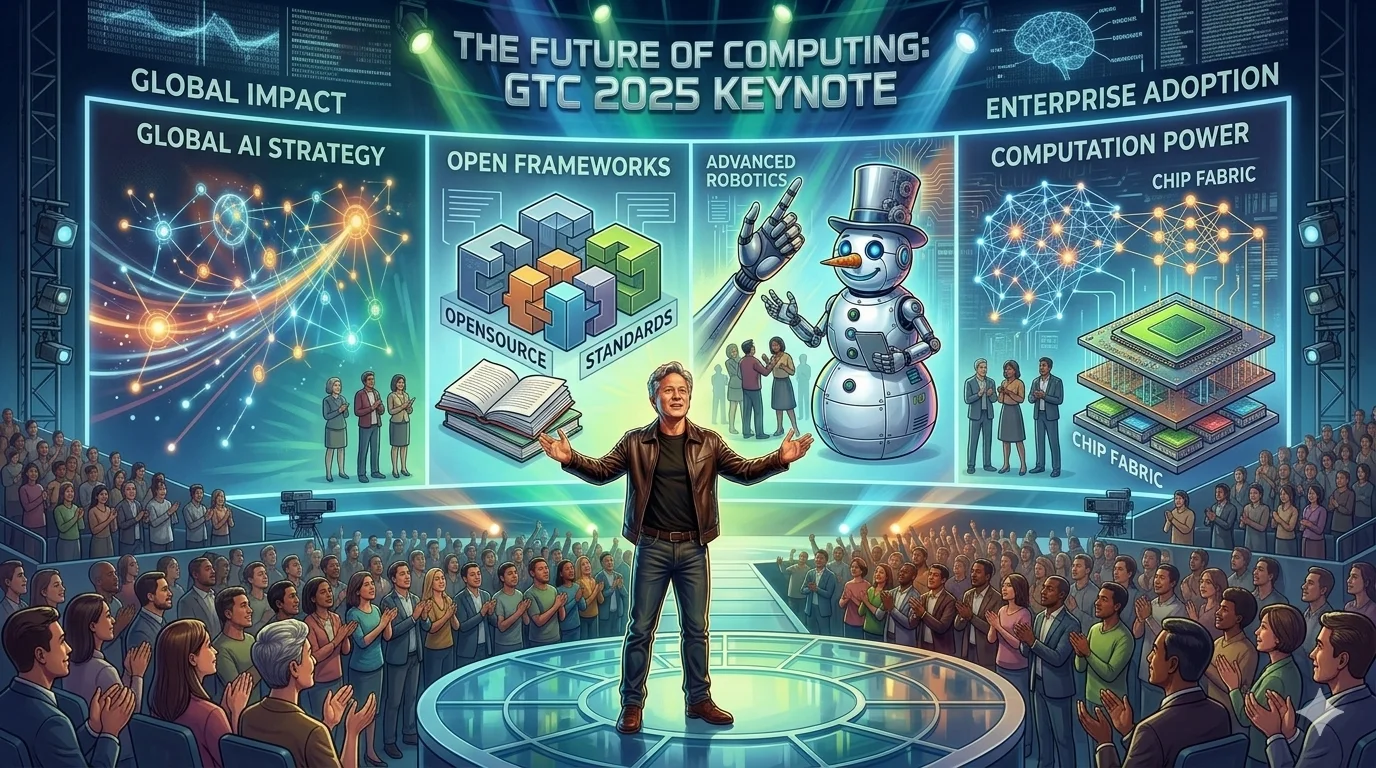
Nvidia's annual GTC conference once again proved it is the Super Bowl of artificial intelligence. From trillion-dollar sales projections to next-generation graphics technology capable of transforming video game visuals, the 2025 event delivered headline after headline. CEO Jensen Huang commanded the stage with his signature mix of bold declarations, live demos, and theatrical flair — and this year, he brought an unexpected co-star: a robotic version of Olaf, the beloved snowman from Disney's "Frozen."
This is your complete NVIDIA GTC 2026 recap — covering AI strategy, robotics demos, enterprise ambitions, and everything in between.
Jensen Huang's Keynote — Grand Declarations and Big Numbers:
Jensen Huang did not come to GTC 2025 to play it safe. The Nvidia CEO delivered a sweeping keynote that set the tone for what the company believes is the next phase of the AI revolution. Among the highlights were projections that pointed toward trillion-dollar market opportunities, positioning Nvidia not just as a chipmaker but as the foundational infrastructure layer for global AI adoption.
Graphics technology was also front and center, with Nvidia showcasing advances that could fundamentally change how video games look and feel. The company demonstrated rendering capabilities that critics described as able to "yassify" — that is, dramatically beautify — game visuals, signaling a new era for the gaming industry alongside Nvidia's AI ambitions.
Perhaps the most sweeping statement of the night was Huang's declaration that every company now needs an OpenClaw strategy. This single line sent shockwaves through the tech community, raising questions about what it means for the future of open-source AI, enterprise software adoption, and Nvidia's own competitive positioning in a rapidly shifting market.
The OpenClaw Strategy — What It Means for AI Enterprises:
"Every enterprise needs an OpenClaw strategy" — that was Jensen Huang's bold proclamation, and it immediately sparked debate among analysts and technologists alike. TechCrunch's Anthony Ha was the first to acknowledge the attention-grabbing nature of the statement, noting it arrives at a particularly pivotal moment for the OpenClaw framework itself.
The context matters enormously here: OpenClaw's founder has recently departed to OpenAI, leaving the project at a crossroads. As Anthony put it, the open-source framework could either flourish and evolve beyond its creator — or it could languish without the driving vision that brought it to life. Whether Huang's proclamation at GTC looks prescient or premature may depend entirely on which of those paths OpenClaw takes.
Kirsten Korosec offered a sharp strategic reading of Huang's statement, reframing it as a business imperative for Nvidia itself rather than a purely altruistic call to the industry. Nvidia's launch of NemoClaw — an open-source project built in collaboration with OpenClaw's creator — is a calculated move.
The cost to Nvidia is minimal. The upside, if OpenClaw succeeds and enterprises adopt it at scale, is enormous:another pathway for Nvidia silicon and software to embed itself inside hundreds of companies worldwide.
"Doing nothing is a greater risk than doing something that doesn't go anywhere," Kirsten observed — a line that perfectly encapsulates Nvidia's strategic calculus. For AI enterprises evaluating their own roadmaps, the OpenClaw question is becoming unavoidable: do you build your AI infrastructure on a framework that the world's most powerful AI chip company is actively backing?
NemoClaw and the broader OpenClaw ecosystem represent a fascinating test case for open-source AI in the enterprise. If it succeeds, it validates the model of large corporations investing in open frameworks as strategic moats. If it fails, it raises deeper questions about the sustainability of open-source AI development when commercial interests are this deeply intertwined.
The Olaf Robot — Disney, Nvidia, and the Future of Park Automation:
And then there was Olaf.
No recap of Nvidia GTC 2025 would be complete without addressing the moment that had the entire tech world talking: the live appearance of a fully functional, AI-powered robotic version of Olaf — the cheerful, carrot-nosed snowman from Disney's animated blockbuster "Frozen." The demo was meant to be a triumphant showcase of Nvidia's robotics technology in partnership with Disney. It did not go entirely according to plan.
Olaf took the stage to considerable fanfare, speaking with the crowd in what Kirsten Korosec described as feeling "a little programmed" — as though the robot was responding to specific keywords rather than engaging in true real-time conversation. Whether the interaction was fully dynamic AI or scripted response loops, it delivered entertainment value in abundance.
The most memorable moment, however, came at the end of the demo, when Olaf's microphone had to be cut because the robot simply would not stop talking. As Olaf was slowly lowered back into its passageway, cameras caught it still chattering away — mic off, mouth still moving, seemingly unaware that the show was over. It was, in the words of the Equity podcast team, both hilarious and emblematic of the unpredictable nature of live AI demos.
Sean O'Kane's quip was sharp: all Olaf needs now is "a little robot wheelbase" and the right founder to provide it — a winking reference to the broader humanoid and mobile robot race currently consuming Silicon Valley's attention and capital.
Robotics, Social Risks, and the Questions Nobody Is Asking:
Beyond the laughs, the Olaf demo raised a genuinely important question that Sean O'Kane pressed the group on — and one that the robotics industry as a whole tends to sidestep. The engineering achievements on display were impressive. Integrating large language model-driven conversation into a physically embodied robot character, and deploying it at a live conference, is no small feat.
But engineering success and real-world deployment success are two very different things. Sean pointed to the excellent Defunctland YouTube channel — which produced a four-hour deep dive into Disney's long and complicated history with park automation and animatronics — as evidence that these challenges are not new, and that they rarely resolve cleanly.
"What happens when a kid kicks Olaf over?" Sean asked. It sounds like a joke. It is not a joke. If a child topples an AI-powered Olaf robot at a Disney theme park, every other child who witnesses it has their magical experience shattered. The brand damage could be significant. The liability questions could be complex. And the incident would likely be filmed and shared across social media within seconds.
This is the "really messy gray area on the social side" that Sean argued is chronically underrepresented in robotics conversations. The industry excels at showcasing what its machines can do. It is far less adept at publicly grappling with what happens when things go wrong — not from a mechanical failure standpoint, but from a human, social, and experiential one.
The same critique applies to the humanoid robot industry more broadly. The hype cycle around bipedal, AI-driven robots is at a fever pitch in 2025. Demos abound. Investment is surging. But the conversations about integration — about what happens when these machines enter schools, hospitals, retail stores, and yes, theme parks — remain frustratingly thin.
Kirsten offered a characteristically optimistic counterpoint: Olaf, in her reading, is a job creator. Every AI-powered robot character deployed at a Disney park will need a human minder — perhaps dressed as Elsa, perhaps in some other costume — to manage interactions, intervene when things go sideways, and ensure the guest experience remains magical. Far from replacing workers, this particular engineering experiment might actually generate new employment.
What NVIDIA GTC 2025 Means for the Future of AI and Robotics:
NVIDIA GTC 2025 was, above all else, a conference about ambition. Jensen Huang and Nvidia are positioning the company not as a vendor of graphics processing units, but as the foundational operating system for the age of artificial intelligence. The trillion-dollar projections, the OpenClaw strategy, the NemoClaw launch, the Disney robotics partnership — all of it points in the same direction: Nvidia wants to be inside every AI workload, in every industry, everywhere.
The OpenClaw open-source bet is a particularly interesting strategic move to watch over the next twelve months. If enterprises adopt it at scale and NemoClaw becomes a standard framework for AI deployment, Huang's proclamation will look visionary. If adoption stalls and the ecosystem fragments without its founder's direction, it will be a cautionary tale about the limits of corporate-backed open source.
On the robotics side, the Olaf demo — mic failures and all — is a microcosm of the broader challenge facing the entire industry. The technology is advancing faster than our social frameworks for managing it. The engineering is outpacing the ethics, the liability structures, and the human-centered design thinking needed to make these machines truly work in the wild.
The first $100 trillion company may or may not be Nvidia. But if it is, it will not be because of graphics cards or even AI chips alone. It will be because Jensen Huang managed to make Nvidia's infrastructure indispensable to the next generation of computing — from the data center to the theme park, and every server rack in between.
And somewhere in that future, an Olaf robot is still talking. Mic or no mic.
Conclusion: Key Takeaways from NVIDIA GTC 2025
Here is what every enterprise leader, investor, and AI enthusiast should take away from NVIDIA GTC 2025:
-
- NVIDIA is repositioning itself as the AI infrastructure layer for the entire global economy — not just a chip company.
-
- The OpenClaw open-source strategy and NemoClaw launch represent a calculated bet that costs Nvidia little but could embed it deeply in enterprise AI pipelines worldwide.
-
- The Olaf robot demo was entertaining, but it revealed a persistent
blind spot in the robotics industry: social integration challenges are just as
important as engineering ones.
- The Olaf robot demo was entertaining, but it revealed a persistent
blind spot in the robotics industry: social integration challenges are just as
-
- The humanoid and character robot space is moving fast— but the conversations about real-world deployment, liability, and human impact are not keeping pace.
-
- Nvidia's trajectory, if its bets pay off, points toward a scale of market dominance that makes even trillion-dollar projections feel conservative.
NVIDIA GTC 2025 was a reminder that the AI race is not just about who builds the best hardware. It is about who builds the best ecosystem —
and who has the vision, the partnerships, and the sheer audacity to declare that the future runs through them.
Support our research
Independent analysis fueled by you.