
Gemini 3.5 Flash: Google Bets Its Next AI Wave on Agents, Not Chatbots:
Google’s New AI Agents Built a Functional Operating System From Scratch in 12 Hours:
Introduction: The Chatbot Era Is Over — The Agent Era Has Begun:
Something fundamental shifted at Google IO 2026, and it wasn't just another model launch. When Google unveiled Gemini 3.5 Flash, its strongest AI model to date, the company wasn't announcing a smarter conversational assistant. It was announcing a pivot — from AI that answers questions to AI that does work. Plans, builds, iterates, executes, and delivers. Autonomously.
For hours at a time. Without waiting to be asked what to do next. The implications of that shift ripple far beyond the developer community. Gemini 3.5 Flash is not just a new model — it is Google's clearest signal yet that the conversational AI wave that defined 2023 and 2024 is giving way to something more powerful and more disruptive: the agentic AI era. And Google is moving fast to own it.
Section 1: What Is Gemini 3.5 Flash — And What Makes It Different:
Gemini 3.5 Flash is Google's newest AI model, launched at Google IO 2026, and it arrives with a striking set of benchmark claims. According to Koray Kavukcuoglu, DeepMind's chief technologist, the model outperforms Google's own previous frontier model — Gemini 3.1 Pro — on nearly every benchmark it was tested against, including coding tasks, agentic capabilities, and multimodal reasoning. For a company that has been playing catch-up in the public perception of the AI race, that is a significant statement.
"3.5 Flash offers an incredible combination of quality and low latency. It outperforms our latest frontier model, 3.1 Pro, on nearly all the benchmarks — including coding, agentic tasks, and multimodal reasoning." — Koray Kavukcuoglu, Chief Technologist, DeepMind Speed is where Gemini 3.5 Flash makes its most dramatic claim.
Kavukcuoglu stated that the model is four times faster than comparable frontier models — a speed advantage that matters enormously for agentic workloads, where multiple AI agents run in parallel on long-running tasks. But Google didn't stop there. The company also developed an optimised version of Flash that is twelve times faster than existing frontier models while maintaining the same output quality. For developers building agent-based pipelines, that speed differential is not a luxury — it is infrastructure.
The model's architecture was designed from the ground up with agentic workflows in mind. Unlike general-purpose language models optimised primarily for single-turn question answering, Gemini 3.5 Flash is built to sustain autonomous operation across extended, multi-step tasks — managing context, making decisions, using tools, and coordinating with other agents over hours of continuous execution.
Section 2: Antigravity 2.0 — The Native Environment Built for AI Agents:
A model built for agentic work needs an environment built for agentic work — and that is precisely what Antigravity 2.0 delivers. Launched alongside Gemini 3.5 Flash at IO 2026, Antigravity is Google's agent-first development platform and integrated development environment. It is a standalone desktop application redesigned around the assumption that AI agents are not tools running inside your IDE — they are collaborators working alongside you in a shared environment.
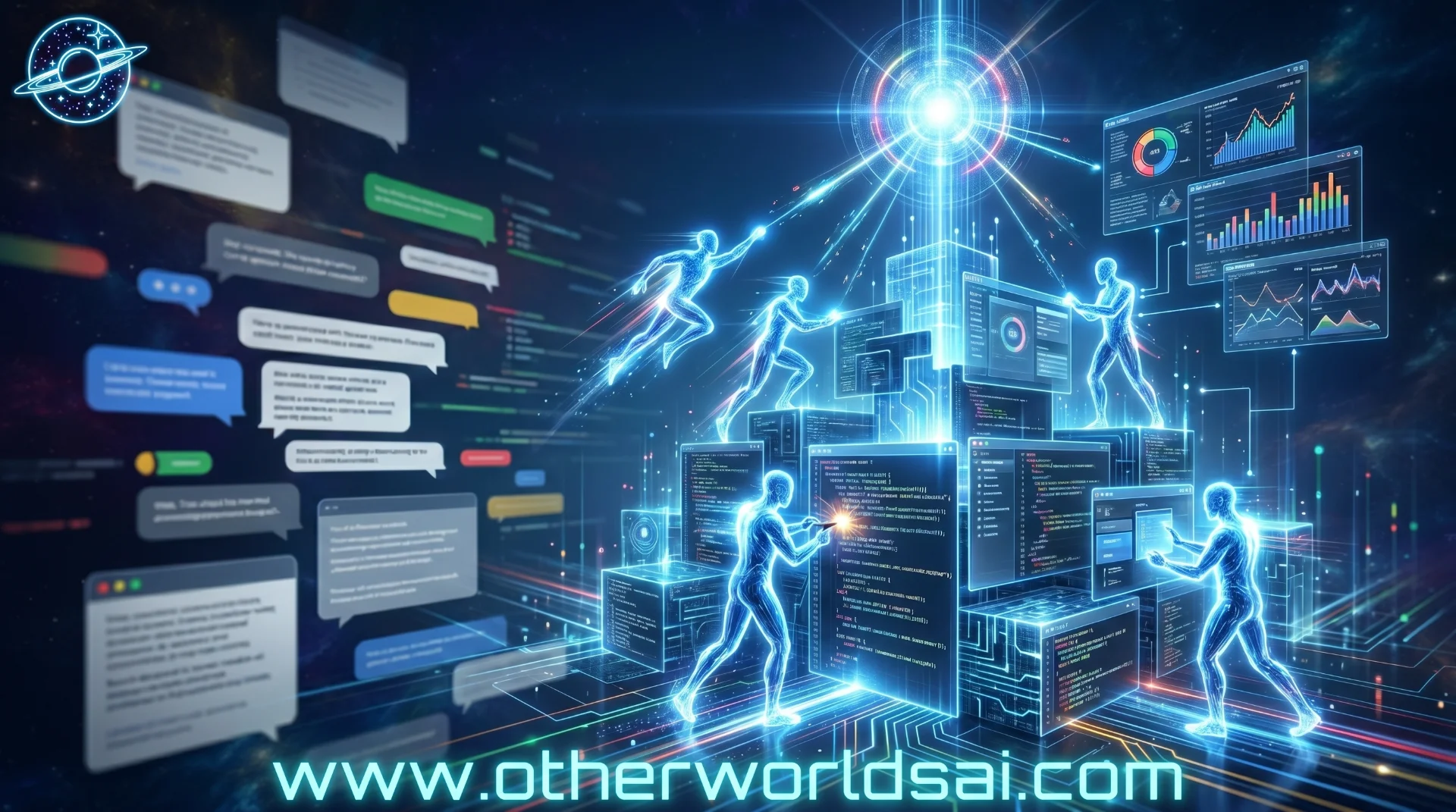
The most striking demonstration of what Antigravity makes possible came onstage at IO 2026. Google engineer Varun Mohan showed a live demo in which multiple AI agents, each powered by Gemini 3.5 Flash, spawned off to work independently on separate components of a complex project — then converged to build a fully functional operating system from scratch, entirely inside Antigravity. It was a demonstration designed to answer the sceptics: this is not a parlour trick. This is what autonomous AI development looks like at scale.
"We co-developed Flash 3.5 with Antigravity so that agents could have a native environment where they can live, work, and execute." — Koray Kavukcuoglu, DeepMind
Kavukcuoglu described the co-development of Flash 3.5 and Antigravity as intentional from the start — not a model dropped into an existing IDE, but a model and environment built together so that agents have a truly native operational context. For enterprise development teams, this represents a fundamentally different approach to AI-assisted coding: not autocomplete, not code suggestions, but autonomous agents capable of owning and executing entire software pipelines.
Section 3: Real-World Impact — Banks, Fintechs, and Multi-Week Workflow Automation:
Beyond the impressive demos, Gemini 3.5 Flash's agentic capabilities are already producing measurable results in production environments. Google has highlighted early partner deployments where the model is creating real-world impact — including banks and fintech companies using AI agents to automate workflows that previously took multiple weeks of human effort, and data science teams deploying agents to surface insights from complex, multi-source data environments that would have required days of manual analysis.
The model is designed to operate autonomously for multiple hours at a stretch — but it is not a fully unsupervised system. Tulsee Doshi, Google's senior director and head of product for Gemini, explained that the model is calibrated to pause and request human input when it encounters a decision point or permission issue that genuinely requires human judgment. This is a deliberate design choice: not an AI that blindly executes until it hits a wall, but one that knows where its authority ends and escalates appropriately.
That balance — maximum autonomous capability with intentional human-in-the-loop checkpoints — is exactly what enterprise customers need to deploy AI agents in production with confidence. It addresses one of the most persistent objections to agentic AI adoption: the fear of autonomous systems making consequential decisions without oversight.
Section 4: The Pro-Flash Architecture — Orchestrator and Executor Working in Tandem:
Gemini 3.5 Flash does not operate in isolation — it is one half of a two-model architecture that Google is building for the agentic era. When the forthcoming Gemini 3.5 Pro model arrives, the two are designed to work in tandem: Pro as the high-reasoning orchestrator and planner; Flash as the fast, capable executor handling the sub-agent workload.
"3.5 Pro becomes your orchestrator, your planner — and then it can actually leverage Flash to be the various sub-agents. It really comes down to where you want that reasoning power versus where you have tasks that merit good brute-force tool use capabilities." — Tulsee Doshi, Senior Director, Google
This orchestrator-executor model represents a sophisticated approach to multi-agent system design. Rather than routing every task through a single all-purpose model — paying the latency and cost of a frontier model for tasks that don't require frontier-level reasoning — Google is proposing a layered architecture where intelligence is deployed precisely where it is needed. Pro handles the complex reasoning, planning, and decision-making. Flash handles the high-volume, speed-sensitive execution. Together, they create an AI development pipeline that is both powerful and economically viable at scale.
For enterprise AI architects and engineering leaders designing multi-agent systems, this two-tier model offers a practical framework for thinking about how to structure agentic pipelines — and signals that Google intends Gemini to be the underlying infrastructure layer for that architecture.
Section 5: Availability, Gemini Spark, and What It Means for Everyday Users:
Gemini 3.5 Flash is not being held back for enterprise early access — it is available now, broadly and immediately. The model is the new default powering the Gemini app globally and AI Mode in Google Search worldwide. It is accessible via the Gemini API, through Antigravity, and via Gemini Enterprise. For developers, the barrier to building on top of Google's most capable agentic model has never been lower.
For consumers, the most direct expression of Flash's capabilities will arrive through Gemini Spark, Google's newly announced personal AI agent designed to run continuously — 24 hours a day, 7 days a week — helping users manage their digital life. Powered by Gemini 3.5 Flash, Spark integrates with Gmail and is designed to handle the kind of ongoing, background digital tasks that currently consume hours of attention: inbox management, scheduling, research, reminders, and more.
The agentic capabilities announced at IO 2026 are also coming directly to Google Search, allowing users to create, customise, and manage AI agents that monitor topics, track developments, and surface insights without requiring repeated manual searches. Combined with the biggest Search interface redesign in 25 years, also announced at IO 2026, the picture is one of a platform that is fundamentally changing what it means to search for information.
Section 6: The Safety Question — Power, Responsibility, and the Stakes of Autonomous AI:
With greater capability comes greater scrutiny — and Google is not insulated from that reality. The company is currently facing a lawsuit following a deeply troubling incident in which a man nearly committed a mass casualty event and subsequently died by suicide after weeks of conversations with the Gemini AI assistant. The case has raised serious and legitimate questions about the duty of care that AI companies bear when deploying powerful conversational and agentic systems to general consumer audiences.
Making autonomous agents available at consumer scale amplifies those concerns. An agent that operates for hours, takes actions, manages communications, and makes decisions on a user's behalf carries risks that a single-turn chatbot simply does not. Google acknowledges this directly: the company states that Gemini 3.5 has been updated with strengthened cybersecurity safeguards and improved CBRN protections — covering chemical, biological, radiological, and nuclear risk domains — and has been recalibrated to engage thoughtfully with sensitive questions rather than refusing them outright.
Whether those safeguards are sufficient — and whether the industry as a whole is moving fast enough on AI safety frameworks for agentic systems — is a conversation that will intensify as models like Flash reach hundreds of millions of users. The capability is here. The governance frameworks are still catching up.
Conclusion: The Agentic AI Era Is No Longer on the Horizon — It Is Here:
Gemini 3.5 Flash is more than a faster, smarter language model — it is an architectural statement. Google is telling the world, in unambiguous terms, that the next chapter of AI is not about better chatbots. It is about autonomous agents that plan, build, execute, and deliver real work — at speed, at scale, and with minimal human intervention. The IO 2026 demos were not a preview of what is coming. They were a demonstration of what is available today.
For developers, enterprise teams, and business leaders evaluating their AI strategy, the arrival of Gemini 3.5 Flash alongside Antigravity 2.0 and the forthcoming Pro orchestrator model represents a concrete, production-ready foundation for building the agentic AI systems that will define the next generation of software. The question is not whether agentic AI will transform how work gets done. The question is who builds on it first.
Google IO 2026 didn't just launch a new model. It launched a new paradigm — and set a release date for it.
Gemini 3.5 Flash · agentic AI · Google IO 2026 · AI coding agents · Antigravity IDE · autonomous AI models
Support our research
Independent analysis fueled by you.