
Google IO 2026: How Google Is Reshaping AI-Powered Productivity, Design, and Search:
Google Takes Aim at Canva With a Brand-New Collaborative AI Design Tool:
Gmail Live Unveiled: Google Will Soon Let You Talk Directly to Your Inbox:
Google's Most Ambitious IO Yet:
Google's annual developer conference, Google IO 2026, arrived not just as a product showcase — it arrived as a declaration of war. In a single keynote, the tech giant unveiled a sweeping AI-first vision that touches every layer of how people work, create, and stay informed. From a brand-new AI-powered design app taking direct aim at Canva, to a voice-powered conversational layer built into Gmail, to autonomous background agents that fundamentally reinvent what Google Search can do — IO 2026 signals that AI-powered productivity is no longer a promise. It is here, and the competition is fierce.
For anyone working in digital marketing, content creation, small business ownership, or knowledge work, these announcements are impossible to ignore. This is the complete breakdown of every major reveal — and what it means for the way you work starting this summer.
Section 1: Google Pics — AI Image Generation Meets Collaborative Design:
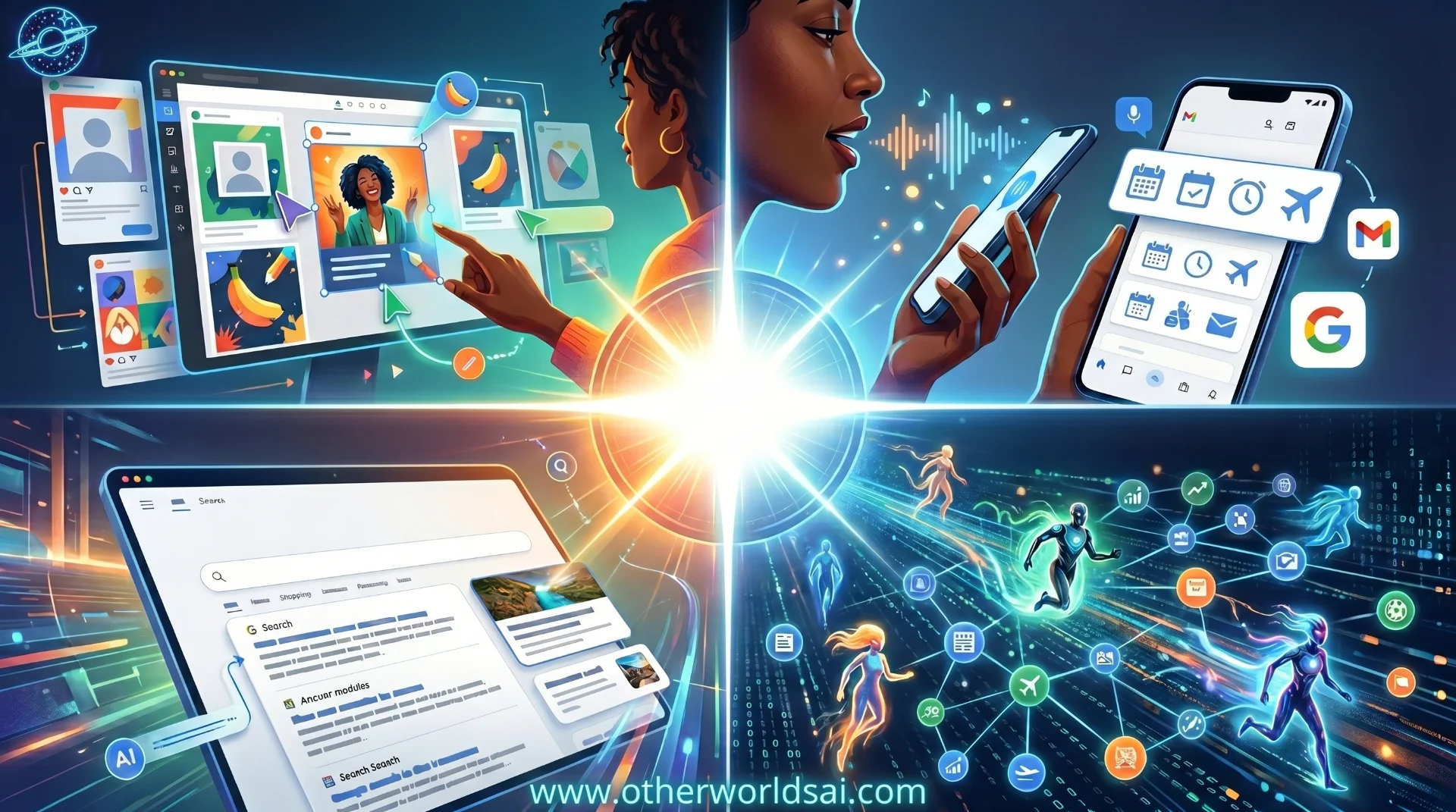
Google's most surprising IO 2026 announcement was Pics, a brand-new AI-powered design and image generation app built natively into Google Workspace. Designed to be accessible to teachers, small business owners, and marketing teams alike, Pics lets anyone create professional-quality visuals — social media graphics, event invitations, product mockups, and marketing materials — using nothing more than a simple text prompt. No editing skills required. No expensive software needed.
What sets Pics apart from every other AI image generation tool on the market is its answer to the industry's most persistent frustration: editability. Google openly acknowledged the limitation that has plagued AI image generators — getting an almost-perfect image is easy, but changing one small detail without regenerating the entire thing is still painfully difficult. Pics solves this by making every single element in a generated design fully adjustable.
Powered by Google's Gemini AI model, users can click any part of a generated image, leave a comment — just like leaving feedback in a Google Doc — and the AI updates only that element. Nothing else changes.
The app runs on Nano Banana 2, Google's model purpose-built for precise text rendering, real-world knowledge integration, and rich visual output. This technical foundation makes Pics particularly well-suited for branded content where accurate text placement and visual consistency are non-negotiable. Once satisfied, users can download, copy, print, share, or hand off their design for a final round of edits — all without leaving the Google ecosystem.
Google's entry into the AI-powered design space is a competitive milestone that the industry cannot ignore. Canva has long owned the 'design for non-designers' market. AI-native competitors like Anthropic's Claude Design have been chipping away at creative workflows. Now Google arrives with Pics embedded directly into Google Workspace — where millions of teams already collaborate daily — giving it a distribution advantage neither rival can easily match.
Pics is currently launching to a group of early testers at IO 2026 and will roll out broadly to Google AI Ultra subscribers this summer.
Section 2: Gmail Live — Talk to Your Inbox Like a Person:
If Pics is Google's play for creative professionals, Gmail Live is its gift to everyone else. Announced at IO 2026 and detailed by Gmail product lead Devanshi Bhandari, Gmail Live is a voice-powered AI feature that lets users ask their inbox natural language questions — out loud — and receive accurate, contextually aware answers in real time. It is one of those features that sounds obvious in hindsight and makes you wonder why it took this long.
The pain point it solves is universal and deeply familiar. Finding a specific email has always been clumsy — typing keywords into a search bar that doesn't always understand what you mean, scanning through threads hoping the right one surfaces. Gmail Live replaces that friction entirely with conversation.
Need your hotel room number for an upcoming trip? Just ask. Want to know your child's class trip departure time from a permission slip buried weeks back? Ask. Gmail Live understands nuance, handles follow-up questions, and can pivot topics mid-conversation without losing its thread.
"Gmail Live can answer naturally phrased questions, respond to follow-up questions, and pivot if you need to interrupt it." — Devanshi Bhandari, Gmail Product Lead In live demos at IO 2026, Gmail Live navigated fluidly between topics — distinguishing between a 'field trip' and a 'trip,' inferring which people were being referenced even when names weren't mentioned, and surfacing granular details like hotel room numbers from deep within email threads. It even understands context well enough to pull information about people you're referencing without needing their exact name.
Critically, Gmail Live is an addition to existing Gmail search — not a replacement. Google appeared to absorb a hard lesson from its controversial AI-only Google Photos update, which drew significant backlash and was eventually rolled back. Gmail Live is positioned as an optional, opt-in assistant layer sitting alongside the search interface users already know. The choice remains with the user.
Gmail is gaining a suite of complementary AI capabilities alongside Live: ready-to-send draft suggestions, instant file access from within emails, and the ability to mark individual to-do items as done directly from the inbox. Google Keep is receiving similar voice-powered upgrades. The AI Inbox overview — previously restricted to Google AI Ultra subscribers — will expand to Pro and Plus tiers. Gmail Live itself rolls out to Ultra subscribers first, later this summer.
Section 3: AI Information Agents — Google Search Goes Autonomous:
Perhaps the most forward-looking announcement at IO 2026 was the reveal of Google's AI information agents — a fundamental reimagining of what a search engine is capable of. Rather than waiting to be asked, these agents operate continuously in the background, monitoring topics of interest around the clock, synthesising new information as it emerges, and proactively alerting users when something significant happens. You don't have to search. The search comes to you.
Think of them as a dramatically evolved successor to Google Alerts, the notification service Google launched back in 2003. Where Alerts sent a simple link when a keyword appeared online, information agents go several layers deeper: they synthesise information across multiple sources, explain why a development matters, compare competing perspectives, and surface actionable insights — all without the user lifting a finger.
Instead of delivering a list of links, the agents synthesise information, explain why something matters, compare perspectives, and provide actionable insights — operating continuously, 24/7.
The practical use cases are broad and immediately compelling. An investor could deploy an agent focused on specific stocks, earnings reports, or macroeconomic indicators — receiving real-time summaries when markets shift. A traveller could set an agent to track flight prices without repeatedly checking booking sites. A job seeker could monitor hiring trends. A sports fan could track live match updates. A journalist could follow a breaking story across multiple outlets simultaneously. The agents handle all of it — continuously, intelligently, silently.
To activate an information agent, users simply open AI Mode in Google Search and enter a prompt — for example: 'Keep me updated on nearby movie tickets for The Mandalorian and Grogu.' When relevant updates appear, the Google app sends a push notification. All active agents appear in AI Mode history, where they can be refined, paused, or deactivated at any time.
Information agents will begin rolling out this summer, first to Google AI Pro and Ultra subscribers in the United States, with additional markets to follow.
Section 4: Google's Biggest Search Redesign in 25 Years:
Alongside the information agents launch, Google announced what it describes as its most significant Search redesign in more than 25 years — a complete rethinking of the interface that has barely changed since 1998. The centrepiece is a reimagined intelligent search box built to support longer, more conversational queries. The era of two-to-five keyword searches is being deliberately phased out in favour of natural language that reflects how people actually think and speak.
Complementing the new interface is an AI-powered query suggestion system that goes well beyond traditional autocomplete. Rather than predicting the next word, the new system helps users craft nuanced, context-aware searches — essentially acting as a coach that helps people ask better questions and receive richer answers. For SEO professionals and content strategists, the implications are significant: search intent is becoming conversational, and content strategies will need to follow suit or risk falling behind.
Section 5: What Google IO 2026 Means for Businesses and Creators:
Taken together, the announcements at Google IO 2026 paint an unmistakable picture of where AI-powered productivity is heading. The era of AI as a standalone chatbot is over. What's replacing it is AI as an embedded, always-on intelligence layer woven across every tool people already use daily — design, email, research, discovery. These are no longer separate apps. They are capabilities built into the infrastructure of work itself.
For small businesses, content creators, and knowledge workers, the practical implications are immediate. Pics removes the cost and skill barrier to professional-quality visual content. Gmail Live eliminates the time wasted hunting through inboxes. Information agents replace hours of daily manual research with proactive, curated intelligence delivered to your phone. The Search redesign promises that finding what you need — in plain language, on any topic — is about to become dramatically faster.
Google IO 2026 is equally a competitive signal to the broader AI industry. With Pics in the market, pressure intensifies on Canva, Adobe Express, and AI-native design startups. With Gmail Live and information agents deeply embedded in Google's ecosystem, rivals like Microsoft Copilot and OpenAI's assistant integrations face a significant distribution challenge. Google's advantage has never been just its AI — it is the billions of people who already live inside its products every single day.
Conclusion: The AI-Powered Productivity Era Has Arrived:
Google IO 2026 was more than a product launch — it was a statement. AI-powered design, AI email assistants, autonomous AI search agents, and conversational AI tools are no longer experiments or roadmap items. They are the new foundation of Google's core products, and they are arriving in people's hands this summer.
The question for every business, creator, and professional is no longer whether AI will transform how they work. It is how quickly they will adapt to a world where the tools they use every day — Search, Gmail, design software — have fundamentally changed. With Pics, Gmail Live, and information agents rolling out across Google AI Pro and Ultra subscriptions starting this summer, that window is narrower than most people realise.
Google IO 2026 didn't just show us the future of AI productivity. It set a shipping date for it.
AI design tools · Gmail AI · Google Search AI agents · Google Workspace AI · Gemini 2026
Anthropic’s Surprise Double Launch Directly Targets OpenAI and Google’s AI Dominance
Support our research
Independent analysis fueled by you.