
Nvidia's $200B Agentic AI Revolution: How Jensen Huang Is Reshaping the Future of Computing:
Meet Vera: Nvidia’s Brand-New CPU Built Entirely for Agentic AI:
Nvidia CEO Jensen Huang unveils a brand-new $200 billion TAM with the Vera CPU, posts record $81.6B revenue, and doubles down on AI infrastructure — signaling a pivotal shift in the global AI chip market.
Introduction: The Relentless Rise of Nvidia's AI Empire:
Few technology leaders have matched Jensen Huang's track record of turning bold proclamations into quarterly realities. Nvidia's founder and CEO has long been hailed as the semiconductor industry's most compelling visionary — a leader who doesn't just set expectations but consistently exceeds them. In a week that saw the company report record-breaking revenues and unveil a landmark new product category, Huang delivered what may be his most significant strategic announcement yet: a brand-new $200 billion total addressable market (TAM) for Nvidia — a market it has never touched before.
This dual announcement — a historic earnings beat paired with a sweeping agentic AI strategy — positions Nvidia not just as the dominant force in GPU computing, but as the architect of an entirely new AI computing paradigm. For investors, technologists, and enterprise leaders watching the AI chip market, this is a watershed moment.
Record-Breaking Q1 2025 Earnings: Nvidia Sets New Financial Benchmarks:
Nvidia's latest quarterly results shattered expectations across every key financial metric. For the quarter ending April 26, 2025, the company reported $81.6 billion in total revenue — a 20% increase from the previous quarter — along with a record $75.2 billion in data center revenue. The strength of these figures prompted the company to authorize $80 billion in share repurchases, signaling deep confidence in long-term growth.
The company's Blackwell GPU architecture continues to serve as the engine driving this explosive growth. As CFO Colette Kress confirmed on the earnings call: "Our Blackwell architecture is everywhere, adopted and deployed by every major hyperscaler, every cloud provider, and every major model maker." Looking ahead, Nvidia is forecasting $91 billion in revenue for the next quarter — a projected 12% sequential growth that, while a moderation from recent triple-digit gains, underscores sustained institutional demand for AI infrastructure.
On the geopolitical front, Nvidia's management addressed China export uncertainty head-on. Despite H200 GPUs being cleared for U.S. export, CFO Kress confirmed that Nvidia has "yet to generate any revenue" from China, adding that the company remains "uncertain whether any imports will be allowed." This candid disclosure reflects the complex regulatory environment surrounding advanced AI chips — a dynamic that could reshape the global AI semiconductor supply chain in the months ahead.
The $43 Billion Startup Portfolio: Nvidia's Strategic Bet on the AI Ecosystem:
Perhaps the most surprising revelation from Nvidia's latest filing was the dramatic expansion of its stakes in privately held AI companies. The company's non-marketable equity securities — essentially its portfolio of private startup investments — nearly doubled in a single quarter, growing from $22 billion to $43 billion, driven by $18.5 billion in new purchases over just three months. This compares to a modest $649 million in equivalent purchases the prior quarter, marking a staggering 28x increase in private investment activity.
These figures don't even account for Nvidia's publicly announced commitments to major AI players. The company pledged $30 billion to OpenAI in February 2025, and has also made strategic investments in publicly traded companies including Corning and IREN. Taken together, Nvidia's investment activity signals a deliberate strategy to embed itself into every layer of the AI value chain — from infrastructure chips to frontier model development to enterprise AI deployment.
The pending buildout with Anthropic, referenced directly by Huang, further illustrates this approach. "The amount of capacity we're going to bring online for Anthropic this year and next year is going to be quite significant," Huang told investors. "Our coverage for Anthropic had been largely zero until this." For the generative AI infrastructure ecosystem, Nvidia is fast becoming not just a supplier, but a foundational strategic partner.
Vera CPU: Nvidia Enters the $200B Agentic AI Market:
The most strategically significant announcement from Nvidia this week was not an earnings figure — it was the commercial rollout of Vera, the company's purpose-built agentic AI CPU. Introduced in March 2025 and now generating real revenue, Vera represents Nvidia's first serious bid to capture a CPU market it has historically left to Intel and AMD. More importantly, it targets an entirely new computing workload: the autonomous operation of AI agents at scale.
Jensen Huang positioned Vera as the world's first CPU architecturally designed for the demands of agentic AI workflows. Unlike traditional cloud CPUs built around "cores" — optimized for running multiple app instances simultaneously — Vera is engineered to process tokens as fast as possible. This distinction matters enormously in the context of how modern AI agents operate: they don't just run inference; they autonomously execute multi-step tasks, consume context, and call tools — all of which are token-driven operations.
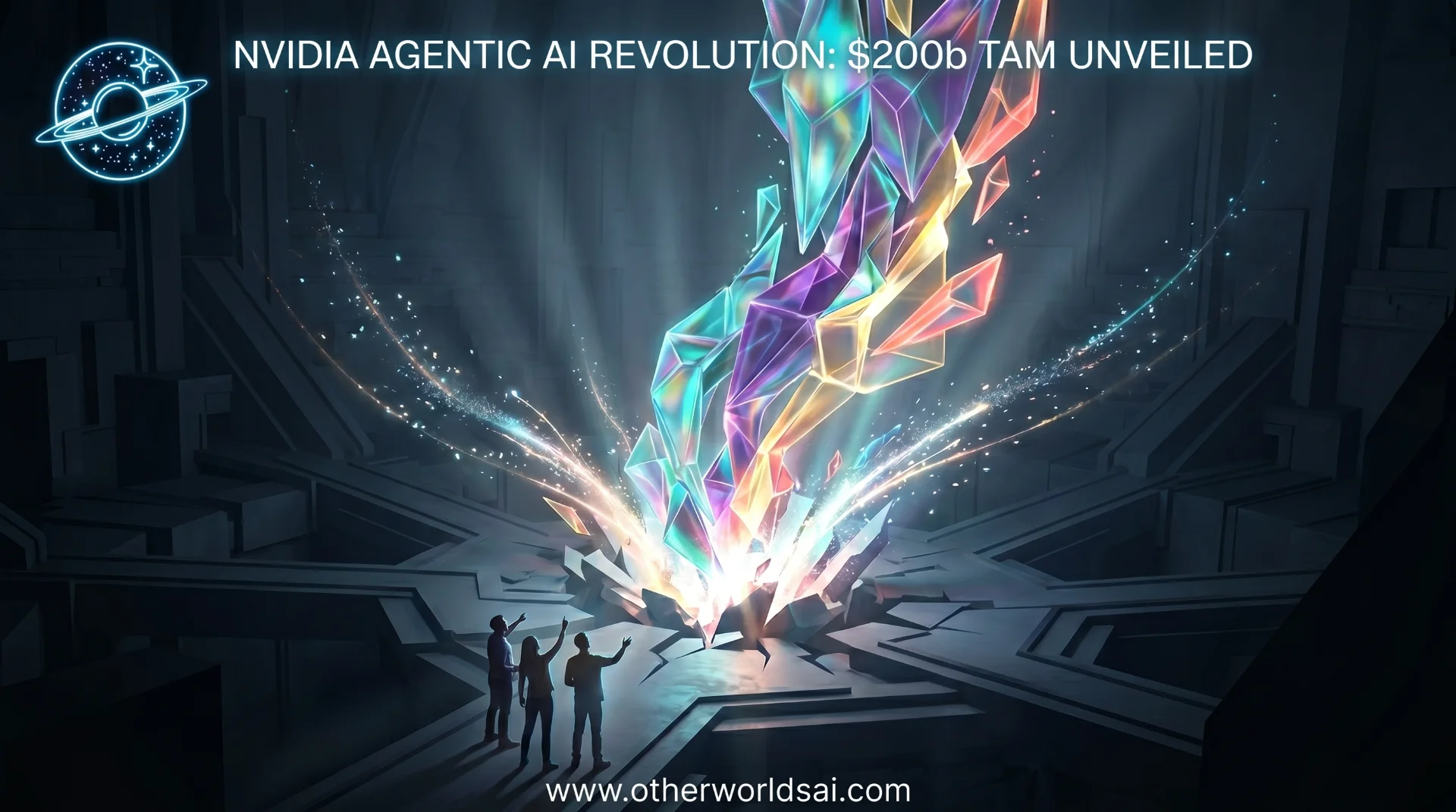
The market opportunity, by Huang's own assessment, is staggering. "Vera opens a brand new $200 billion TAM for Nvidia, a market we have never addressed before, and every major hyperscaler and system maker is partnering with us to deploy it," Huang declared. While such proclamations from any other CEO might invite skepticism, Huang's consistent delivery on ambitious forecasts has earned him an unusual degree of market credibility.
Crucially, Vera is already demonstrating commercial traction. Nvidia has reportedly sold $20 billion worth of standalone Vera CPUs in 2025 alone — a figure that, if accurate, would make this one of the fastest product ramps in semiconductor history. Vera is also sold bundled with Nvidia's Rubin GPU, creating a compelling end-to-end AI infrastructure package for hyperscalers and enterprise system builders.
The Agentic AI Economy: Billions of Agents, Trillions in Infrastructure:
To understand why Vera matters, it's essential to grasp Huang's broader vision for the agentic AI economy — and the sheer scale of computing infrastructure it demands. Speaking on the earnings call, Huang articulated a future in which AI agents don't just assist humans — they operate independently at planetary scale, each running on dedicated compute.
"The world has a billion users — human users," Huang explained. "My sense is that the world is going to have billions of agents. And those billions of agents will all use tools. And those tools are going to be like PCs, just like us humans using PCs today." In this model, every AI agent requires its own computational substrate — its own form of CPU-driven infrastructure — creating demand that could dwarf today's PC market in scale.
This framing redefines how the industry should think about AI compute demand. If every human needs a personal computer, and every AI agent needs a comparable processing unit, then the addressable market for agentic CPUs isn't measured in millions of units — it's measured in billions of endpoints. Nvidia, with Vera purpose-built for this workload and already shipping to every major hyperscaler, is positioning itself to own this emerging category of AI agent infrastructure.
Competitive Landscape: Can Nvidia Fend Off AWS, Intel, and Custom Silicon?
Not everyone is ceding the CPU agentic AI market to Nvidia without a fight. Amazon Web Services recently announced a massive contract with Meta for millions of Amazon's homegrown AI CPUs, with CEO Andy Jassy asserting that AWS can develop AI chips — both GPUs and CPUs — at least as well as, and possibly better than, Nvidia. Meanwhile, startups and other hyperscalers continue to pour resources into custom AI silicon development, seeking to reduce dependence on any single chip vendor.
Yet Nvidia's competitive moat extends well beyond silicon design. The CUDA software ecosystem, years of developer tooling investment, deep hyperscaler partnerships, and now a co-packaged CPU+GPU offering via Vera + Rubin all create substantial switching costs. Nvidia's claim that "every major hyperscaler and system maker" is already partnering to deploy Vera — if borne out by continued revenue figures — would suggest a level of platform lock-in that rivals find extremely difficult to displace.
The $20 billion in Vera sales already recorded in 2025 adds a powerful data point to this competitive narrative. Momentum in the AI chip market tends to be self-reinforcing: developers build for the platform with the largest install base, which attracts more customers, which deepens the moat. Nvidia appears to be executing this same flywheel in the emerging agentic AI CPU market.
What This Means for Enterprise AI and the Global AI Infrastructure Build-Out:
For enterprise decision-makers, the convergence of Nvidia's earnings results and its agentic AI strategy carries clear implications. The transition to agentic AI architectures is accelerating faster than most enterprise roadmaps anticipated. Organizations investing in AI-powered automation, autonomous workflows, and multi-agent systems will increasingly need to plan not just for GPU infrastructure, but for the purpose-built CPU layer that powers agent execution.
Nvidia's investment in the broader AI ecosystem — from OpenAI to Anthropic to its $43 billion startup portfolio — also signals that the company sees itself as a long-term infrastructure partner, not merely a chip supplier. This positions Nvidia to benefit from every layer of enterprise AI adoption: from training large language models on Blackwell GPUs to running fleets of autonomous agents on Vera CPUs to investing in the AI companies that will build the applications running on that hardware.
The global AI infrastructure build-out, already measured in hundreds of billions of dollars annually, shows no signs of deceleration. With Blackwell "everywhere" according to Nvidia's own CFO, and Vera now carving out a new $200 billion market opportunity, the company is executing a multi-front expansion strategy that few competitors are positioned to match in scope or speed.
Conclusion: Nvidia's Next Trillion-Dollar Chapter Begins:
Jensen Huang has once again reframed the conversation around Nvidia's growth trajectory — not by defending existing market share, but by opening entirely new frontiers. The Vera CPU launch, the record $81.6 billion quarter, the $43 billion startup portfolio, and the deepening strategic partnership with AI leaders like Anthropic and OpenAI collectively paint the picture of a company at the center of the most significant computing transition in a generation.
The era of agentic AI is not a distant forecast — it is an unfolding infrastructure reality. And with Nvidia sitting, as Huang put it, "at the center of these transitions," the company's next chapter may be its most consequential yet.
For those tracking the future of AI computing, GPU market leadership, and the next wave of enterprise AI investment, the signals from Nvidia this week could not be clearer: the agentic AI economy is here, and Nvidia intends to build the computers it runs on.
Support our research
Independent analysis fueled by you.