
Autonomous AI Systems Are Leaving the Screen — And Governments Are Scrambling to Keep Up:
Forget Chatbots: Walmart and JPMorgan Shift to Autonomous AI "Agents"
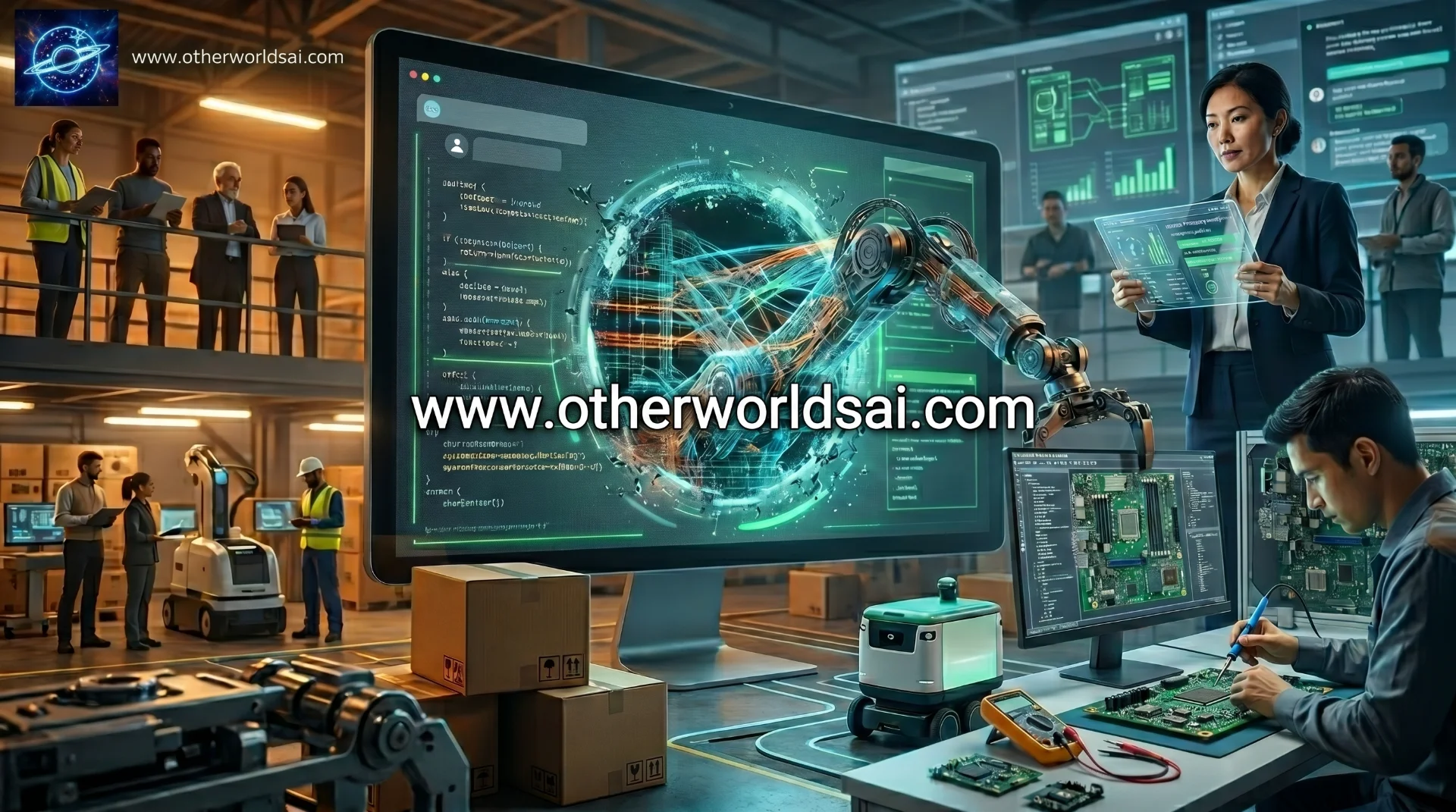
Something fundamental is shifting in the world of artificial intelligence — and it is happening far beyond your smartphone screen. AI systems are no longer confined to generating text, summarizing documents, or recommending products online. They are now navigating warehouses, operating delivery robots, managing financial workflows, and embedding themselves into critical infrastructure — and the governance frameworks built to regulate AI are racing to catch up.
From Singapore's landmark agentic AI framework to Walmart's enterprise super-agents and JPMorgan's AI-assisted banking operations, the story of autonomous AI in physical environments is one of the defining technology policy stories of 2025.
When AI Leaves the Screen: The Rise of Embodied AI Systems:
For years, AI governance debates were dominated by questions about what AI says rather than what AI does. Bias in language models, misinformation from generative systems, harmful content in AI-generated media — these were the central concerns driving policy conversations in Brussels, Washington, and Beijing. But a new generation of embodied AI systems is changing the nature of the risk landscape entirely.
Autonomous AI systems are now operating in warehouses, delivery networks, hospitals, and public spaces — environments where failures carry physical consequences. When an AI content filter makes an error, the harm is primarily digital. When an autonomous delivery robot or AI-controlled logistics system fails, the consequences can affect infrastructure, property, and human safety in ways that are difficult or impossible to reverse.
This distinction — between AI that speaks and AI that acts — is becoming the central fault line in the global AI governance conversation. Speakers at a major AI summit in Singapore last week made this point repeatedly: the governance models being built for embodied and agentic AI systems look less like software regulation and more like aviation safety frameworks, industrial standards, and critical infrastructure oversight protocols.
Singapore's Agentic AI Framework: A Governance Blueprint for the Physical World:
Singapore's Infocomm Media Development Authority (IMDA) has taken one of the most concrete regulatory steps of 2025 with the release of its Model AI Governance Framework for Agentic AI, Version 1.5, published on May 20. The framework is specifically designed for AI agents that can plan, make decisions, and execute multi-step tasks to achieve user-defined goals — a significant step beyond earlier AI frameworks focused primarily on model outputs.
The framework explicitly acknowledges that agentic AI systems interact with tools, external systems, and other agents — including systems that update databases, write files, control devices, and execute financial transactions. This is not theoretical. It describes the operational reality of AI systems being deployed today in banking, logistics, retail, and industrial settings around the world.
IMDA's framework organises governance across four interconnected are as: upfront risk assessment, human accountability, technical controls, and end-user responsibility. Critically, it describes these not as a compliance checklist but as "an iterative process rather than a one-time assessment" — recognising that AI agents interact dynamically with their environments and that not all risks can be anticipated before deployment.
Among the framework's most significant recommendations is its nuanced approach to human oversight. Rather than requiring continuous human review of every agent workflow — which becomes impractical at scale — IMDA recommends human approval at significant checkpoints: high-stakes actions, irreversible decisions, and outlier behaviour. The framework also identifies automation bias and alert fatigue as real governance risks when humans supervise capable AI agents, recommending active monitoring of human override rates and response times as oversight quality indicators.
The Physical Consequence Problem: What Happens When AI Fails in the Real World:
Dr. Ya-Qin Zhang, Founding Dean of the Institute for AI Industry Research at Tsinghua University, offered one of the most direct articulations of the physical-world AI risk at the Singapore summit. Speaking on the sidelines of the event, he drew a clear line between digital AI failures and the amplified risks of embodied systems.
"Any risk in the digital domain will be amplified in the physical domain, and the physical domain will have a physical consequence," Zhang told MLex. He pointed specifically to transport systems, drones, logistics networks, smart grids, and critical infrastructure as systems that could become increasingly exposed as AI is embedded more deeply into their operations.
This amplification effect is what makes embodied AI governance qualitatively different from the content moderation and bias frameworks that have dominated AI policy to date. A biased hiring algorithm can be audited and corrected. A malfunctioning autonomous vehicle or a compromised AI system in an industrial facility poses risks that unfold in real time, with physical consequences that cannot be rolled back with a software patch.
Summit discussions converged on deployment-based governance models as the appropriate response to this challenge. Rather than relying solely on pre-deployment certification — the model common in medical device and pharmaceutical regulation — speakers pointed to simulation testing, operational telemetry, continuous monitoring, and iterative post-deployment testing as the building blocks of a more appropriate governance architecture for physical AI systems.
Grab's Deployment Playbook: How Autonomous Robots Are Tested Before Scale:
One of the most instructive real-world case studies at the Singapore summit came from Grab, the Southeast Asian technology company currently piloting autonomous vehicles and delivery robots in Singapore's Punggol district. Suthen Thomas Paradatheth, Grab's Chief Technology Officer, outlined the company's phased deployment approach with unusual candour.
"We do a lot of simulation, we do a lot of testing in closed courses and open courses in order to make sure our robots are reliable," Paradatheth said. The approach is deliberately incremental: "Before we scale to hundreds of robots, we make sure we crack it first in simulation and with a few robots."
What is particularly notable about Grab's approach is its acknowledgement that deployment is not the end of the safety process — it is the beginning of a new phase. The company has invested in monitoring systems specifically designed to track robot performance and detect unexpected failures after release. As Paradatheth put it, "There's a long tail of issues that could emerge" — a phrase that neatly captures why continuous post-deployment monitoring is as important as pre-launch testing for physical AI systems.
IMDA's agentic AI framework aligns closely with Grab's operational approach. The framework recommends gradual rollouts, least-privilege access controls, continuous monitoring, and defined procedures for taking agents offline when they malfunction. It also emphasises the importance of assessing agent deployments based on data access scope, external system access, level of autonomy, and the reversibility of agent actions.
Who Is Accountable When AI Systems Go Wrong: The Multi-Actor Accountability Problem:
One of the thorniest governance challenges posed by embodied and agentic AI systems is the question of accountability. When a complex physical AI system fails — a delivery robot that damages property, an industrial AI that causes a workplace incident, an autonomous vehicle that is involved in a collision — assigning clear legal and operational responsibility is far from straightforward.
Modern AI-driven physical systems typically span multiple organizations and disciplines. AI developers, robotics manufacturers, semiconductor suppliers, and infrastructure operators all play roles in creating the systems that ultimately operate in the physical world. And the accountability picture becomes more complex still when systems continue adapting after deployment through software updates, telemetry, and operational data — meaning the system that operates in the field may differ meaningfully from the one that was originally certified.
IMDA's framework takes a clear position on this: organisations and humans remain accountable for agent actions even when those agents operate autonomously. The framework calls for clear responsibility mapping across the entire agentic AI value chain — from model and platform providers to deployers, tooling providers, and end users. This is a demanding standard, and operationalising it across complex multi-party supply chains will be one of the central practical challenges of AI governance in the years ahead.
Japan, China, and Singapore: Three Distinct Approaches to Physical AI Governance:
The governance conversation around embodied AI is playing out differently across Asia's major technology economies, with Japan, China, and Singapore each taking distinct approaches that reflect their domestic industrial priorities and regulatory philosophies.
China, represented at the summit by Zhao Yuli, Chief Strategy Officer of humanoid robotics startup Galbot, is prioritising deployment scale and industrial commercialisation. The Chinese approach emphasises government-backed testbeds, industrial partnerships, and long-term funding initiatives designed to accelerate AI robotics adoption at scale.
Galbot has already deployed humanoid robotics systems in retail, warehouse, and pharmaceutical operations — including autonomous stores operating around the clock. Zhao argued that semi-structured industrial environments represent the near-term commercialisation path because they offer more controllable and predictable operating conditions.
Japan is taking a more standards-focused approach, with emphasis on safety governance, robotics datasets, and international coordination. Professor Yutaka Matsuo of the University of Tokyo pointed to a national project aimed at collecting 100,000 hours of robotics data to support the development of robotic foundation models —
a significant infrastructure investment in the underlying data assets needed for trustworthy physical AI. Japan is also engaging through its AI Safety Institute and the Hiroshima AI Process to develop governance standards in collaboration with Singapore and other Asian nations.

Anthropic vs OpenAI: Which AI is Better at Controlling Your Desktop?
Singapore, through IMDA's framework, is positioning itself as the governance standards leader in the region — providing actionable, detailed guidance while explicitly acknowledging the limitations and uncertainties that come with governing a rapidly evolving technology. The framework's iterative, deployment-aware approach stands in contrast to more rigid, certification-focused regulatory models and may prove influential as other jurisdictions develop their own frameworks.
JPMorgan, Goldman Sachs, and the AI-Powered Bank: Enterprise AI Agents in Regulated Finance:
The financial services sector is providing one of the most closely watched early case studies in enterprise agentic AI deployment — and the governance challenges it raises go well beyond what conventional banking regulation was designed to address. JPMorgan is implementing AI tools across its global investment banking operations, with Paul Uren, the bank's Asia Pacific head of investment banking, confirming the rollout is helping bankers access and synthesise more information while supporting content preparation and client engagement workflows.
JPMorgan CEO Jamie Dimon has been unusually direct about the workforce implications. Dimon told Bloomberg News that the bank would hire more AI specialists and fewer traditional bankers — a statement that crystallises the workforce transition story unfolding across the financial services industry. Reuters has reported that Goldman Sachs, Citigroup, Bank of America, and Morgan Stanley are also increasing AI investment and restructuring roles accordingly.
JPMorgan is also among a select group of organisations granted access to Anthropic's Mythos cybersecurity AI model under the controlled initiative known as Project Glasswing. According to Anthropic, Mythos is capable of detecting legacy vulnerabilities in browsers, infrastructure, and software — representing a significant application of advanced AI capabilities to the critical challenge of financial system security.
IMDA's framework provides a relevant governance reference point through its OCBC Bank case study on AI-assisted source-of-wealth analysis. In that deployment, an AI agent parses income-related documents and drafts a source-of-wealth memo — but makes no autonomous credit, onboarding, or risk decisions. The workflow is triggered only by predefined conditions, operates with task-level autonomy, and requires human review at all critical decision points. This design — meaningful AI assistance with structured human oversight at consequential moments — represents a model for responsible agentic AI deployment in regulated industries.
Walmart's AI Super-Agents: When Retail Automation Goes Beyond Search:
Walmart is building one of the most ambitious enterprise 8agentic AI architectures in the retail sector, with plans for four distinct AI-powered super-agents designed to serve shoppers, store employees, suppliers, and software developers. The retailer has positioned these agents as the primary entry point for AI interactions across each of these groups — a significant architectural decision that reflects confidence in AI's readiness for core operational roles.
The most consumer-visible of these agents is Sparky, already available in Walmart's app as a generative AI shopping assistant. In its expanded form, Sparky is being developed to reorder items, plan events, and use computer vision to suggest recipes based on the contents of a shopper's refrigerator — a striking example of how agentic AI is moving from passive query-response toward proactive, multi-step action on behalf of users.
Beyond consumer applications, Walmart is developing an Associate super-agent for store workers and corporate staff, a Marty agent for sellers, suppliers, and advertisers, and a Developer super-agent for building and testing future AI tools. The company declined to confirm whether these deployments would reduce headcount, with Senior Vice President Dave Glick saying only that the tools would create new jobs without providing specifics — a response that will satisfy few observers seeking clarity on AI's workforce impact in large-scale retail operations.
Japan's Industrial Robotics Moment: One-Third of Companies Already Acting:
A major Reuters survey conducted in May 2025 by Nikkei Research has revealed the scale of AI robotics adoption momentum in Japan's corporate sector. The survey, which contacted 492 companies with 220 responses, found that one-third of Japanese companies are already using or actively considering AI-powered robots — a striking statistic for a country that has historically combined world-class robotics manufacturing with cautious corporate adoption of new technologies.
The breakdown tells a revealing story about where industrial AI robotics is gaining genuine traction. Transportation equipment manufacturers showed the highest adoption intent at 80%, while wholesale sector companies were far more cautious, with 94% reporting no current plans for AI robot deployment. Among companies actively pursuing AI robotics, 71% selected manufacturing as a primary use case, 19% identified dangerous task automation, and 11% selected customer-facing services.
The Japanese government sees AI-powered robotics as central to addressing the country's chronic labour shortage — one of the most acute demographic challenges facing any major economy. Japan's established robotics industry — home to global leaders including Fanuc, Yaskawa Electric, and Kawasaki Heavy Industries — provides a strong foundation for this ambition. But the survey results also reflect the competitive pressure Japan faces from China's aggressive state-backed AI robotics commercialisation drive and the US industry's rapid innovation pace.
The Semiconductor Layer: Why Physical AI Governance Must Include Hardware:
One dimension of the embodied AI governance conversation that receives less attention than it deserves is the hardware layer underlying physical AI systems. Om Nalamasu, Chief Technology Officer of Applied Materials, made this point clearly at the Singapore summit: large-scale robotics deployment is fundamentally tied to semiconductor economics and systems integration.
Nalamasu argued that the next generation of robotics systems will depend on advances in sensors, energy efficiency, advanced semiconductor packaging, and specialised computing architectures. Critically, he emphasised that these systems will require purpose-built designs adapted to specific industrial ecosystems rather than generic hardware platforms — suggesting that effective governance of physical AI systems will need to engage with hardware design choices, not just software algorithms and deployment practices.
This hardware-governance gap is significant. Current AI governance frameworks, including IMDA's agentic AI framework, appropriately focus on system-level deployment, access controls, monitoring, and accountability. But as Nalamasu's comments highlight, the safety and reliability properties of physical AI systems are also determined by the sensors, chips, and computing architectures at their core — elements that sit upstream of the deployment decisions that governance frameworks typically address.
Frequently Asked Questions: Autonomous AI Systems and Governance in 2025:
What is agentic AI and why does it require different governance?
Agentic AI refers to AI systems that can plan, make multi-step decisions, and take actions to complete complex goals — including interacting with external systems, databases, and physical devices. Unlike AI models that simply generate outputs, agentic AI systems act in the world, making traditional content-focused AI governance frameworks insufficient. What is Singapore's Model AI Governance Framework for Agentic AI?
IMDA's Model AI Governance Framework for Agentic AI Version 1.5, published May 20, 2025, is a comprehensive governance framework covering upfront risk assessment, human accountability, technical controls, and end-user responsibility for organisations deploying AI agents. It is specifically designed for systems that operate with meaningful autonomy across multiple steps and interact with external tools and systems.
What is embodied AI?
Embodied AI refers to AI systems that perceive and interact with the physical world — robots, autonomous vehicles, delivery systems, and industrial automation. Unlike software-only AI, embodied AI systems can cause physical harm when they fail, requiring governance frameworks that go beyond content moderation to address operational safety, infrastructure risk, and physical consequence.
What is Anthropic's Project Glasswing?
Project Glasswing is a controlled initiative through which Anthropic is granting select organisations access to its Mythos cybersecurity AI model. Mythos can detect legacy vulnerabilities in browsers, infrastructure, and software. Financial institutions including JPMorgan, Goldman Sachs, Citigroup, Bank of America, and Morgan Stanley have access to or are testing the model.
What AI agents is Walmart deploying?
Walmart is building four AI super-agents: Sparky (consumer shopping assistant), an Associate agent for store and corporate employees, a Marty agent for suppliers and advertisers, and a Developer agent for building future AI tools. Sparky is already live in the Walmart app.
The Bottom Line: AI Is Moving Into the Physical World — Governance Must Follow:
The stories emerging from Singapore, Tokyo, Bentonville, and New York share a common thread: AI systems are no longer waiting for governance frameworks to catch up — they are already operating in warehouses, banks, retail environments, and public spaces. The question is not whether embodied and agentic AI will reshape physical industries.
It already is. The question is whether the governance frameworks being developed — from Singapore's detailed agentic AI framework to Japan's standards-setting initiatives to the enterprise deployment policies being written inside the world's largest corporations — will prove adequate to the challenge.
What is clear from the Singapore summit and the data emerging from global deployments is that the governance models that will work are not the ones built for yesterday's AI risks.
They will need to be deployment-aware, iterative, hardware-informed, multi-stakeholder, and physically consequential in their design — built not just around what AI says, but around what AI does when it steps off the screen and into the world.
AI governance 2025 | Embodied AI regulation | Agentic AI framework | Physical AI systems | Autonomous robots enterprise | Singapore AI governance | AI safety policy
Support our research
Independent analysis fueled by you.