World Leaders Want American AI — But Not America's Off Switch: The G7 AI Sovereignty Crisis:
The Anthropic Export Ban: A Wake-Up Call for Enterprise AI Resilience:
The Anthropic Mythos 5 export ban has ignited a global debate over AI sovereignty, digital dependency, and who really controls the foundational technology shaping the future of every nation.
Section 1: A New Kind of Geopolitical Fault Line:
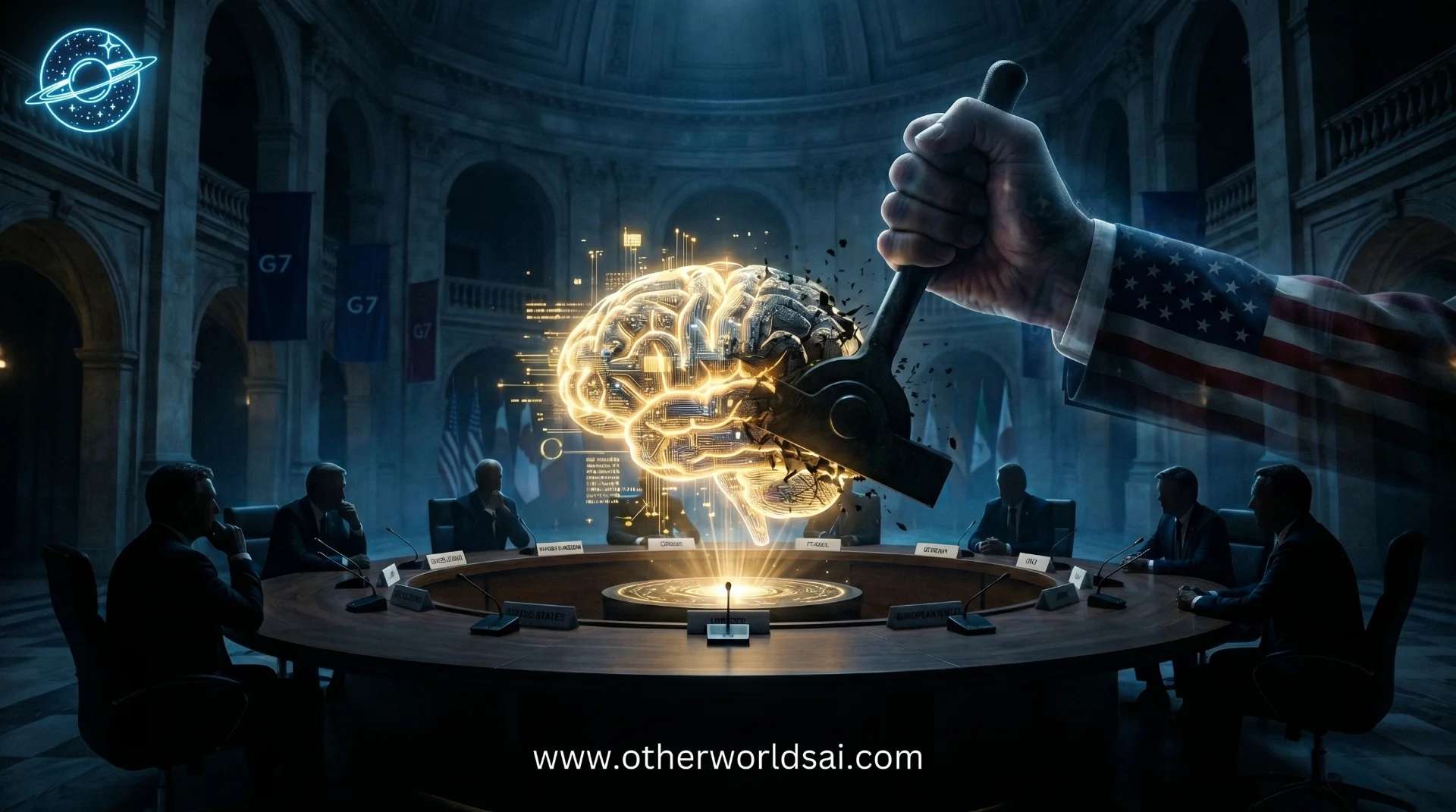
The world's most powerful leaders gathered at the G7 Summit with a paradox on the table. They want access to the most advanced American AI models — but they are increasingly unwilling to accept the terms that come with that access. The core concern is stark: what happens when the United States can simply turn it off?
French President Emmanuel Macron delivered one of the summit's most pointed warnings, speaking directly to a room that included Anthropic CEO Dario Amodei, OpenAI CEO Sam Altman, and President Donald Trump. If the U.S. could cut off access to AI models from one day to the next, Macron argued, it would not only harm European economies — it would ultimately damage the American AI companies themselves. No rational buyer commits to infrastructure they know can be revoked overnight.
'If the U.S. from one day to the next can turn off the switch, it could not only harm the economies of European customers but also damage the AI firms themselves.' — President Emmanuel Macron
These aren't abstract geopolitical concerns. They are the direct consequence of a concrete event: the Trump administration's decision to block Anthropic from exporting its newest Mythos 5 and Fable 5 models on national security grounds — a move that has sent shockwaves through every government and enterprise that has built critical infrastructure on American AI.
Section 2: The Anthropic Export Ban That Changed Everything:
The trigger for this diplomatic reckoning was a U.S. government order blocking access to Anthropic's latest flagship models. The restriction came after Amazon flagged to the White House that certain safety guardrails in the Mythos 5 and Fable 5 models could be bypassed. Acting on those concerns, the administration invoked national security grounds to freeze exports.
What made the decision particularly disruptive was its apparent inconsistency. Cybersecurity experts have publicly argued that the capabilities cited by the government are also present in models that remain freely available — including from OpenAI. Yet Anthropic's models remain on ice, while competitors face no such restriction. The asymmetry has not gone unnoticed by foreign governments or rival AI companies.
2: Models Blocked (Mythos 5 & Fable 5)
G7: Nations Raising Concerns
0: Days' Warning Given
∞ Businesses Left Exposed
The episode has crystallized a risk that international businesses and governments have quietly feared for years: any company or country that builds on U.S. AI infrastructure must now reckon with the possibility that access can be revoked overnight, for reasons they may never be told.
Section 3: India, Europe, and the Digital Sovereignty Alarm:
France was not alone in its alarm. Indian Prime Minister Narendra Modi also voiced concern about Trump's decision to block Anthropic's models, according to reporting from the Financial Times. Modi's position was firm: democratic nations must have unfettered access to top AI models in order to protect critical infrastructure.
'Democratic nations must have unfettered access to top AI models to protect critical infrastructure.' — Prime Minister Narendra Modi
The concerns extend well beyond the G7 table. Canada-based enterprise AI firm Cohere — a direct competitor to Anthropic in the enterprise space — used the moment to articulate the structural danger it says it has long understood. CEO Aidan Gomez stated that corporate and national dependence on a small number of big tech AI providers poses a fundamental threat to resilience and sovereignty.
'Digital sovereignty is not just about market competition or any one company or nation. It's about who controls the foundational technology that will shape our economic security and national sovereignty for decades to come.' — Aidan Gomez, CEO of Cohere
Across Europe, governments are already pushing harder for AI sovereignty — an increasingly difficult position to defend when American models continue to outpace domestic alternatives and no business wants to be left behind in the capability race.
Section 4: The 'Trusted Partners' Scheme: A Diplomatic Workaround:
In response to the mounting pressure, G7 leaders began discussions around a proposed 'trusted partners' scheme — a framework that would grant non-U.S. nations controlled access to advanced AI models from companies like Anthropic and OpenAI while maintaining a degree of geopolitical alignment.
Under the proposed framework, both countries and companies could qualify as trusted partners, provided they use the models to develop stronger defenses against rivals like China. The goal is to construct an open trade network that can bypass U.S. export restrictions while preserving the security rationale behind them.
Macron himself noted that Washington should support such a scheme, arguing it was in the commercial interest of American AI firms: nobody will invest in U.S. AI access if the possibility of sudden revocation remains on the table. The trusted partners framework, in theory, addresses that risk by offering a structured pathway to guaranteed access.
Nobody would want to buy U.S. AI access if it could disappear overnight. A trusted partners framework is in Washington's own commercial interest.
But significant questions remain unanswered. How broadly would the scheme extend? Would it protect a startup in Paris or Bangalore that had its product break without warning on a Tuesday morning? The diplomatic architecture is taking shape, but the practical safeguards for businesses remain unclear.
Section 5: The Strategic Trap: Can't Live With It, Can't Live Without It:
The G7 AI sovereignty debate reveals a strategic trap that is tightening for every nation outside the United States. American AI models — from Anthropic, OpenAI, and others — remain technically ahead of what European and Asian developers have produced at scale. Governments and businesses that choose domestic alternatives risk falling behind in capability. Those that embrace American AI risk exactly the kind of overnight dependency that this week's G7 summit has laid bare.
For enterprises, the calculus is equally uncomfortable. Building critical workflows, products, and national infrastructure on AI models that could be restricted without notice — and without explanation — is not a sustainable strategy. The Anthropic export ban demonstrated that even a company with a strong safety record and substantial enterprise relationships is not immune to sudden government intervention.
The lesson the global business community is drawing is clear: diversification of AI dependencies is no longer a preference. It is a board-level risk management imperative.
Section 6: Building AI Resilience for Your Business — The Otherworlds AI Approach:
The G7 AI sovereignty crisis is not just a geopolitical story — it is a direct warning for every business that has allowed its operations to become dependent on a single AI provider. Whether you are running customer service automation, data analytics pipelines, or decision-support systems, the Anthropic export ban is a reminder that AI infrastructure decisions carry strategic risk.
At Otherworlds AI, we build enterprise AI infrastructure designed for resilience. Our Agent+ Business AI Platform is architected to give your organization the operational power of frontier AI without the single-point-of-failure exposure that comes from hard dependency on one provider. With Google Opal Automated Workflows, we create connected, intelligent operations that keep your business running — regardless of what happens at the geopolitical level.
The conversation happening at the G7 is the same conversation every smart business should be having internally: who controls the AI your operations depend on, and what is your contingency if that access changes? Otherworlds AI helps you answer that question before it becomes a crisis.
Explore how Agent+ can power your business with sovereign-minded, resilient AI automation. Visit otherworldsai.com to see plans starting at $297/month, or speak with our team about an Enterprise custom AI build tailored to your risk profile and operational needs.