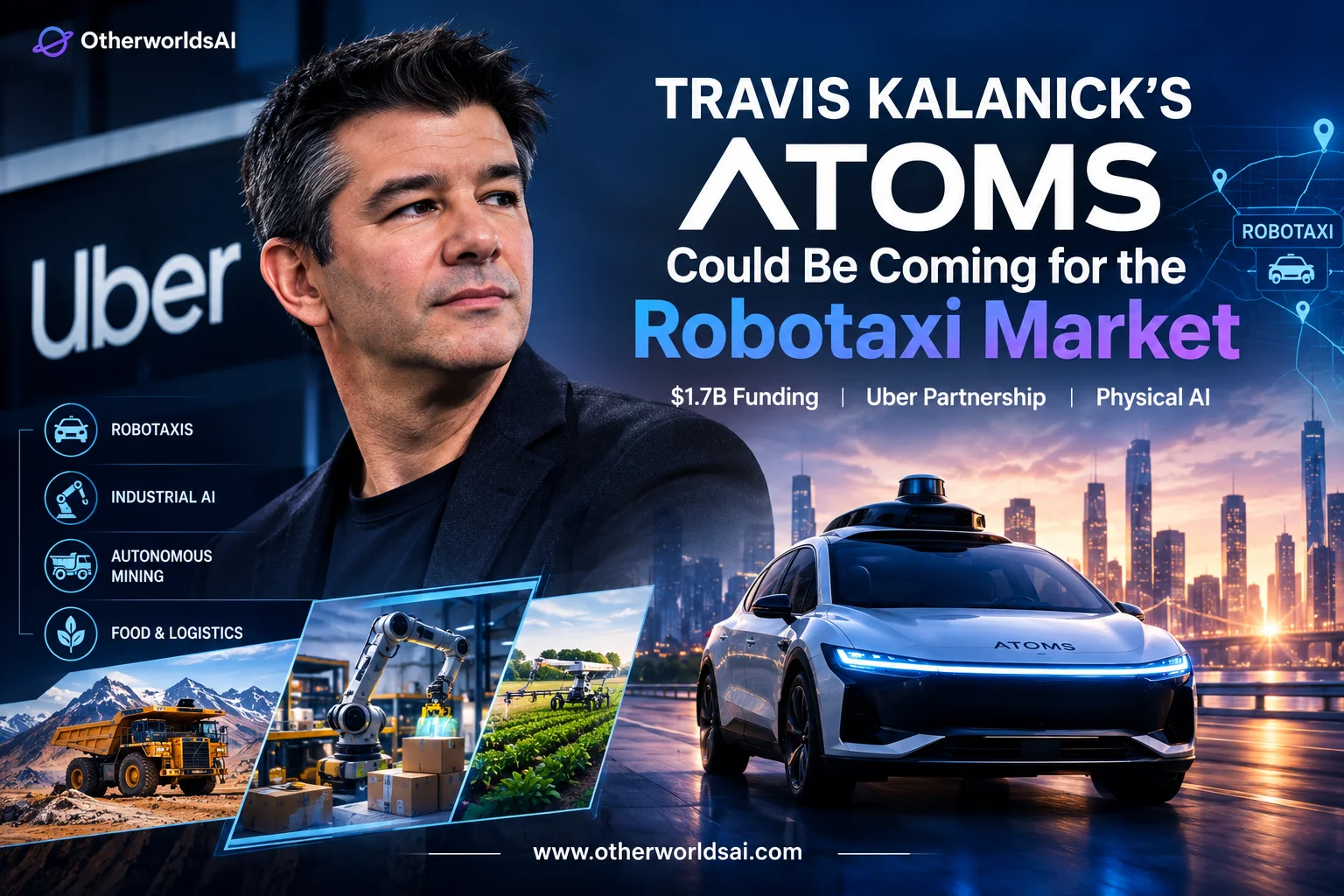

Travis Kalanick’s Atoms: The $1.7 Billion Bet on Robotaxis and Physical AI:
Travis Kalanick, the co-founder and former CEO of Uber, is back with a new technology bet—and this time, he is aiming beyond software.
His company, Atoms, has raised an extraordinary $1.7 billion funding round led by Andreessen Horowitz, acquired autonomous-mining company Pronto, and brought several former Uber executives back into Kalanick’s orbit. Now, according to recent reporting, Atoms is exploring the robotaxi business and has discussed how its autonomous-driving technology could potentially work with Uber’s massive ride-hailing network.
The robotaxi opportunity is important, but it may only be one part of a much larger strategy.
Kalanick appears to be betting on physical AI: intelligent machines capable of operating in the real world, from autonomous vehicles and mining trucks to industrial robots and logistics systems.
From Uber to Atoms: Kalanick’s Second Act:
Kalanick spent years helping transform transportation through Uber. During his leadership, the company aggressively pursued autonomous driving, including investments in self-driving technology and the acquisition of Otto, a company founded by autonomous-driving engineers.
Uber eventually abandoned its internal autonomous-driving operation and sold the business to Aurora in 2020.
Now the story has taken an unexpected turn.
Kalanick has returned to robotics with Atoms, while Uber has become an investor in the company. Atoms has also acquired Pronto, founded by Anthony Levandowski, another figure associated with Uber’s original autonomous-driving ambitions.
The result is an unusual Silicon Valley reunion.
But Atoms is not simply trying to recreate Uber’s old self-driving program. Its ambitions appear considerably broader.
The $1.7 Billion Physical AI Bet:
Atoms’ $1.7 billion investment round gives the company significant financial firepower to pursue its vision.
The company has described a strategy involving specialized automation across areas such as food, mining and transportation. Instead of building one general-purpose robot capable of performing every task, the approach focuses on machines designed for specific real-world jobs.
That strategy fits into the rapidly developing field of physical AI.
Traditional artificial intelligence primarily operates in the digital world. AI can write software, analyze documents, generate images, answer questions and automate business processes.
Physical AI takes the concept further.
It involves giving machines the ability to perceive their surroundings, make decisions and perform actions in the physical world.
That includes:
- Autonomous vehicles.
- Robotaxis.
- Autonomous trucks.
- Mining robots.
- Industrial robotics.
- Warehouse automation.
- Logistics systems.
- Food-production automation.
For companies like Atoms, the ultimate opportunity is to make physical work increasingly autonomous.
Why Pronto Matters:
Atoms’ acquisition of Pronto could be one of its most strategically important moves.
Pronto specializes in autonomous vehicle technology for mining and industrial environments. Unlike city streets, mining operations provide relatively controlled environments where autonomous systems can operate along predictable routes.
That makes mining an attractive testing ground for AI-powered autonomous vehicles.
Pronto’s technology has already been used in commercial mining operations, giving Atoms experience that would otherwise take years to develop.
But there is a major difference between an autonomous mining truck and a robotaxi.
A mining vehicle does not normally have to deal with pedestrians suddenly crossing the road, cyclists, emergency vehicles, unpredictable drivers, complicated intersections or changing traffic patterns.
Robotaxis face all of those challenges simultaneously.
That means Atoms would still have significant technical work ahead if it wants to bring its autonomous technology from industrial environments into major cities.
Why Uber Could Be the Missing Piece:
This is where the potential relationship between Atoms and Uber becomes particularly interesting.
Uber has increasingly positioned itself as a marketplace for autonomous vehicles, rather than trying to develop every self-driving technology internally.
The company has partnerships with multiple autonomous vehicle developers.
That business model could create an opportunity for Atoms.
Instead of building and operating an enormous robotaxi fleet itself, Atoms could potentially provide the autonomous-driving technology, while Uber provides the marketplace, customers, routing, payments and transportation infrastructure.
In simple terms:
Atoms could provide the autonomy. Uber could provide the distribution.

Meta's Next Big Bet: This New App Lets You Build Games Simply by Typing a Prompt
If that model works, Atoms would not necessarily need to become another Waymo or Zoox.
It could become an important technology provider within the growing autonomous transportation ecosystem.
The Robotaxi Market Is Changing:
The autonomous vehicle industry has reached an important stage.
For years, robotaxis were presented as a future technology. Today, autonomous ride services are becoming increasingly visible in commercial markets.
Companies including Waymo, Zoox, Tesla, Wayve and others are competing to determine what the future of autonomous transportation will look like.
But the biggest challenge is no longer simply proving that an autonomous vehicle can drive.
The real challenge is scaling autonomous transportation safely and profitably.
Support our research
Independent analysis fueled by you.
That requires far more than an AI model.
Companies need reliable sensors, computer vision, mapping, vehicle platforms, fleet management, insurance, regulatory approvals, charging infrastructure, maintenance and customer support.
This complexity creates opportunities for companies that can specialize in individual parts of the ecosystem.
Atoms could potentially occupy one of those positions.
Former Uber Talent Returns:
Another interesting part of the Atoms story is Kalanick’s decision to bring former Uber talent back into his organization.
Atoms hired Gautam Gupta, who previously served as Uber’s finance chief under Kalanick, as its CFO.
The company’s relationship with Pronto also reconnects Kalanick with Anthony Levandowski, who played a major role in the early development of autonomous-driving technology.
This history gives Atoms an unusual combination of transportation experience, robotics expertise and substantial new capital.
But the technology landscape has changed dramatically since Kalanick’s Uber days.
In 2016, autonomous vehicles were still largely viewed as an emerging research project.
In 2026, autonomous driving is becoming a real commercial industry.
That makes Kalanick’s return particularly interesting.
The Bigger Opportunity: Physical AI:
The robotaxi story may ultimately be smaller than the physical AI opportunity.
Artificial intelligence is moving beyond chatbots and digital assistants toward systems that can interact with the physical environment.
The next generation of AI automation could involve machines that move products, operate equipment, drive vehicles and perform industrial tasks with limited human intervention.
For businesses, this could become one of the biggest technology shifts of the next decade.
The same underlying technologies—machine learning, computer vision, sensor fusion, autonomous navigation, planning and real-time decision-making—can be applied across many industries.
That makes physical AI potentially much larger than autonomous transportation alone.
What Atoms Could Mean for the AI Industry:
Atoms is still difficult to categorize.
-
It is not simply a robotics startup.
-
It is not simply an autonomous vehicle company.
-
And it is not simply an industrial AI company.
Instead, Kalanick appears to be combining these technologies into a broader physical automation strategy.
The company’s $1.7 billion funding, Pronto acquisition, former Uber connections and reported interest in autonomous transportation suggest that Atoms is preparing for an ambitious expansion.
The robotaxi opportunity remains a developing story, rather than a confirmed Atoms launch.
Move Over Nvidia: Anthropic and Samsung Team Up to Break the AI Chip Monopoly
But if the company can successfully combine industrial autonomy with transportation technology—and potentially connect that technology to Uber’s global marketplace—it could become an important player in the AI robotics and autonomous vehicle industry.
What This Means for OtherworldsAI:
The Atoms story highlights a trend that businesses should be watching closely.
AI is moving from systems that simply answer questions to systems that can take action.
Today, businesses are adopting AI assistants, AI agents, generative AI and automation software.
Tomorrow, increasingly intelligent systems could control vehicles, robots, warehouses, manufacturing equipment and logistics operations.
This transition from digital AI to physical AI could define the next phase of the artificial intelligence revolution.
For businesses exploring AI automation, the lesson is clear: AI will not only change how people use computers. It may fundamentally change how machines operate in the physical world.
And Travis Kalanick’s $1.7 billion Atoms bet could be one of the most ambitious attempts yet to make that future a reality.