
The New AI Race: From Nvidia-Powered Logistics to Open-Source AI and the Fight Against AI Sameness.
Artificial intelligence is moving beyond chatbots and image generators. In 2026, AI is increasingly becoming the infrastructure behind how businesses make decisions, optimize operations, automate workflows, and serve customers.
Two recent developments illustrate this transformation particularly well.
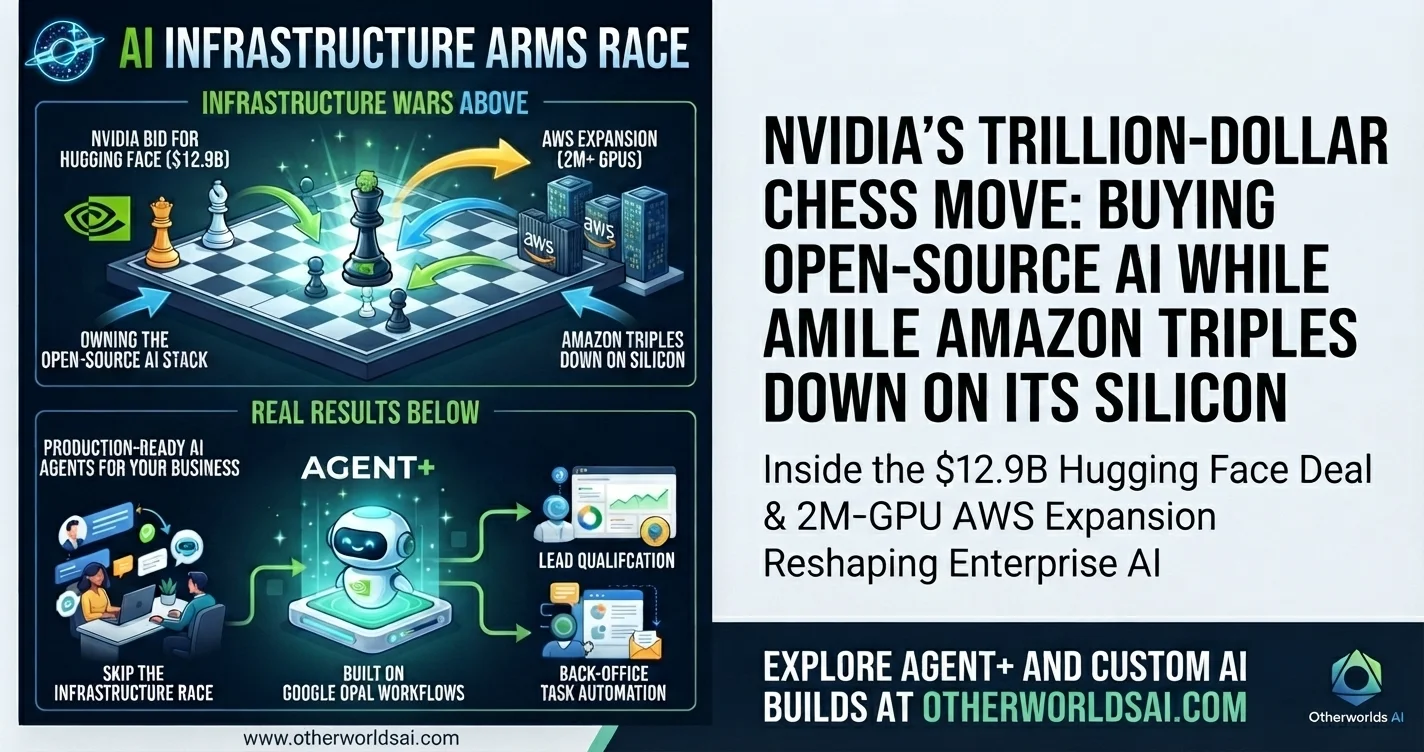
One involves OneRail, which is using Nvidia technology to make real-time last-mile delivery decisions. The other involves Nvidia’s reported $12.93 billion acquisition of Hugging Face, a major open AI platform with millions of developers, models, datasets, and applications.
At first, these stories may appear unrelated.
-
One is about logistics.
-
The other is about open-source AI.
But together they reveal a much bigger trend: AI is evolving from a content-generation technology into an operational intelligence layer for businesses.
AI Is Moving From Prediction to Real-Time Decisions.
OneRail's OmniSTAR platform demonstrates how AI can directly influence physical-world business operations.
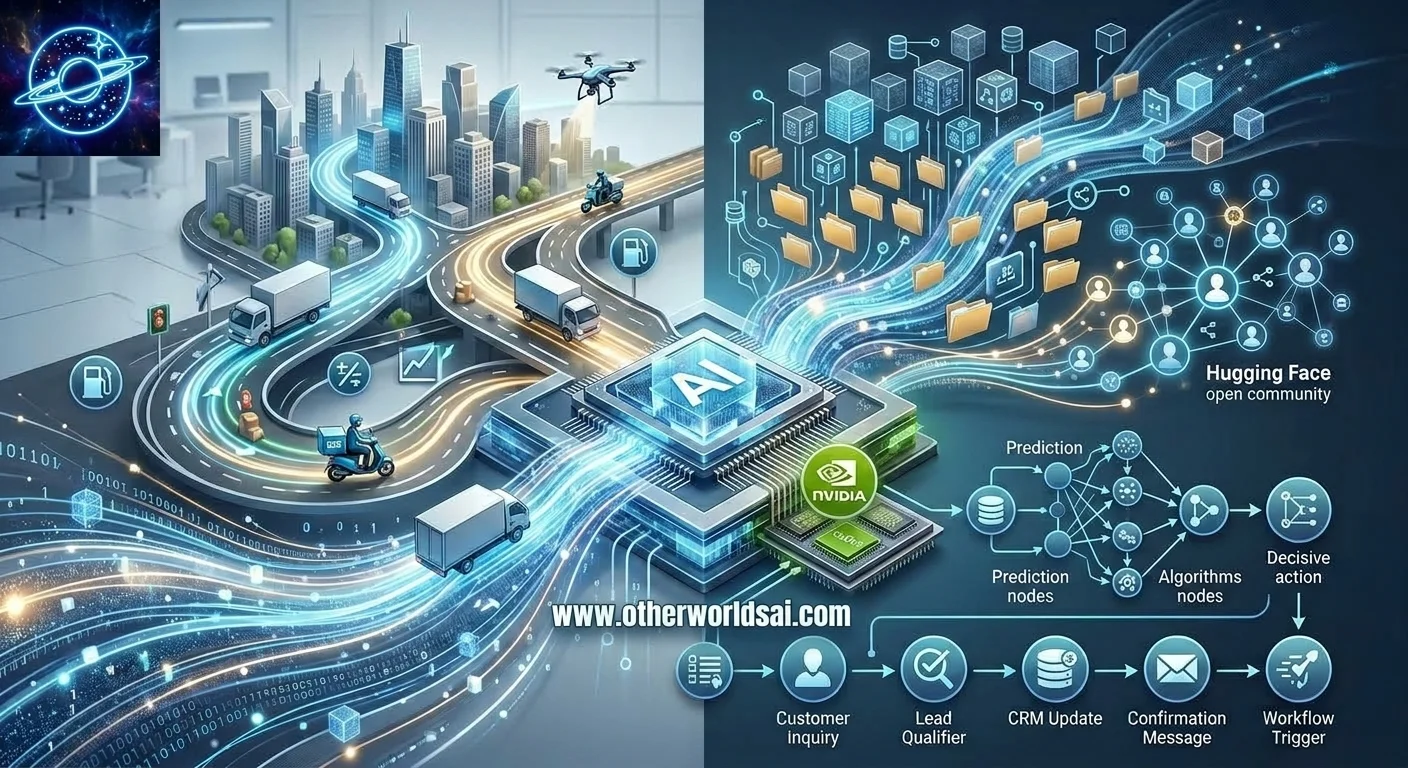
The system evaluates different ways an individual order could be delivered—including company-owned fleets, courier services, parcel carriers, and other delivery options—and selects an option based on cost and required service levels.
The platform combines OneRail's delivery data with Nvidia cuOpt, a GPU-accelerated optimization engine, and Nvidia cuDF, a GPU-accelerated data-processing library. According to OneRail, this architecture can reduce certain computation times by as much as 10 times. A calculation that previously required approximately 20 minutes can potentially be completed in under two minutes.
That speed matters.
Last-mile delivery is one of the most expensive and complicated parts of modern commerce. Fuel prices, traffic, weather, vehicle availability, driver shortages, delivery windows, and customer priorities can change continuously.
Traditional static rules struggle to respond quickly.
AI-powered optimization can continuously evaluate changing conditions and help businesses make better operational decisions.
Nvidia AI Infrastructure Is Becoming a Business Advantage.
The OneRail example highlights something important about the modern AI stack.
AI isn't simply a chatbot sitting on a website.
Behind sophisticated AI applications are increasingly powerful layers of GPU computing, data processing, machine learning, mathematical optimization, and real-time decision systems. Nvidia's cuOpt is designed for vehicle routing and other mathematical optimization problems.
It can account for factors such as vehicle capacity, operating windows, travel times, costs, and starting locations.
The result is an AI system capable of evaluating complex combinations of variables much faster than conventional approaches.
For businesses, this creates a new category of opportunity:
AI can become part of the operational infrastructure itself.
Instead of simply generating a marketing email, AI can determine how an order should be fulfilled.
Instead of merely predicting customer behavior, AI can help determine what action the business should take next.
That distinction—between AI prediction and AI decision-making—could define the next phase of enterprise AI.
The Open-Source AI Revolution:
At the same time, the AI ecosystem is becoming increasingly dependent on open models and developer platforms.
Hugging Face has grown into a major hub for the open AI community, with more than 18 million developers, researchers, and creators and millions of models, datasets, and applications according to the supplied report.
Nvidia's reported agreement to acquire Hugging Face for $12.93 billion reflects the strategic importance of this ecosystem.
The combination of Nvidia's computing infrastructure and Hugging Face's open AI platform could accelerate the development and deployment of open-source AI, open-weight models, AI applications, and enterprise AI solutions.
Importantly, Nvidia stated that Hugging Face would remain an open platform and that developers would continue to have choices regarding models, frameworks, cloud providers, inference services, and computing hardware.
This is significant for businesses that don't want to be locked into a single AI ecosystem. Why Open AI Matters to Businesses
Move Over Nvidia: Anthropic and Samsung Team Up to Break the AI Chip Monopoly
The growth of open-source AI gives startups and enterprises more flexibility.
Organizations can select models according to their specific requirements instead of automatically relying on one proprietary AI provider.
For some companies, the priorities may be cost and performance.
For others, data privacy, cybersecurity, data sovereignty, customization, or on-premise AI deployment may be more important.
This is particularly relevant as businesses increasingly use AI for sensitive operations. Manufacturing companies can deploy AI for predictive maintenance.
-
Logistics companies can optimize routes.
-
Retailers can forecast demand.
-
Healthcare organizations can analyze information.
-
Customer-service teams can automate conversations.
-
SaaS companies can build AI agents into their products.
The underlying principle is the same: AI becomes valuable when it is connected to real business processes.
Support our research
Independent analysis fueled by you.
From AI-Generated Content to AI Business Automation:
"An AI system could answer a customer's question, qualify the lead, schedule an appointment, update a CRM, send a confirmation message, and trigger a follow-up workflow.
That is no longer simply content generation.
It is AI-powered business automation."
The Evolution of Enterprise AI ValueWaveCore CapabilityOperational FocusPrimary Business ValueGenerative AI (The Past)Text, Image, & Video GenerationMarketing, Copywriting, Creative ContentSpeeding up manual content creation and draftingPredictive AI (The Transition)Pattern Recognition &
ForecastingDemand Forecasting, Risk Modeling, InsightsIdentifying trends before they happenOperational Intelligence (The Future / OtherworldsAI)Real-Time Execution & Workflow AutomationDynamic Logistics Routing, Automated Lead Conversion, AI AgentsAutonomous, continuous decisions that drive revenue and cut operational costs
This evolution also changes how businesses should think about AI.
The first wave of mainstream generative AI focused heavily on text, images, videos, and other content.
That remains valuable.
Businesses can use AI content creation, AI marketing automation, AI-generated images, AI copywriting, AI social media tools, and AI productivity software to reduce repetitive work. But the next opportunity is significantly larger.
AI agents can increasingly connect content generation with actual business operations. An AI system could answer a customer's question, qualify the lead, schedule an appointment, update a CRM, send a confirmation message, and trigger a follow-up workflow.
That is no longer simply content generation.
It is AI-powered business automation.
The OtherworldsAI Opportunity:
This is where platforms such as OtherworldsAI fit into the broader AI transformation. The real value of artificial intelligence is not simply producing another impressive demo. It is integrating AI into the systems that businesses already use.
For small and mid-sized businesses, this could mean AI customer service, AI voice agents, AI chatbots, lead generation automation, appointment scheduling, CRM automation, workflow automation, and 24/7 customer support.
For larger organizations, the opportunity can extend to private AI agents, custom AI models, enterprise AI automation, AI infrastructure, and secure AI deployment.
The objective is to make AI useful, measurable, and connected to business outcomes.
The Bigger Lesson: AI Needs Intelligence, Not Just Generation:
The stories of OneRail, Nvidia, and Hugging Face point toward the same conclusion. The future of AI will not be determined solely by who generates the most impressive images or writes the most convincing text.
It will increasingly be determined by who can use AI to make faster, smarter, and more economically valuable decisions.
Meta's Next Big Bet: This New App Lets You Build Games Simply by Typing a Prompt
OneRail is applying AI to real-time delivery optimization.
Nvidia is expanding the computing infrastructure required for advanced AI.
Hugging Face represents the growing importance of open AI models and developer ecosystems.
And businesses are beginning to connect these technologies to everyday operations.
For companies exploring AI automation, AI agents, generative AI, enterprise AI, open-source AI, and intelligent business software, the message is clear:
The winners of the next AI era will not simply use AI to create more content.
They will use it to automate processes, optimize decisions, reduce costs, improve customer experiences, and build entirely new ways of operating.
That is the real transformation—and it has only just begun.