
Imagine a computer so powerful it could solve problems that would take today's supercomputers billions of years.
This isn't science fiction; it's the promise of quantum computing. For years, this revolutionary technology has been hampered by significant challenges, primarily scalability and the sheer bulk of the equipment required. But what if a breakthrough as small as a microchip could change everything?
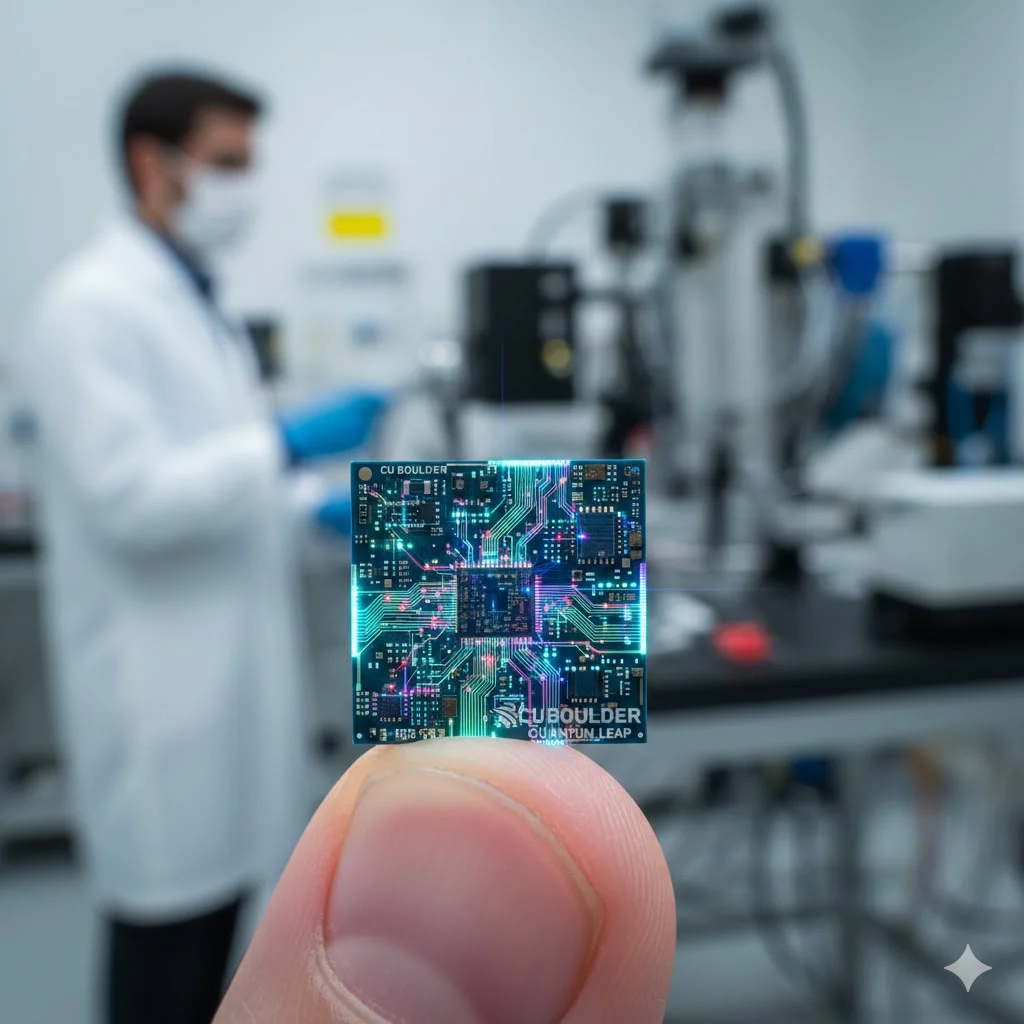
Researchers at the University of Colorado at Boulder have unveiled just such a device: a groundbreaking optical chip that could accelerate the scalability of quantum machines, offering unprecedented precision while dramatically reducing power consumption. Even more remarkably, this tiny marvel can be manufactured using standard chip fabrication techniques, paving the way for large-scale production and a future where quantum computers are not just theoretical wonders but practical tools.
A Quantum Leap in Miniaturization:
The core of this innovation is an optical phase modulator, a device almost 100 times thinner than a human hair. This isn't just a feat of miniaturization; it's a game-changer for quantum computing. Quantum computers, especially those that use trapped ions or neutral atoms, rely on thousands, or even millions, of qubits—the quantum equivalent of bits—to perform calculations. To interact with these individual atoms (which act as qubits), ultra-precise lasers are essential.
Historically, manipulating these laser frequencies has required bulky, laboratory-sized equipment, severely limiting the scalability of quantum systems. Imagine trying to build a powerful computer if every transistor needed its own dedicated, room-sized apparatus!
The new chip, however, is built using the same scalable manufacturing methods that produce the processors in our smartphones, computers, and even our cars. This means mass production is not only feasible but designed into the very fabric of the technology, opening the door for quantum machines far larger and more powerful than anything we've seen to date.
Precision Lasers: The Key to Quantum Accuracy:
The precision required for quantum computing is staggering. Each laser must be tuned with astonishing accuracy—sometimes to within billionths of a percent—to ensure correct calculations.
Jake Freedman, an incoming PhD student leading this pivotal research, highlights the critical role of this capability: "Creating new copies of a laser with very exact differences in frequency is one of the most important tools for working with atom- and ion-based quantum computers. But to do that at scale, you need technology that can efficiently generate those new frequencies."
The CU Boulder chip achieves this through microwave-frequency vibrations that oscillate billions of times per second. These rapid vibrations allow for the precise manipulation of laser beams, resulting in stable, efficient laser frequency shifts. This isn't just a boon for quantum computing; it's a vital requirement for other cutting-edge fields such as quantum sensing and quantum networking, both poised to revolutionize everything from medical diagnostics to secure communication.
Unprecedented Efficiency and Scalability:
One of the most compelling advantages of this new device is its remarkable energy efficiency. It consumes approximately 80 times less microwave power than many existing modulators, which translates directly into significantly less heat generation.
In the world of high-performance computing, heat is the enemy, limiting how densely components can be packed and how efficiently they can operate. This enhanced efficiency means that more optical channels can be integrated onto a single chip, directly increasing the number of qubits that can be controlled simultaneously.
Professor Matt Eichenfield, a co-author of the study, underscores the paramount importance of scalability: "You’re not going to build a quantum computer with 100,000 bulky modulators sitting on optical tables. We need a solution that can be mass-manufactured, integrated onto microchips, and produce significantly less heat. That’s exactly what this chip achieves." His words paint a clear picture of the paradigm shift this tiny chip represents—moving from bespoke, laboratory-bound systems to robust, scalable quantum architectures.
From Vacuum Tubes to a Photonic “Transistor Revolution”:
Perhaps one of the most exciting aspects is that the device was manufactured entirely in a CMOS fabrication facility. For those unfamiliar, CMOS (Complementary Metal-Oxide-Semiconductor) is the same ubiquitous technology responsible for producing billions of identical transistors in modern microelectronics.
Co-senior author Nils Otterstrom aptly compares this transition to a historical turning point: "We’re helping to push optics into its own ‘transistor revolution,’ moving away from the optical equivalent of vacuum tubes toward scalable, integrated photonic technologies."
This isn't merely an incremental improvement; it's a fundamental reimagining of optical components. By transforming bulky, power-hungry optical modulators into small, efficient, and highly integrable devices, the CU Boulder team has created a critical building block—a sort of quantum "transistor"—that is essential for bringing real-world quantum computing to fruition.
The Road to Fully Integrated Quantum Chips:
The journey doesn't end here. The research team is now focused on developing fully integrated photonic circuits that will combine frequency generation, filtering, and pulse shaping all on a single chip. This level of integration could bring the field significantly closer to a complete, operational quantum photonic platform.
Freedman expresses palpable optimism: "This device is one of the final pieces of the puzzle. We’re getting close to a truly scalable photonic platform capable of controlling very large numbers of qubits." The next crucial step involves collaborating with leading quantum computing companies to rigorously test these chips within advanced trapped-ion and neutral-atom quantum computers.
With robust funding from the U.S. Department of Energy through the Quantum Systems Accelerator program and a device designed for mass production, the future of scalable quantum computing finally appears to be within reach.
This tiny chip from CU Boulder isn't just an innovation; it's a beacon of hope for realizing the transformative power of quantum technology.
Support our research
Independent analysis fueled by you.