
Nvidia has already committed $40B to equity AI deals this year in 2026:
Beyond the Chip: Why Nvidia Just Dropped $40 Billion on AI Equity Deals.
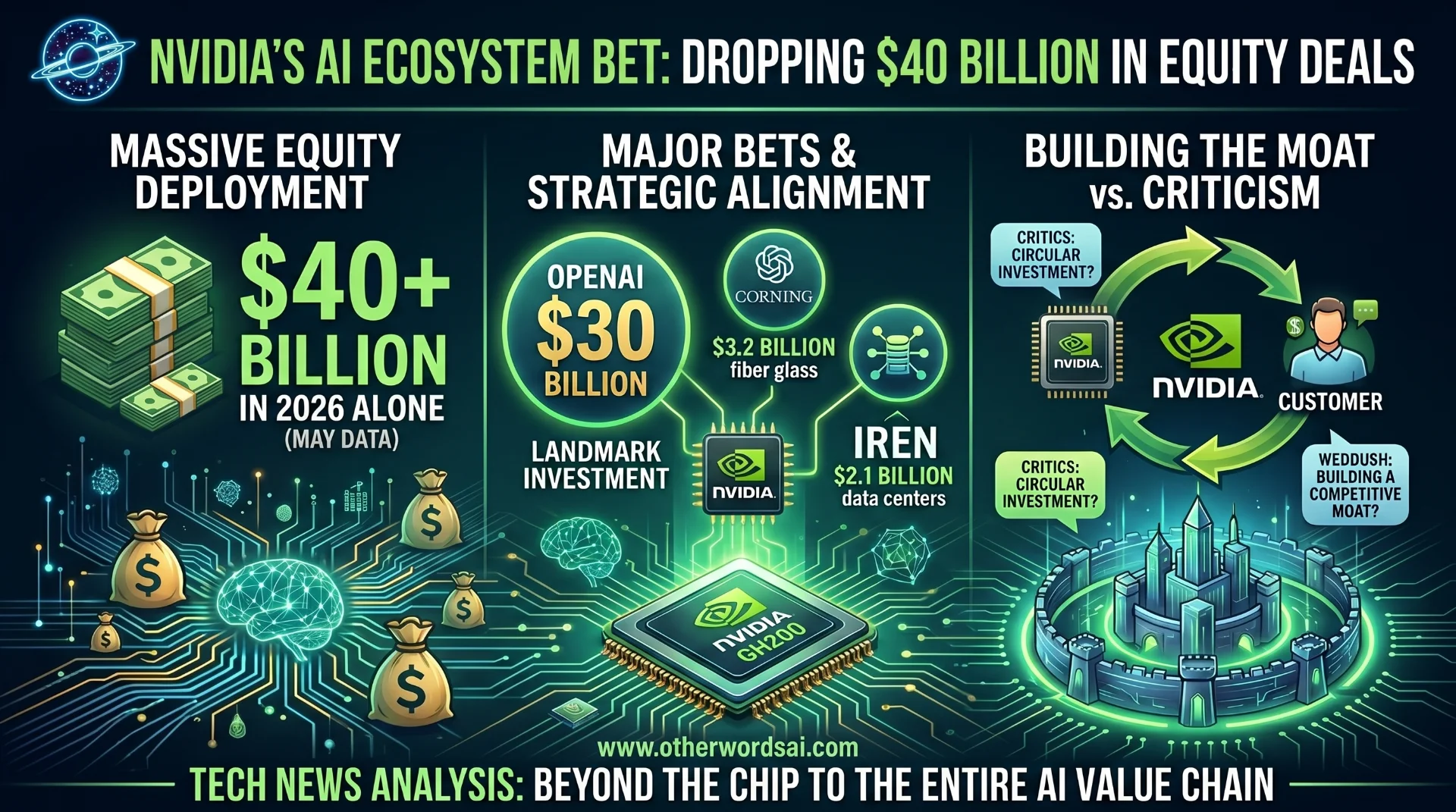
Nvidia continues to be a major investor in the AI ecosystem, committing more than $40 billion to equity investments in AI companies — and that’s just in these early months of 2026, according to CNBC.
Much of that total comes from a single bet, a $30 billion investment in OpenAI. But CNBC reports that the chipmaker has also announced seven multi-billion dollar investments in publicly traded companies, most recently deals to invest up to $3.2 billion in glassmaker Corning and up to $2.1 billion in data center operator IREN.
We’ve previously rounded up Nvidia’s investments in AI startups, including 67 venture deals in 2025. And according to FactSet data, it’s already participated in around two dozen investment rounds in private startups in 2026. The fact that Nvidia has been investing in some of its own customers has led to the recurring criticism that these are circular deals moving money back-and-forth between the same companies.
Wedbush Securities analyst Matthew Bryson said Nvidia’s investments fall “squarely into the circular investment theme,” but suggested that if successful, they could help the company build a “competitive moat.”
Nvidia's Bold AI Investment Strategy: The chipmaker best known for powering the AI revolution through its GPUs has made a dramatic pivot in 2026 — not just as a hardware giant, but as one of the most aggressive equity investors in the artificial intelligence ecosystem. With more than $40 billion committed to AI-related equity deals in just the first few months of 2026, Nvidia is redefining what it means to be a technology company in the modern AI era.
Why This Matters: Nvidia's staggering investment pace signals a broader strategy — one that goes far beyond selling chips. By taking equity stakes across the AI value chain, the Santa Clara-based company is positioning itself as both an enabler and a direct financial beneficiary of the AI boom it helped ignite.
The $30 Billion OpenAI Bet: Nvidia's Landmark AI Investment:
-
A Single Deal That Rewrites the Record Books: At the heart of Nvidia's massive 2026 investment total sits a blockbuster commitment — a $30 billion investment in OpenAI, the company behind ChatGPT and the broader generative AI revolution. This single deal accounts for the vast majority of Nvidia's 2026 equity deployment and stands as one of the largest single corporate investments ever made in an AI company.
-
Strategic Alignment at the Highest Level: The OpenAI investment is not merely financial. It underscores the deep, symbiotic relationship between Nvidia's GPU hardware and OpenAI's frontier AI models. OpenAI is one of Nvidia's largest customers for its flagship H100 and Blackwell-series chips, making the investment a calculated bet on the very ecosystem that drives Nvidia's core hardware revenue.
Beyond OpenAI: Seven Multi-Billion Dollar Equity Deals in 2026:
-
A Diversified Investment Portfolio Taking Shape: While the OpenAI deal dominates headlines, Nvidia has simultaneously announced seven additional multi-billion dollar investments in publicly traded companies this year alone. This deliberate diversification across the AI infrastructure stack suggests a systematic portfolio-building approach rather than opportunistic deal-making.
-
Corning and IREN Lead the Latest Wave: Among the most recent announcements are an investment of up to $3.2 billion in Corning — the specialty glassmaker whose fiber optic and advanced display technologies are increasingly critical to data center infrastructure — and an investment of up to $2.1 billion in IREN,
A data center operator whose facilities help power the compute-intensive workloads that modern AI demands. These deals reflect Nvidia's recognition that AI's growth depends not just on chips, but on the entire physical infrastructure that surrounds them.
- Building an End-to-End AI Ecosystem: From chip design to software platforms to physical data center infrastructure, Nvidia's investment choices reveal a deliberate strategy to secure its relevance at every layer of the AI stack. As AI workloads grow more complex and energy-intensive, companies like Corning and IREN represent critical links in the supply chain Nvidia depends on.
A Serial Investor: Nvidia's AI Startup Dealmaking History:
67 Venture Deals in 2025 — And Accelerating Into 2026: Nvidia's appetite for dealmaking is nothing new. Throughout 2025, the company participated in 67 venture capital deals spanning the breadth of the AI startup ecosystem. From foundation model developers to AI-native SaaS companies, Nvidia has been a consistent and prolific backer of emerging AI businesses.
Two Dozen Private Rounds Already in 2026: According to data from FactSet, Nvidia has already joined approximately 24 private startup funding rounds in 2026 — and the year is still young. This pace, if maintained, would put Nvidia on track to far exceed its 2025 venture activity, cementing its status as one of the most active corporate venture investors in Silicon Valley and beyond.
The NVentures Advantage: Nvidia's corporate venture arm, NVentures, has been the vehicle through which many of these deals flow. By investing early in AI startups, Nvidia gains not just financial returns but strategic intelligence — early visibility into where AI technology is heading and which companies are building on its platforms.
The Circular Investment Controversy: Critics Sound the Alarm:
-
The 'Round-Trip Money' Problem: Not everyone is celebrating Nvidia's investment spree. A growing chorus of critics — including investors, analysts, and industry observers — has raised pointed concerns about what they describe as circular investment arrangements at the heart of many of these deals. The concern is straightforward: Nvidia invests in companies that use that funding to buy Nvidia chips, which in turn boosts Nvidia's revenue and valuation.
-
Money Moving in Closed Loops: Critics argue that this creates a self-reinforcing cycle where capital flows between the same network of companies without necessarily generating real external economic value. In effect, Nvidia may be inflating the apparent health of the AI investment market by recycling its own capital through customer relationships.
-
Transparency and Governance Concerns: These circular dynamics raise deeper questions about corporate governance, conflicts of interest, and how AI companies are valuing themselves. When a chip supplier becomes a major equity investor in its own buyers, the lines between vendor, customer, and co-investor blur in ways that could distort competitive dynamics.
Analyst Perspective: Building a Competitive Moat or Creating Risk?
-
Wall Street Weighs In: Wedbush Securities analyst Matthew Bryson offered a measured but telling take on Nvidia's strategy. Bryson acknowledged that Nvidia's investments "fall squarely into the circular investment theme," a characterization that validates the critics' concerns while stopping short of outright condemnation.
-
The Moat-Building Argument: Despite the circular concerns, Bryson suggested that if these investments succeed, they could help Nvidia build a "durable competitive moat" — entrenching its position not merely as a chip supplier but as a foundational stakeholder in the companies shaping the AI future. By owning equity in AI leaders, Nvidia aligns its financial fortunes with the success of the broader AI ecosystem.
-
Risk vs. Reward at Scale: The bullish case for Nvidia's strategy rests on the assumption that AI adoption continues its rapid ascent and that the companies Nvidia has backed — OpenAI foremost among them — deliver transformative, durable value. The bearish case raises the risk of over-concentration: if AI investment sentiment turns or key bets falter, Nvidia's balance sheet could face significant exposure.
What This Means for the AI Investment Landscape in 2026:
-
A New Template for Big Tech Investment Strategy: Nvidia's approach is increasingly being watched by other large technology companies as a potential model — or cautionary tale — for how to participate in the AI economy beyond selling products. The company has effectively blurred the line between technology vendor and venture capitalist.
-
AI Infrastructure as the Next Battleground: Nvidia's investments in data center operators and materials companies like Corning signal that the next phase of the AI arms race will be fought not just in algorithms and models, but in the physical infrastructure — power, cooling, fiber, and compute density — that makes large-scale AI possible.
-
Nvidia's Unique Position in 2026: With over $40 billion deployed in equity investments, a hardware business generating record revenues, and a software platform ecosystem growing through CUDA and its AI Enterprise suite, Nvidia stands at the intersection of every major force shaping the AI economy. Whether its investment strategy proves visionary or overextended, it has already fundamentally changed how the industry thinks about the role of chip companies in the AI era.
Key Takeaways: Nvidia's AI Investment Story in 2026:
✅ Nvidia has committed over $40 billion to AI equity deals in the first months of 2026 alone.
✅ A $30 billion OpenAI investment anchors the total, representing one of the largest single corporate AI investments ever.

Move Over Nvidia: Anthropic and Samsung Team Up to Break the AI Chip Monopoly
✅ Seven additional multi-billion dollar bets in public companies, including Corning ($3.2B) and IREN ($2.1B), broaden the portfolio.
Support our research
Independent analysis fueled by you.
✅ ~24 private startup funding rounds already participated in during 2026, following 67 deals in 2025.
✅ Critics flag circular investment concerns; analysts suggest potential for a durable competitive moat if bets succeed.

Meta's Next Big Bet: This New App Lets You Build Games Simply by Typing a Prompt
By Tech Desk | May 2026 | 5 min read | #NvidiaAI #AIInvestment #TechNews #GenerativeAI #AIEcosystem #ChipMaker #OpenAI #VentureCapital