
Cloudflare's AI Revolution: Record Revenue, 1,100 Layoffs, and the Future of Work in the Agentic AI Era:
The AI Paradox: Cloudflare Hits Record Revenue While Cutting 20% of Its Staff.
Cloudflare just made history — and not entirely in the way a record-breaking quarter usually does. On Thursday, the internet security and performance giant announced it was cutting 1,100 jobs — roughly 20% of its entire global workforce — even as it reported the highest revenue quarter in its 16-year history. The reason CEO Matthew Prince gave wasn't financial pressure or poor performance. It was artificial intelligence.
This is the new face of Big Tech's AI transformation: soaring revenues, widening ambition, and a brutal reckoning with how many human roles a sufficiently powerful AI can absorb. Cloudflare's announcement puts it squarely alongside Meta, Microsoft, and Amazon in a growing club of tech giants reporting record growth while simultaneously slashing headcount — and pointing to AI as the engine driving both trends.
Record Revenue, Record Layoffs: Inside Cloudflare's Q1 2026 Earnings:
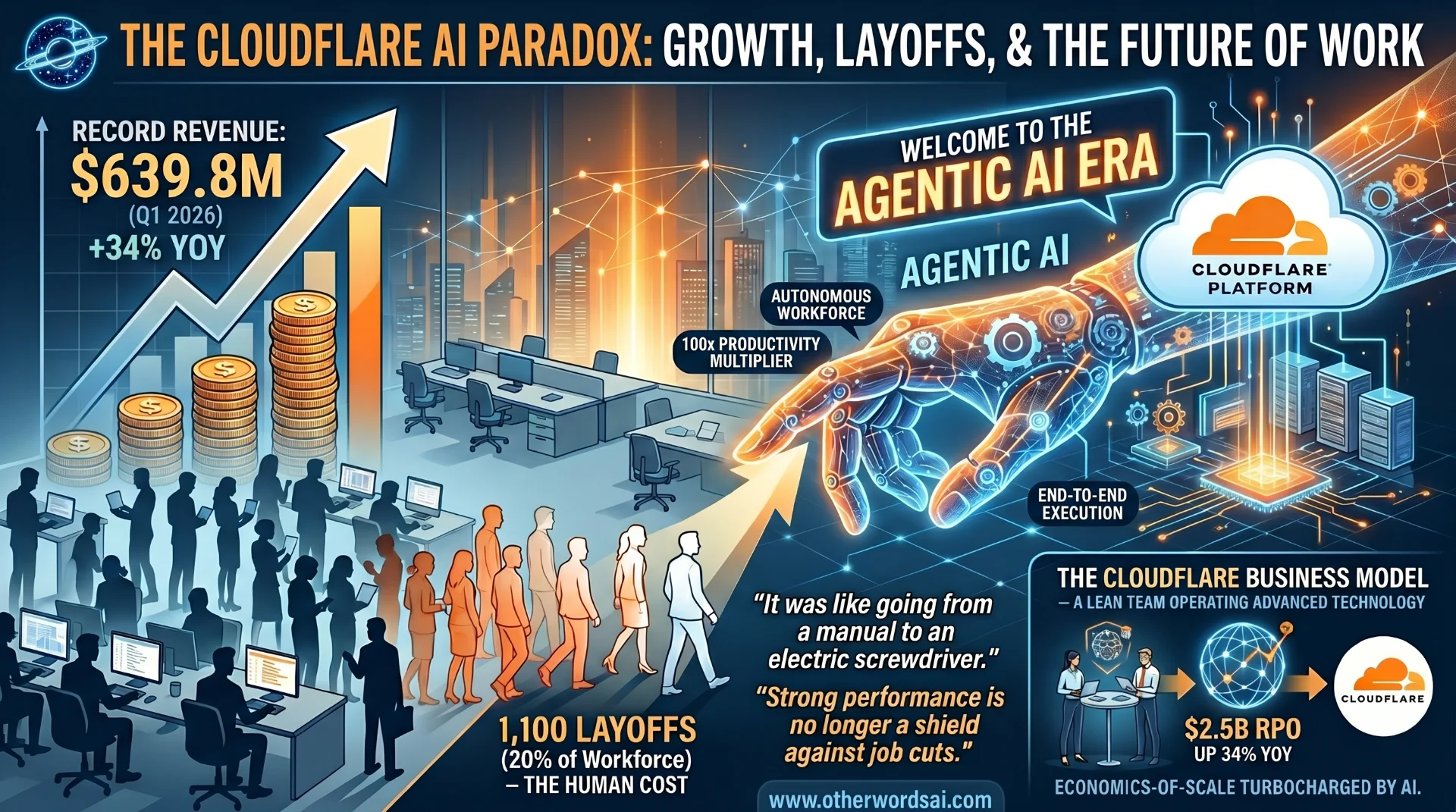
Cloudflare's Q1 2026 earnings report reads like a tale of two companies. On one hand, the company posted quarterly revenues of $639.8 million — a 34% year-over-year increase and the single highest revenue quarter in Cloudflare's history. On the other hand, the company simultaneously reported a net loss of $62.0 million, wider than the $53.2 million loss in the same period last year.
Digging deeper into the numbers, however, reveals a more nuanced picture. While the net loss expanded in absolute terms, it shrank as a percentage of revenue — a signal that Cloudflare is scaling faster than it's bleeding. The company also reported over $2.5 billion in remaining performance obligations (RPO), up 34% year-over-year. RPO — the value of contracted revenue not yet recognized — has become the go-to indicator for analysts evaluating high-growth SaaS and cloud companies, and Cloudflare's figure here is genuinely impressive.
The revenue growth and RPO trajectory suggest a business firing on all cylinders. The layoffs, then, weren't a distress signal — they were, according to Cloudflare's leadership, a strategic statement about what the company intends to become.
'We've Never Done This Before': Matthew Prince on Cloudflare's Historic Layoffs:
CEO Matthew Prince did not shy away from the weight of what Cloudflare was doing. Speaking on the Q1 2026 earnings call, Prince acknowledged that this was the first mass layoff in the company's entire history — a significant admission from a leader who has built Cloudflare's culture around talent retention and mission-driven growth.
“We’ve never done something like this in Cloudflare’s history,” Prince said on the call. The cuts span all teams and geographies, with one notable carve-out: salespeople carrying revenue quotas are exempt. CFO Thomas Seifert confirmed the scope of the reductions, underscoring that this was a company-wide restructuring, not a targeted pruning of underperformers.
The framing Prince and co-founder Michelle Zatlyn used in their accompanying blog post was deliberate and striking. The layoffs were described not as cost-cutting, not as performance management, but as Cloudflare's declaration of how a world-class company operates in the agentic AI era. That language — agentic AI — is worth paying attention to. It signals that Cloudflare sees AI not merely as a productivity tool, but as an autonomous workforce capable of executing tasks end-to-end.
The November Tipping Point: When AI Changed Everything at Cloudflare:
Prince was unusually candid about when, exactly, the calculus changed inside Cloudflare. He pointed to November 2025 as the internal inflection point — the moment when AI-driven productivity gains became too dramatic to ignore. What followed, he described, was a fundamental shift in what individual team members could accomplish.
“Team members that were two, 10, even 100 times more productive than they had been before. It was like going from a manual to an electric screwdriver,” Prince said on the earnings call. That metaphor — electric screwdriver versus manual — is vivid, but it also understates the disruption. When some workers become 100x more productive, the math on headcount changes dramatically. The value of the 99 people behind them evaporates almost overnight.
The scale of Cloudflare's internal AI adoption has been breathtaking by any measure. Prince revealed that Cloudflare's internal usage of AI tools increased by more than 600% in just the last three months — a staggering acceleration that reflects both the company's embrace of the technology and the speed at which AI capabilities have improved. Cloudflare went from being cautious about internal AI adoption to becoming, by Prince's account, a case study in AI-driven workforce transformation.
AI Layoffs in Tech: Cloudflare Joins a Growing and Troubling Trend:
Cloudflare is not alone in this moment — and that's precisely what makes it so significant. Across Silicon Valley and beyond, a pattern has emerged: tech companies reporting strong revenue growth while simultaneously reducing headcount and attributing both outcomes to artificial intelligence. Meta has been explicit about AI-driven efficiency gains underpinning its workforce reductions. Microsoft has quietly shed thousands of roles. Amazon has restructured entire divisions with AI automation in mind.
What sets Cloudflare apart is the explicitness and the scale. A 20% workforce reduction in a single move — the largest in the company's history — announced on the same day as a record revenue quarter, with the CEO directly crediting AI: this is the starkest version yet of a narrative that has been building quietly across the industry for two years. The AI job displacement debate, once largely theoretical, is now showing up in quarterly earnings calls.
For workers across the technology sector, the Cloudflare layoffs carry a chilling implication: strong company performance is no longer a reliable shield against job cuts. In the AI era, growing revenues and shrinking workforces can coexist — and increasingly, they do.
What Is Agentic AI — And Why Is It Eliminating Jobs Faster Than Expected?
The phrase 'agentic AI era' that Cloudflare's leadership used in their blog post deserves unpacking. Agentic AI refers to artificial intelligence systems capable of autonomous decision-making and multi-step task execution — AI that doesn't just assist humans but independently plans, acts, and delivers outcomes. Unlike earlier AI tools that required constant human direction, agentic AI systems can handle complex workflows with minimal oversight.
For a company like Cloudflare, which operates vast, complex internet infrastructure at global scale, the implications of agentic AI are profound. Tasks that previously required teams of engineers, analysts, and operations staff — monitoring, threat detection, performance optimization, incident response — can increasingly be handled by AI agents operating continuously, without fatigue or error. The productivity multiplier Prince described (2x, 10x, even 100x) becomes plausible when you consider what autonomous AI systems can do in these domains.
The uncomfortable truth is that agentic AI doesn't just make workers more productive — it makes many workers redundant. When an AI agent can do in minutes what previously took a team hours or days, the arithmetic of employment changes fundamentally. Cloudflare's 1,100 job cuts may be among the first major public acknowledgments of this shift, but they almost certainly won't be the last.
Cloudflare's Business Model: Why Record Revenue Didn't Prevent Job Cuts:
To understand why Cloudflare cut jobs even as revenue surged, it helps to understand the company's business model. Cloudflare provides internet security, content delivery, and performance services to millions of websites worldwide. Its platform sits between users and the internet, filtering threats, accelerating content, and ensuring reliability. Crucially, Cloudflare's services scale digitally — meaning the company can serve vastly more customers without proportionally growing its headcount.
This economics-of-scale dynamic, turbocharged by AI, creates a situation where revenue growth and workforce growth decouple. Cloudflare's $639.8 million quarter doesn't require 1,100 more people to sustain — in fact, AI has made it possible to deliver that revenue with fewer people than before. The company's widening net loss ($62 million versus $53.2 million a year ago) also suggests pressure to improve margins, even if leadership insists cost-cutting wasn't the motivation.
The remaining performance obligations figure of $2.5 billion is the number that truly explains Cloudflare's confidence. With that much contracted future revenue already locked in, the company has the runway to restructure aggressively today in anticipation of a leaner, AI-powered operating model tomorrow. The bet is that the revenue keeps coming — and that AI keeps reducing the cost of delivering it.
The Human Cost: What 1,100 Job Losses Really Mean:
Behind the earnings metrics and strategic narratives are 1,100 people who have lost their jobs. In the current tech labor market — already softened by years of post-pandemic corrections and previous rounds of industry-wide layoffs — finding new roles isn't easy. The fact that Cloudflare's cuts span all teams and geographies means the impact is diffuse and far-reaching, affecting engineers, product managers, operations staff, and more. Prince's framing — that this is about the future, not individual performance — offers little comfort to those affected.
Being told you've been made redundant not because of anything you did wrong, but because an AI system can now do your job better and cheaper, is a distinctly modern form of professional obsolescence. It raises urgent questions about retraining, reskilling, and how society supports workers displaced not by economic downturns but by technological acceleration.
The Cloudflare layoffs are a data point in a much larger story about the future of work. And as AI systems grow more capable — as the gap between what humans and AI agents can do continues to narrow — the frequency and scale of announcements like this one will only increase. The question is whether policy, education, and corporate responsibility can keep pace with the speed of the transformation.
What Comes Next: Cloudflare's Vision for the AI-First Company:
Cloudflare's leadership has been explicit that this restructuring is not an ending — it's a reimagining. The company is betting that a smaller, AI-augmented workforce can outperform the larger team it replaces, delivering faster innovation, better products, and improved margins. Prince's 'electric screwdriver' metaphor captures the aspiration: each remaining employee, empowered by AI tools, becomes dramatically more capable.
Cloudflare is also, notably, a company that sells AI-powered products. Its Workers AI platform, Zero Trust security solutions, and edge computing infrastructure are all positioned to benefit from the enterprise AI adoption wave. The company's own internal AI transformation, then, serves double duty: it reduces costs and it generates a living proof-of-concept that Cloudflare can sell to its customers. 'We ate our own cooking' is a powerful sales narrative in enterprise tech.
Whether Cloudflare's vision of the AI-first company becomes a template for the industry — or a cautionary tale about the human cost of moving too fast — will depend on how the next several quarters unfold. The revenue trajectory is strong. The RPO pipeline is healthy. But turning a record top line into consistent profitability, with a leaner team operating in a rapidly evolving AI landscape, is easier said than done.
The Bottom Line: A Defining Moment for AI and the Future of Employment:
Cloudflare's Q1 2026 earnings announcement will be remembered as a milestone moment — not just for the company, but for the broader conversation about AI and employment. A 34% revenue surge. A record $639.8 million quarter. And 1,100 people out of work, not because the business is struggling, but because AI made their roles obsolete.
This is the paradox of the agentic AI era laid bare: companies can grow faster, serve more customers, and generate more revenue than ever before — while simultaneously needing fewer humans to do it. That is an extraordinary technological achievement. It is also an enormous social and economic challenge that neither Cloudflare, nor any single company, can solve alone.
What Cloudflare has done is hold up a mirror to where the technology industry is heading. The reflection isn't comfortable. But it is honest. And in a landscape full of corporate doublespeak about AI being purely additive to human potential, that honesty —
however painful for those affected — may be the most significant thing Matthew Prince said on that earnings call.
Cloudflare layoffs 2026 | AI workforce reduction | Tech companies cutting jobs | Agentic AI era
Support our research
Independent analysis fueled by you.