
Intel's Comeback Story: Inside the Wildest Turnaround in Silicon Valley:
Apple, Tesla, and Musk: The Secret Partnerships Fueling Intel’s Fab Revolution.
Intel is back — and Wall Street is betting big on it. What began as a quiet leadership transition has evolved into one of the most dramatic corporate turnaround stories in recent tech history. Bloomberg's deep dive into Intel's revival under new CEO Lip-Bu Tan only scratches the surface of a saga that is simultaneously thrilling and precarious.
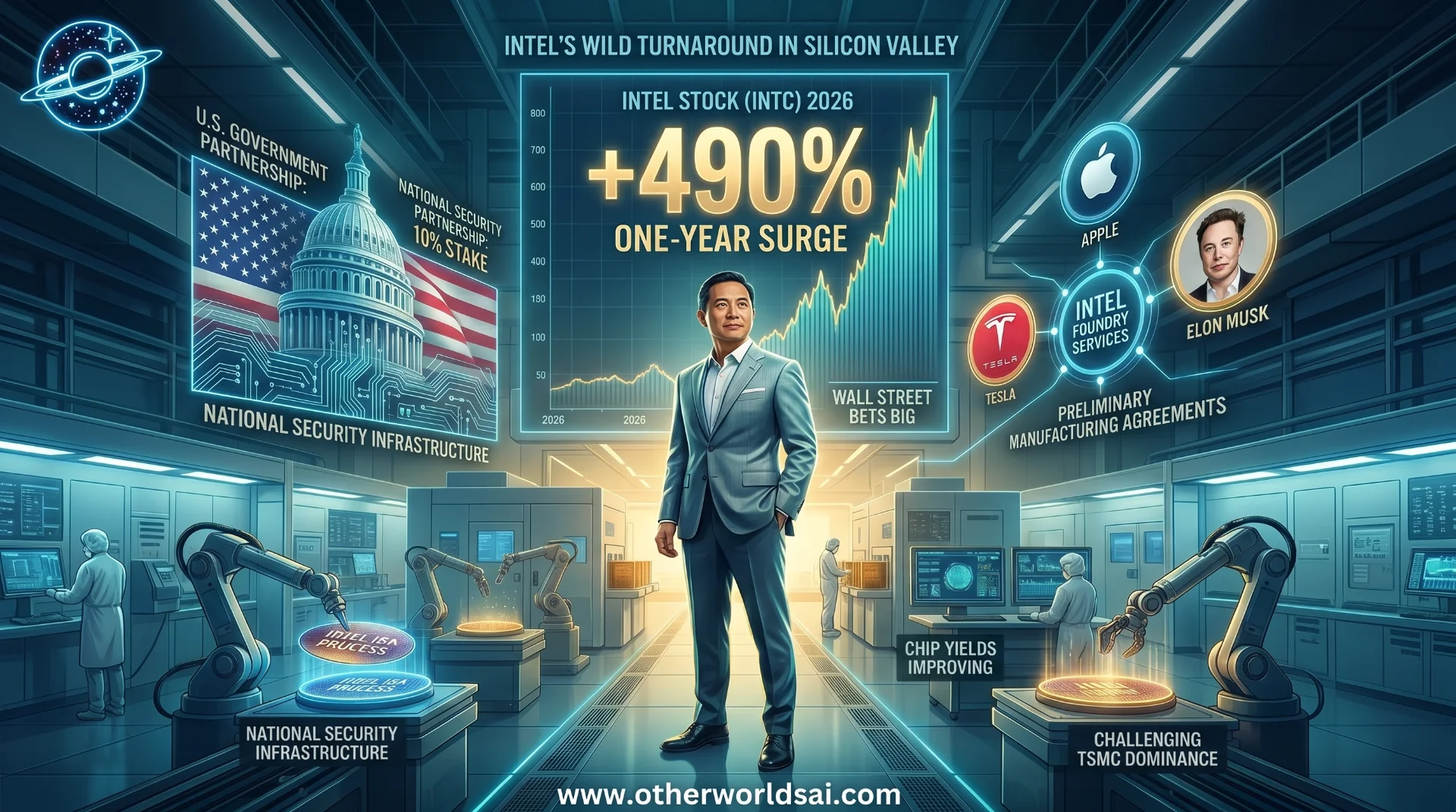
The real headline? Intel's stock has surged an extraordinary 490% over the past year, a staggering vote of confidence from investors — even as the company's fundamentals remain complicated.
This is the Intel turnaround story that everyone in the semiconductor industry is watching closely — and it's about far more than chips. It's about geopolitics, government partnerships, celebrity CEOs, and a race to reclaim America's dominance in advanced chip manufacturing.
Who Is Lip-Bu Tan — And Why Does He Matter to Intel's Future?
When Lip-Bu Tan stepped into the Intel CEO role in March 2025, the chip giant was in serious trouble. Intel had lost ground to TSMC on manufacturing, ceded AI chip leadership to NVIDIA, and was bleeding talent and investor confidence. Tan, a seasoned venture capitalist and former Cadence Design Systems CEO, was a surprising but strategic pick — a steady hand with deep industry credibility and a formidable global network.
Tan's early approach has been notably diplomatic rather than disruptive. Rather than launching sweeping internal restructurings in his first months, the Intel CEO prioritized relationship-building at the highest levels — with government officials, tech titans, and potential manufacturing partners. Critics inside Intel have noted that some teams have been left adjusting missed deadlines rather than recovering from them, raising questions about operational execution.
But the deals he's brokered tell a different story about his strategic vision. Tan has positioned Intel not merely as a chip designer, but as a cornerstone of America's semiconductor sovereignty — a bold and well-timed narrative in today's geopolitical climate.
The U.S. Government Deal: Intel's Most Powerful New Shareholder:
Perhaps the most remarkable element of Intel's resurgence is its newly forged relationship with the U.S. federal government. The government has taken a 10% stake in Intel, making Washington the company's third-largest shareholder — an extraordinary development that blurs the lines between public policy and private enterprise in America's semiconductor strategy.
This government investment reflects growing bipartisan urgency around domestic chip manufacturing. As the U.S.-China tech rivalry intensifies and supply chain vulnerabilities remain top of mind following years of shortages, Intel has successfully positioned its fab (fabrication) business as critical national infrastructure.The Intel foundry services division is now seen not just as a business unit — but as a matter of national security.
This kind of public-private semiconductor partnership has no real precedent in modern American tech history. Whether it gives Intel the runway it needs to close the gap with TSMC — the world's dominant contract chipmaker — remains the central question for analysts tracking the Intel stock forecast.
Elon Musk, Apple, and Tesla: Intel's High-Profile Partnership PlayZ:
Tan's schmoozing has extended well beyond Washington D.C. In a move that sent shockwaves through the semiconductor industry, Intel announced a factory partnership with Elon Musk — an alliance that immediately attracted attention given Musk's influence across the tech and manufacturing worlds. The partnership signals Intel's ambition to become a go-to foundry not just for legacy clients, but for the new generation of AI-driven hardware makers.
Even more significant are the preliminary manufacturing agreements reportedly in place with both Apple and Tesla. For Intel, landing Apple as a fab customer would be a watershed moment — Apple currently relies heavily on TSMC for its custom silicon, including the M-series chips that power MacBooks and iPhones. Any shift toward Intel Foundry Services would represent a seismic change in the global chip manufacturing landscape.
Tesla's potential involvement is equally intriguing, particularly as the EV giant continues to develop custom AI chips for its autonomous driving systems. These high-profile relationships are still preliminary, but they speak to the credibility Tan has rapidly accumulated in a short period — and they've fueled the Intel stock rally that has stunned even bullish observers.
The Hard Truth: Intel's Manufacturing Challenges Aren't Fixed Yet:
For all the excitement, Intel's turnaround is far from complete — and the technical challenges are daunting. Intel's chip yields, a critical measure of how many usable chips come off a production line, continue to lag significantly behind TSMC's. In the semiconductor industry, yield rates directly affect profitability, delivery timelines, and the ability to win and retain customers.
Internally, the picture is even more sobering. According to Bloomberg's reporting, employees describe a leadership style from Tan that has been light on specifics, with teams sometimes adjusting timelines rather than genuinely recovering from delays. For a company competing at the bleeding edge of semiconductor technology — where nanometer precision matters — execution gaps can be enormously costly.
Intel's process technology roadmap, including its ambitious Intel 18A node, is considered the linchpin of the entire turnaround. Intel 18A is meant to demonstrate that the company can match or exceed TSMC's manufacturing capabilities at the frontier. Delays or yield issues with 18A could rapidly deflate the optimism that has driven the Intel stock price surge.
Intel Stock Up 490%: Is Wall Street Getting Ahead of the Story?
The most jaw-dropping data point in Intel's comeback narrative isn't a deal or a partnership — it's the stock chart. A 490% rise in Intel's share price over twelve months is extraordinary by any measure. For context, even NVIDIA — the poster child for AI-era semiconductor success — didn't see gains of that magnitude in a single year during its peak hype cycle.
What does the Intel stock surge reflect? Analysts point to a combination of factors: relief that a credible CEO is finally in place, optimism about the government partnership and its implied financial backstop, excitement about the Apple and Tesla manufacturing talks, and broader enthusiasm for domestic semiconductor plays amid trade tensions. The stock has also benefited from short-covering and momentum trading.
But there's a real risk that investor enthusiasm is running well ahead of operational reality. Intel's revenue, margins, and market share in key categories haven't yet shown the kind of improvement that would justify a near-fivefold valuation increase. The Intel semiconductor comeback story is compelling — but it is still, fundamentally, a story about the future, not the present.
Intel vs. TSMC: The Battle for Advanced Chip Manufacturing Supremacy:
At the heart of Intel's turnaround is an audacious ambition: to challenge TSMC's dominance in advanced semiconductor manufacturing. TSMC currently produces the vast majority of the world's most sophisticated chips, including those designed by Apple, NVIDIA, AMD, and Qualcomm. Intel Foundry Services aims to become a credible alternative — a goal that requires not just catching up technically, but convincing skeptical customers to take a risk on a manufacturer still proving itself.
The competitive landscape is shifting in ways that could work in Intel's favor. TSMC's concentration in Taiwan remains a geopolitical vulnerability that makes governments and companies nervous. Intel's U.S.-based manufacturing capacity — expanded significantly with CHIPS Act funding — offers a geographic diversification that TSMC simply cannot match. In a world increasingly concerned about supply chain resilience, that's a genuine strategic advantage.
Whether Intel can translate geopolitical advantage into technological parity is the multibillion-dollar question hanging over every quarterly earnings call, every manufacturing update, and every analyst note about the company's future.
What Intel's Turnaround Means for the Broader Semiconductor Industry:
Intel's revival — if it succeeds — would reshape the global semiconductor supply chain in profound ways. A credible Intel Foundry Services could break TSMC's near-monopoly on cutting-edge chip production, giving chip designers more options, more leverage, and potentially better pricing. It could also accelerate the U.S. semiconductor renaissance that policymakers have been trying to engineer since the CHIPS and Science Act was signed into law.
For AI chip manufacturing specifically, the stakes are even higher. As demand for advanced AI accelerators continues to grow exponentially, the world's capacity to produce chips at the cutting edge is being stretched. An Intel that can reliably manufacture at the frontier would meaningfully expand global AI infrastructure capacity — a macro development with implications far beyond Intel's own balance sheet.
The semiconductor industry is watching Lip-Bu Tan's every move with intense interest — not just as a corporate story, but as a test case for whether legacy American tech giants can reinvent themselves in the age of AI and geopolitical competition.
The Bottom Line: A Comeback Story Still Being Written:
**Intel's turnaround under Lip-Bu Tan **is one of the most compelling corporate narratives in Silicon Valley today. The ingredients are all there: a charismatic CEO with powerful relationships, a government partnership unlike anything seen before in American tech, preliminary deals with Apple and Tesla, and a stock price that has already made believers of millions of investors.
But the fundamentals tell a more cautious story. Chip yields lag. Internal execution has been uneven. The 18A manufacturing node — Intel's great technological hope — has yet to prove itself at scale. And a 490% stock rally means expectations are sky-high, leaving very little room for disappointment.
Intel's comeback story is real — but it's also, in many ways, still being written. The schmoozing phase is over. Now comes the part where Intel has to actually deliver.
Whether Wall Street's extraordinary bet pays off depends entirely on what happens inside those fabrication plants — and that's a story no amount of dealmaking can shortcut.
Intel stock surge 2026 | Intel CEO Lip-Bu Tan | Semiconductor industry comeback

Meta's Next Big Bet: This New App Lets You Build Games Simply by Typing a Prompt
Support our research
Independent analysis fueled by you.