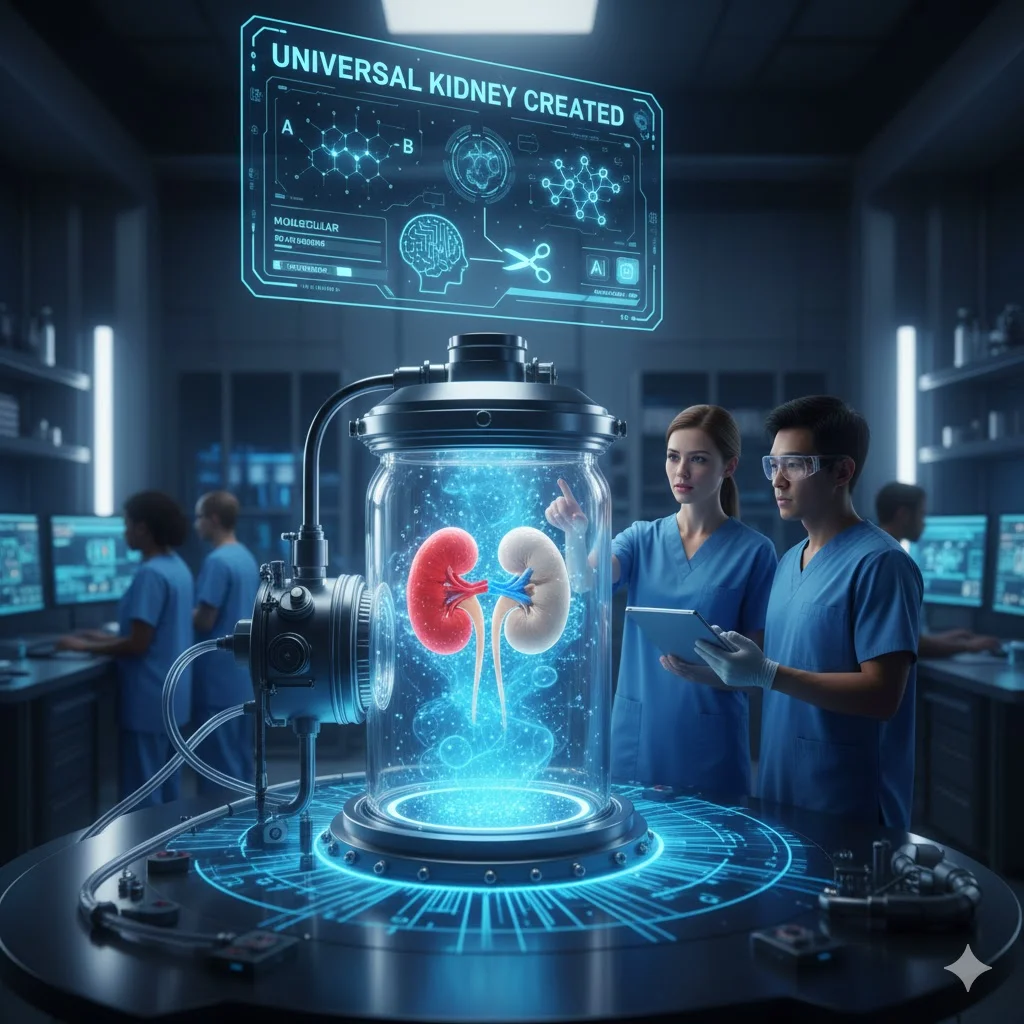

Imagine a world where the agonizing wait for a life-saving kidney transplant is dramatically shortened,
where the lottery of blood type matching no longer dictates who lives and who dies. This isn't a distant dream; it's a rapidly approaching reality, fueled by groundbreaking scientific discovery and powered by the silent intelligence of Artificial Intelligence.
For over a decade, scientists have been relentless in their pursuit of a "universal kidney" – an organ capable of being accepted by any patient, regardless of their blood type. Today, we stand on the precipice of a medical revolution, thanks to a collaborative team from institutions across Canada and China. Their success in creating a kidney that, in theory, can be accepted by any patient is not merely an incremental step; it's a monumental leap that promises to transform the landscape of organ transplantation forever.
The Silent Crisis: When Blood Types Become Barriers:
To truly appreciate the magnitude of this breakthrough, we must first understand the formidable challenge that has plagued organ transplantation for decades: blood type matching. Our individual blood types (A, B, AB, and O) are determined by specific sugar molecules, known as antigens, present on the surface of our red blood cells and, crucially, on the cells of our organs.
When an organ carrying foreign antigens is introduced into a recipient with a different blood type, their immune system mounts a fierce attack, leading to rapid and often irreversible rejection of the transplant.
This biological reality has created a devastating bottleneck, particularly for individuals with Type O blood. While Type O individuals are "universal donors" for blood transfusions, their immune systems can only accept organs from other Type O donors. This means that over half the people on kidney waiting lists, many of whom are Type O, face the longest and most perilous waits, tragically succumbing to their illness before a compatible organ can be found.
Traditional methods to overcome this, such as "desensitization" therapies, are expensive, risky, and resource-intensive, making them inaccessible to the vast majority.
The Molecular Scissors: How a Universal Kidney is Born:
The brilliance of this new approach lies in its elegant simplicity: instead of modifying the patient's immune system, scientists have figured out how to modify the organ itself. The research team, spearheaded by biochemist Stephen Withers from the University of British Columbia, discovered special enzymes that act like "molecular scissors."
Here's the mechanism:
-
The Target: These enzymes are specifically designed to target and remove the A and B sugar molecules (antigens) from the blood vessels of a donor kidney. This process effectively "erases" the organ's blood type identity.
-
The Transformation: By snipping away these specific markers, a Type A or Type B kidney is converted into an ABO antigen-free status – the defining characteristic of Type O blood.
-
The Analogy: Withers aptly describes it as "removing the red paint from a car and uncovering the neutral primer." Once these "paints" are gone, the recipient's immune system no longer recognizes the organ as foreign.
The result is an enzyme-converted type-O (ECO) kidney, poised for transplant into any patient, regardless of their own blood type.
AI: The Unseen Architect Behind the Breakthrough:
While the enzymes are the tangible heroes of this story,the true unsung hero is Artificial Intelligence. This groundbreaking research, like so many complex scientific endeavors today, could not have progressed at such speed and precision without AI's powerful capabilities. AI has been instrumental in three critical phases of this discovery:
- Navigating the Microbial Universe: The "Haystack" Problem: The enzymes used as "molecular scissors" were found within the vast and complex human gut microbiome. Imagine searching for a specific needle in a haystack the size of a galaxy – that's the challenge of sifting through trillions of bacteria and millions of unique enzymes.
AI's Role: Machine Learning (ML) algorithms and advanced computational biology tools were deployed to scan colossal genomic databases of bacteria. Instead of laboriously testing every single enzyme in a lab, AI models (like AlphaFold) predicted which enzyme structures were most likely capable of efficiently breaking down the specific A and B sugar molecules (antigens). AI drastically accelerated a search that would have taken decades, zeroing in on the most promising candidates with incredible speed and accuracy.
- Precision Engineering: Virtual Trials Before Reality: Before these enzymes could ever touch a delicate human organ, scientists had to be absolutely certain they would perform their task precisely without causing unintended damage.
AI's Role: Researchers utilized Digital Twins – AI-powered virtual models of human organs and their intricate cellular structures. These advanced simulations allowed scientists to virtually test the "molecular scissors," observing how they interacted with the kidney's tissues at a microscopic level. This ensured that while the "red paint" was being removed, the vital "engine" of the kidney remained perfectly intact, minimizing risks before any physical experimentation.
- Decoding the Immune Response: Predicting the Unpredictable: The initial human trial, while incredibly promising, showed a mild immune response as some Type A antigens began to reappear after three days. Understanding why this happens and how to prevent it is the next critical hurdle.
AI's Role: AI is now being applied to analyze the vast datasets generated from the recipient's biological response, including proteomics (the study of proteins) and immunological markers. AI algorithms can identify complex patterns and correlations, predicting why and when these antigen markers return.
This data is crucial for refining the enzyme treatment and developing "smart" dosing schedules for immunosuppressant drugs, potentially tailored to each patient's unique biological clock, to maintain the converted state for longer.

Meta's Next Big Bet: This New App Lets You Build Games Simply by Typing a Prompt
A Landmark Human Trial: Hope Becomes Tangible:
The theoretical promise of the universal kidney, powered by AI-driven insights, recently became a tangible reality. In a groundbreaking procedure, an ECO kidney was transplanted into a brain-dead recipient (with the compassionate consent of their family).
The results were historic: the converted kidney not only survived but functioned effectively for several days, showing no hyperacute rejection—a rapid immune attack typical of mismatched organs.
While a mild immune response was observed on the third day as some Type A antigens reappeared, it was significantly less severe than a standard mismatch. Crucially, the body also showed encouraging signs of trying to tolerate the new kidney. This initial success, though still requiring refinement, offers profound hope and a clear path forward.
Support our research
Independent analysis fueled by you.
The Future: AI-Managed Organ Logistics and a World Without Waiting Lists:
The implications of a universal kidney, especially one refined with AI, are nothing short of revolutionary:
-
Saving Lives: Every day, 11 people die in the United States alone while waiting for a kidney transplant. A universal kidney could drastically reduce this tragic statistic, opening up the donor pool and giving thousands a second chance at life.
-
Ending Disparities: The disproportionately long wait times faced by Type O patients would become a relic of the past, creating a more equitable and efficient allocation system.
-
Optimized Utilization: AI could eventually manage global organ exchange networks, calculating real-time factors like organ viability during transport, patient urgency, and the optimal pre-transplant treatment for each specific donor organ.
This breakthrough is a testament to human ingenuity amplified by the power of AI. While the "molecular scissors" are the tools, AI is the GPS and the blueprint, guiding scientists to find the right solutions and implement them with unprecedented precision. The immediate focus remains on refining the enzyme treatment to maintain the converted state for longer. Yet, this represents an undeniable, monumental step forward.
If perfected, the universal kidney, conceived and refined with AI's guiding hand, could become as transformative for transplant medicine as universal blood donations were for emergency care—removing one of the biggest barriers to saving lives and ushering in a new era of hope for millions worldwide.
The future of organ transplantation looks brighter, and smarter, than ever.