
Altara Secures $7M Seed Funding to Transform AI-Powered Data Intelligence for Physical Sciences:
How a Harvard-founded startup is using artificial intelligence to close the data gap in battery development, semiconductor research, and medical device manufacturing.
The Data Problem Holding Physical Sciences Back:
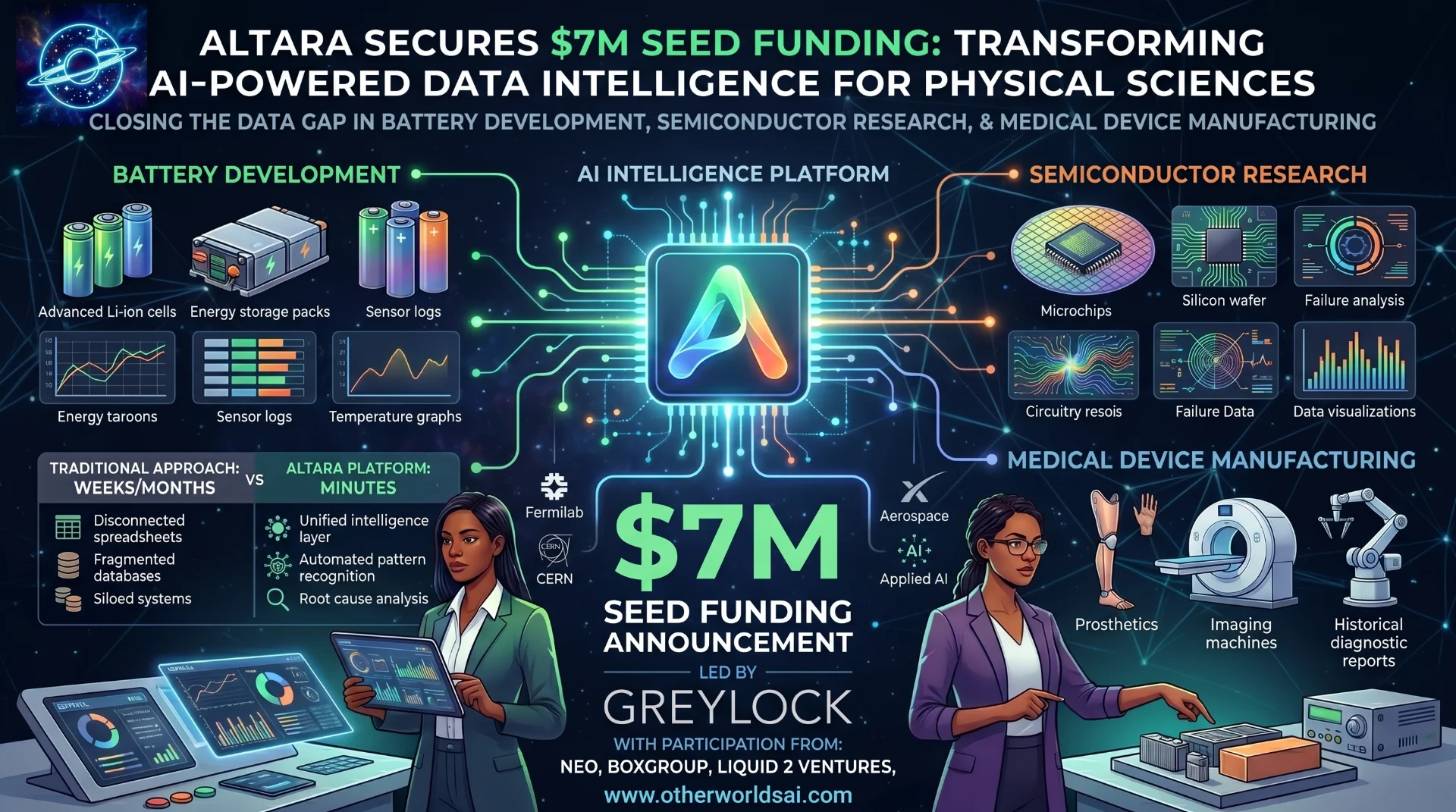
The physical sciences are sitting on a gold mine of untapped data — and most of it is buried. Companies building next-generation batteries, semiconductors, and medical devices generate enormous volumes of technical information every day. Yet the vast majority of this mission-critical data ends up fragmented across disconnected spreadsheets, legacy databases, and siloed systems — impossible to act on, impossible to learn from.
This is the core challenge that San Francisco-based startup Altara has set out to solve. In a market where AI-driven R&D acceleration and manufacturing intelligence are rapidly becoming competitive necessities, Altara is positioning itself as the definitive AI data platform for the physical sciences — offering a unified intelligence layer that transforms raw, scattered technical data into actionable insights.
$7 Million in Seed Funding: Who's Backing Altara and Why:
Altara has officially closed a $7 million seed funding round, marking a significant milestone for the emerging AI-for-hardware space. The round was led by Greylock — one of Silicon Valley's most respected deep-tech investors — with participation from Neo, BoxGroup, Liquid 2 Ventures, and Jeff Dean, the legendary AI researcher and former Google Brain lead.
The caliber of investors backing Altara speaks volumes about the scale of the opportunity. Greylock partner Corinne Riley, who led the investment, has articulated a compelling analogy: Altara is doing for hardware and physical science what site reliability engineers (SREs) do for software. When a software system fails, an SRE investigates the observability stack, traces back a faulty code push, and resolves the outage. Altara brings this same forensic, data-driven approach to the physical world.
"Someone pushed a change to the code, and that's what caused an outage," Riley explained, drawing parallels to how Altara diagnoses hardware failures — from a malfunctioning battery cell to a defective semiconductor component.
Meet the Founders: Physics, AI, and a Harvard Connection:
Altara was founded in 2025 by two exceptional scientists-turned-engineers with complementary and deeply relevant backgrounds. Eva Tuecke brings a rare combination of particle physics expertise — having conducted research at Fermilab, one of the world's leading high-energy physics laboratories — and real-world engineering experience from SpaceX. Co-founder Catherine Yeo previously served as an AI engineer at Warp, giving the team direct experience building production-grade AI systems.
The two founders met as computer science students at Harvard University, where they developed a shared vision for applying advanced AI to the underserved world of physical science data. Their complementary backgrounds — experimental physics meets applied AI engineering — give Altara a uniquely credible foundation in a field where deep domain knowledge is essential.
How Altara's AI Platform Works: From Failure to Fix in Minutes:
To understand Altara's value proposition, consider a real-world scenario that plays out every day in battery R&D labs. A battery cell fails during testing. A team of engineers must manually hunt through sensor logs, temperature data, moisture readings, historical failure reports, and a dozen other data sources — all stored in different systems, in different formats, with no shared context.
"A team of engineers has to go in and manually check a lot of different sources of data, anything from their sensor logs to their temperature data, moisture data. They cross-check historical failure reports," explained Catherine Yeo.
This 'data scavenger hunt' can consume weeks or even months of highly skilled engineering time — time that should be spent on innovation, not data archaeology. Altara's AI platform eliminates this bottleneck by ingesting data from multiple sources, automatically cross-referencing patterns, and surfacing the root cause of failures in a fraction of the time.
The company claims its platform compresses weeks of manual data triaging into mere minutes — a productivity leap that has enormous implications for reducing time-to-market, lowering R&D costs, and improving product quality in industries where physical testing cycles are slow and expensive.
The Market Opportunity: AI for Hardware Is the Next Frontier:
The timing of Altara's launch couldn't be more strategic. The global push toward clean energy, advanced semiconductors, and next-generation medical devices has created an unprecedented demand for faster R&D cycles. At the same time, AI-driven data intelligence is rapidly becoming a standard tool in software companies — and the physical sciences are just beginning to catch up.
Greylock's investment thesis is informed by their experience backing Resolve, an AI platform for software reliability now valued at $1.5 billion. Altara is positioned to become the hardware equivalent — an AI root cause analysis and failure diagnostics platform for manufacturers and research teams working with real-world physical systems.
The addressable market spans battery manufacturers, chip fabs, medical device companies, aerospace firms, and beyond — any organization where physical systems generate data and failures carry significant financial or safety consequences.
Altara vs. the Competition: A Leaner, Smarter Approach to AI in Science:
Altara operates in a growing landscape of AI-for-science startups, but stands out through its deliberately pragmatic strategy. Companies like Periodic Labs — which raised a whopping $300M seed round backed by former OpenAI and DeepMind researchers — and Radical AI are pursuing highly capital-intensive approaches, attempting to rebuild scientific research processes from the ground up.
Altara is taking a fundamentally different, and arguably more immediately deployable, approach. Rather than trying to replace decades of established research infrastructure and manufacturing workflows, Altara provides an intelligence layer that plugs directly into customers' existing data systems. This means faster enterprise adoption, lower switching costs, and a shorter path to demonstrating ROI.
The 'integration-first' strategy is also far less capital-intensive — an important consideration for a startup seeking sustainable growth in a market that rewards patience and technical credibility over pure scale.
Key SEO Takeaways: Why Altara Matters for the Future of Physical Science AI:
Altara represents a pivotal moment in the convergence of artificial intelligence and physical sciences. The startup's platform directly addresses one of the most persistent and costly pain points in hardware R&D: the fragmentation of technical data across incompatible systems. By translating weeks of manual investigation into minutes of AI-powered analysis, Altara has the potential to materially accelerate product development cycles, reduce failure rates, and cut R&D costs across multiple high-value industries.
With $7 million in seed capital, world-class investors, and two founders with rare domain depth, Altara is well-positioned to become a foundational infrastructure platform for the next generation of physical science companies. As the race to build better batteries, smarter chips, and safer medical devices intensifies, intelligent data platforms like Altara will prove indispensable.
The question is no longer whether AI will transform the physical sciences — it's which platforms will lead the way. Altara is making a compelling case that the answer starts with the data.