
Marc Lore's Wonder Wants to Let Anyone Launch an AI-Designed Restaurant in Under a Minute:
How the serial entrepreneur behind billion-dollar exits to Amazon and Walmart is using AI, robotics, and programmable kitchens to reinvent the restaurant industry from the ground up:
The Serial Entrepreneur Who Keeps Betting on the Future of Commerce:
Few entrepreneurs in the American tech landscape have a track record quite like Marc Lore's. The e-commerce veteran built Diapers.com into a billion-dollar business that Amazon acquired, then co-founded Jet.com and sold it to Walmart for $3.3 billion — making it one of the largest e-commerce acquisitions in history. Now Lore has set his sights on an industry that has resisted disruption for generations: the restaurant business.
His current venture, Wonder, is not a restaurant in any traditional sense. It is a vertically integrated dining and delivery platform — part tech company, part food manufacturer, part logistics operation — and Lore's ambitions for it are as sweeping as anything he has built before. Speaking at The Wall Street Journal's 'Future of Everything' conference, Lore laid out a vision that could fundamentally change who gets to own a restaurant brand and how food reaches the table.
Wonder Create: Build Your Own Restaurant Brand with an AI Prompt:
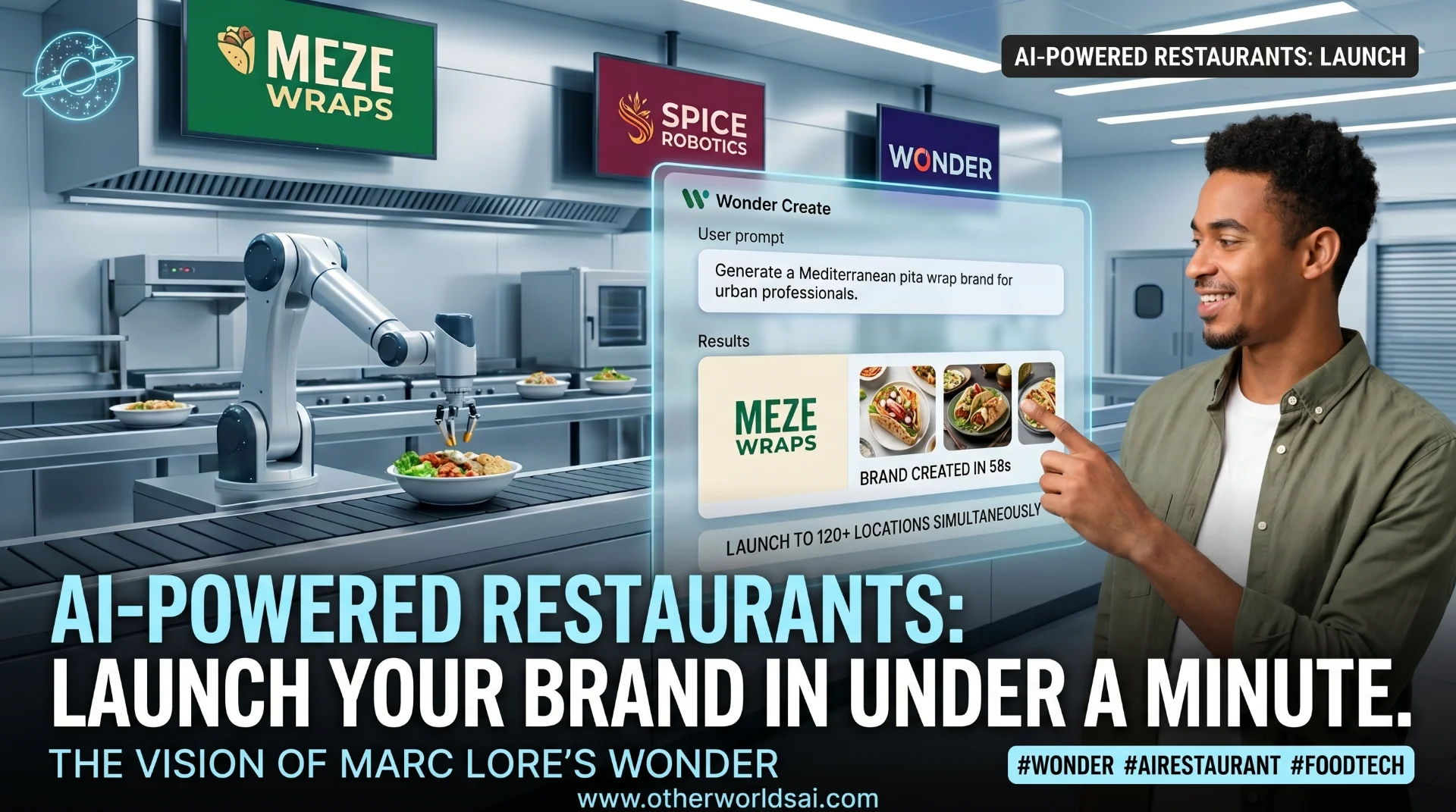
The centerpiece of Wonder's AI strategy is Wonder Create — an initiative that promises to let literally anyone design and launch their own restaurant brand in under sixty seconds. The concept is remarkably straightforward in execution, even if the technology behind it is anything but. A user types a description of the restaurant they want to build, and AI takes over from there.
Lore described the experience as something like a 'Shopify front-end with an AI prompt' — a framing that deliberately evokes the democratization of e-commerce that Shopify enabled for physical retail. The AI handles everything: the restaurant name, branding, visual identity, menu descriptions, photographs, pricing, nutritional information, and complete recipes.
"You type in what kind of restaurant you want to build. It builds the restaurant — AI does — in under a minute. It does the name, branding, description, pictures, pricing, health information, and all the recipes for your restaurant," Lore explained at the WSJ event. Once satisfied with the AI-generated output, the creator can refine through additional prompts — and when ready, the restaurant goes live simultaneously across all of Wonder's physical locations.
Programmable Cooking Platforms: The Tech-Enabled Kitchen Behind the Magic:
To understand how Wonder can promise this kind of instant restaurant creation, you need to understand what its kitchens actually are. Wonder operates what it calls 'programmable cooking platforms' — all-electric kitchen locations that are increasingly robotic and currently number 120 sites across its network, with plans to expand to 400 locations by next year.
These are not ordinary commercial kitchens. Each location is engineered to operate as up to 25 different restaurant types simultaneously, drawing from a 700-ingredient library to fulfill orders across multiple brand identities from a single physical space. Staff of up to 12 people work alongside cooking technology including conveyor systems and robotic arms — a human-machine collaboration optimized for speed, consistency, and scale.
Wonder recently acquired Spice Robotics, maker of an automatic bowl-making machine previously deployed by Sweetgreen, further deepening its automation stack. Next year, the company plans to introduce what it calls an 'infinite sauce machine' — capable of producing approximately 80% of all sauces found in recipes across the internet. The throughput implications are staggering: Wonder currently handles about 7 million meal outputs with 12 staff members per location, and Lore sees a clear path to 20 million throughput from the same 2,500 square feet with the same headcount.
"The goal also is…I guess by 2035, to have 1,000 unique restaurants operating out of the 2,500 square feet," Lore told the WSJ audience — a statement that reframes what a restaurant brand even means in the age of AI and automation.
Who Wonder Create Is Built For: Influencers, Entrepreneurs, and Everyone Between:
The potential user base for Wonder Create is deliberately broad — and Lore's vision for it goes well beyond professional food entrepreneurs. The platform is designed to serve anyone who wants to turn a food concept or an audience into a revenue-generating restaurant brand, without the capital requirements, operational complexity, or physical infrastructure that traditionally come with opening a restaurant.
Lore envisions a diverse spectrum of creators using the platform to monetize in entirely new ways. A fitness influencer could launch a branded bowl restaurant tailored to their audience's nutrition goals. A mega-influencer or micro-influencer could offer fans a tangible, purchasable connection to their personal brand. A nonprofit could create a restaurant concept to fund its mission. Even an entertainment giant like Disney could spin up a themed restaurant experience to market a new film release.
"It could be a mega-influencer, a micro-influencer — anyone that wants to monetize their following. Or it could be a private trainer that wants to make specific bowls. It could be a not-for-profit. It could be Disney for their new movie. Anybody can make a restaurant," Lore said.
For traditional food entrepreneurs, Wonder Create also offers a powerful testing ground. A restaurateur considering a new menu concept could launch it on Wonder to gauge real customer reaction before committing to a permanent addition at their brick-and-mortar locations — dramatically lowering the cost and risk of culinary experimentation.
Learning from the Ghost Kitchen Graveyard: How Wonder Is Different:
Wonder Create's model will inevitably invite comparisons to the ghost kitchen trend that swept the restaurant industry in the early 2020s — and those comparisons come with a cautionary tale. Ghost kitchens promised to let brands sell food without the overhead of owning physical restaurant space, but many of the most high-profile operators struggled to build customer loyalty, maintain food quality across distributed kitchens, and achieve sustainable unit economics.Several major players scaled back sharply or shut down entirely.
MrBeast Burger became the defining case study in ghost kitchen failure. The celebrity-backed brand faced a torrent of customer complaints about inconsistent food quality — a direct consequence of relying on dozens of independently operated contracted kitchens with varying staff, equipment, and standards. The brand became a cautionary illustration of what happens when distribution outruns quality control.
Wonder's architecture is specifically engineered to solve exactly this problem. Because every Wonder kitchen is a standardized, increasingly automated programmable cooking platform drawing from the same ingredient library and executing the same AI-optimized recipes, consistency is baked into the infrastructure — not dependent on the individual skill or standards of a contracted third party. The company owns and controls the entire production stack, from recipe to robotic arm to delivery.
That said, Wonder's model is still largely unproven at scale, and Lore himself acknowledges its current limitations. Wonder's kitchens cannot execute techniques that require skilled human craft — tossing and stretching pizza dough, or slicing and rolling sushi, for example. The platform's sweet spot is in simpler, high-volume categories: burgers, chicken wings, fried chicken, and bowls. Within those parameters, the automation advantage is significant.
The Full Wonder Ecosystem: Grubhub, Blue Apron, and a Brand Acquisition Strategy:
Wonder Create and its AI-powered restaurant generation are just one piece of a much larger strategic mosaic that Lore is assembling. The company has been on an aggressive acquisition spree designed to build a vertically integrated food platform that controls every point of the value chain — from brand creation to delivery.
Wonder's acquisition of Grubhub brought 250 million deliveries per year of delivery infrastructure directly under its roof, while the purchase of Blue Apron added a meal kit business that expands Wonder's reach into the home cooking category. Most recently, Wonder acquired New York City-based Blue Ribbon Fried Chicken for $6.5 million in February — a move that illustrates Lore's broader brand acquisition playbook.
"When you buy a brand — and you can buy a brand that has 10 locations, or even 50 locations — and then overnight put it in 1,000, there's just an incredible arbitrage there," Lore explained. The logic is compelling: established restaurant brands carry consumer trust and brand equity that typically takes years and millions of dollars to build. Wonder can acquire that equity at a fraction of the cost and then distribute it instantly across its expanding network of programmable kitchens.
What Wonder's Vision Means for the Future of the Restaurant Industry:
Marc Lore's Wonder represents one of the most ambitious attempts yet to apply Silicon Valley's scale-first logic to an industry that has historically resisted it. By combining AI-generated brand creation, robotic kitchens, aggressive acquisitions, and a proprietary delivery network, Wonder is building infrastructure that could make the traditional model of restaurant ownership look unnecessarily expensive and slow.
The implications for food entrepreneurs, content creators, and established restaurant brands are profound. If Wonder's programmable kitchen network reaches 400 locations and its AI platform delivers on its promise, the barrier to launching a national food brand could drop from millions of dollars and years of effort to a single well-crafted prompt and sixty seconds of computation time.
The question, as always with moonshot ventures, is execution. Ghost kitchens promised democratization and delivered inconsistency. Robotics in restaurants has been predicted for a decade and remains largely in pilot phase.
But Lore has built and sold billion-dollar companies before by seeing distribution opportunities that others missed. If anyone can make programmable, AI-powered restaurants work at scale, the smart money says it's him.