
SAP Bets $1.16 Billion on 18-Month-Old German AI Lab — and Takes a Hard Stance on Enterprise AI Agents:
The Great AI Lockdown: Why SAP is Blocking OpenClaw and Third-Party Agents:
How SAP's acquisition of Prior Labs and its strict agentic AI policy reveal a company fighting on two fronts — racing to lead in structured data AI while defending its enterprise ecosystem from unauthorized agents.
The Enterprise AI Gap SAP Can No Longer Afford to Ignore:
The promise of AI transforming enterprise business processes has been a headline story for years — but the reality on the ground tells a different story. Even OpenAI's own COO acknowledged as recently as February 2025 that AI had not yet meaningfully penetrated enterprise business workflows at scale. For SAP — the German software giant whose products underpin the accounting, HR, procurement, and expense management operations of thousands of the world's largest companies — that gap represents both an existential threat and a generational opportunity.
SAP's stock has taken a significant hit in 2026, caught in the broader wave of disruption analysts have dubbed the 'SaaSpocalypse' — a reckoning for legacy enterprise software players as AI-native competitors begin to chip away at workflows that incumbents have owned for decades. Against this backdrop, SAP's latest strategic moves are a direct and forceful response: move fast, acquire deep, and control the ecosystem.
SAP Acquires Prior Labs: A $1.16 Billion Bet on Structured Data AI:
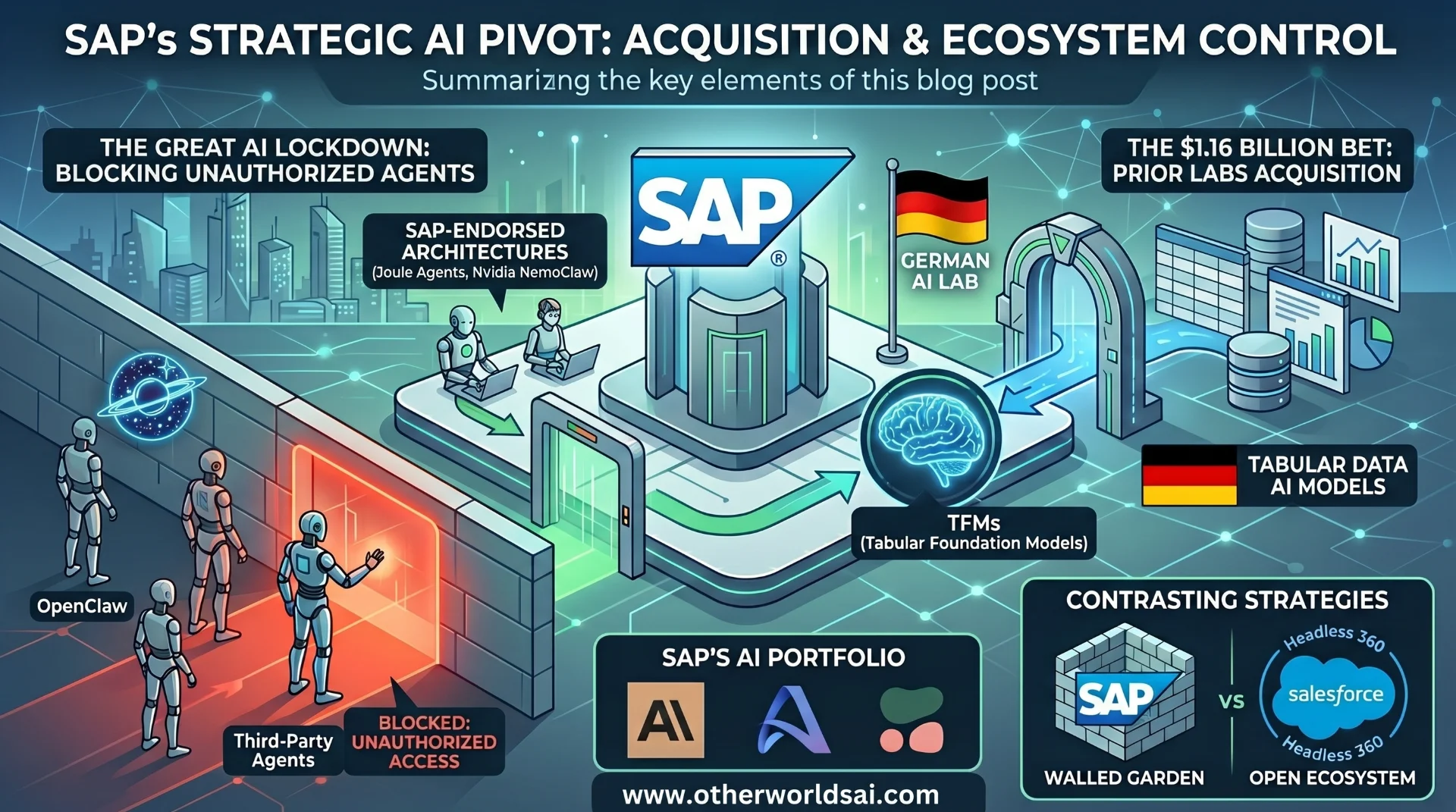
In what may prove to be one of the most strategically significant enterprise AI acquisitions of 2025, SAP has announced its intention to acquire Prior Labs — an 18-month-old German AI startup — for an undisclosed sum. Pending regulatory approval, SAP plans to invest €1 billion (approximately $1.16 billion USD) into the business over the next four years, transforming it into a dedicated AI research lab focused on structured data: the tables, rows, and relational databases where enterprise information actually lives.
While SAP declined to reveal the acquisition price, industry sources confirmed to Pathfounders that this was a very healthy exit for the startup's founders — Frank Hutter, Noah Hollmann, and Sauraj Gambhir. The deal was described as 'almost all cash,' with well over half a billion dollars in cash paid upfront to the founding team. For a startup that raised just $9.3 million in pre-seed funding less than two years ago, this represents one of the most remarkable venture outcomes in German tech history.
Balderton Capital partner James Wise, whose firm led Prior Labs' pre-seed round, celebrated the news on X, calling it "one of Germany's biggest ever venture outcomes." The deal underscores the premium that enterprise software incumbents are now willing to pay to close the AI capability gap.
Who Built Prior Labs and What Makes Their Technology Different:
Prior Labs was founded just 18 months ago with a singular, highly focused mission: building AI that natively understands tabular data. Co-founders Frank Hutter, Noah Hollmann, and Sauraj Gambhir built the company around tabular foundation models (TFMs) — AI models specifically designed to make predictions from data that lives in tables and databases, rather than from unstructured text or images.
This distinction matters enormously in the enterprise context. While large language models have captured the public imagination, the data that actually runs global enterprises — financial records, inventory systems, HR databases, supply chain logs — is overwhelmingly structured and tabular. Prior Labs' TabPFN model series was purpose-built for this reality, and it has gained remarkable traction: its open source models have been downloaded over three million times by developers worldwide.
The startup's headquarters in Freiburg, Germany, adds symbolic resonance to the deal. SAP — Germany's most valuable company — is acquiring a German-born AI lab and promising to help it become a globally-leading frontier AI research institution for structured data, built in Europe, and kept open source.
What SAP Plans to Build: Tabular Intelligence Meets Enterprise AI:
SAP's strategic vision for Prior Labs goes well beyond acquiring a set of impressive models. The company wants to combine tabular foundation models with language capabilities, reasoning, and deep domain knowledge — creating AI that can extract intelligence directly from the structured databases where enterprise data already resides, without requiring complex data migration or transformation.
SAP CTO Philipp Herzig made the company's thesis explicit: "Early on, SAP recognized that the greatest untapped opportunity in enterprise AI wasn't large language models; it was AI built for the structured data that runs the world's businesses." Prior Labs' acquisition is described internally as a significant shortcut toward that goal — plugging in a team and technology stack that SAP would have otherwise taken years to build.
In its official press release, SAP committed to preserving the open source ethos of Prior Labs' research. The lab will operate as an independent unit to protect research velocity, while SAP provides long-term investment and a direct path to productization across its portfolio — including SAP AI Core, SAP Business Data Cloud, and its agentic platform, Joule. Founder and CEO Frank Hutter celebrated the deal as a 'massive boost' that could help Prior Labs achieve its ambition of becoming a new globally-leading frontier AI lab for structured data — in Europe, and in the open.
SAP's Agent Lockdown: Playing Defense in the Agentic AI Era:
Alongside its forward-looking acquisition strategy, SAP is simultaneously drawing hard lines around its ecosystem — particularly when it comes to agentic AI. The company has moved to block unauthorized AI agents, including OpenClaw and any other agent frameworks not explicitly sanctioned by SAP, from accessing its products through its API.
SAP's updated API policy is unambiguous: the company 'prohibits' AI agents from accessing its products except through what it defines as 'SAP-endorsed architectures.' In practice, this means that only SAP's own Joule Agents platform — currently in beta — and a select list of authorized partners are permitted to interact with SAP systems programmatically.
One notable authorized partner is Nvidia, which announced in March that SAP's Joule supports Nvidia's Agent Toolkit — the foundational software layer behind NemoClaw, Nvidia's enterprise-focused, security-hardened competitor to OpenClaw. SAP customers will therefore be able to deploy NemoClaw agents within SAP's ecosystem, while third-party agent frameworks remain locked out.
This represents a strikingly different philosophy from Salesforce, another major incumbent navigating the SaaSpocalypse. Salesforce has taken the opposite approach with its new Headless 360 architecture — welcoming enterprise customers to bring their own agents, including OpenClaw, into the Salesforce ecosystem on their own terms. SAP's walled-garden stance carries real risks of customer friction, but reflects a calculated bet that controlling the agent layer is worth the tradeoff.
SAP's Broader AI Investment Portfolio: Building a Multi-Front Strategy:
SAP has not been passive as the AI revolution has unfolded — the company has been quietly building a diverse portfolio of AI bets across the ecosystem. In 2023, SAP backed Anthropic, the safety-focused AI lab and OpenAI rival, as well as Aleph Alpha and Cohere — two European AI champions that have since announced plans to merge into what they're calling 'a global AI powerhouse.'
The company had also developed its own internal AI research capability in the form of SAP-RPT-1, a relational pretrained transformer model designed for structured enterprise data. Prior Labs' acquisition now supercharges that internal effort, adding a world-class research team, a proven open source model series with millions of downloads, and deep expertise in tabular foundation models — all under one roof.
SAP CFO Dominik Asam, speaking to CNBC in January, framed the urgency clearly: "It's all about how quickly [we can] as SAP actually also embark [on] these technologies in our R&D portfolio to keep the relative economies of scale advantage." The Prior Labs deal is the most decisive answer yet to that strategic imperative.
Why This Deal Matters for the Future of Enterprise AI:
SAP's acquisition of Prior Labs and its aggressive stance on agentic AI access tell a unified story about where enterprise software is heading. The companies that will define the next decade of enterprise technology will not be those that merely adopted AI — they will be those that controlled the infrastructure through which AI interacts with enterprise data.
For Prior Labs, this deal transforms a promising but capital-constrained research startup into a well-funded, productization-ready AI lab with direct access to one of the world's largest enterprise software distribution channels. For SAP, it plugs a critical gap in its AI capability stack with proven technology, an exceptional research team, and a model series already trusted by millions of developers.
The broader lesson for the enterprise tech industry is becoming increasingly clear: in the agentic AI era, distribution and data access are the new moats. SAP is building both — aggressively.