
For years, we’ve watched Artificial Intelligence master the logical:
it can beat grandmasters at chess, navigate busy city streets in self-driving cars, and even identify diseases with pinpoint accuracy. But AI has just broken through into a realm we always thought was "human-only"—the world of pure, raw creativity.
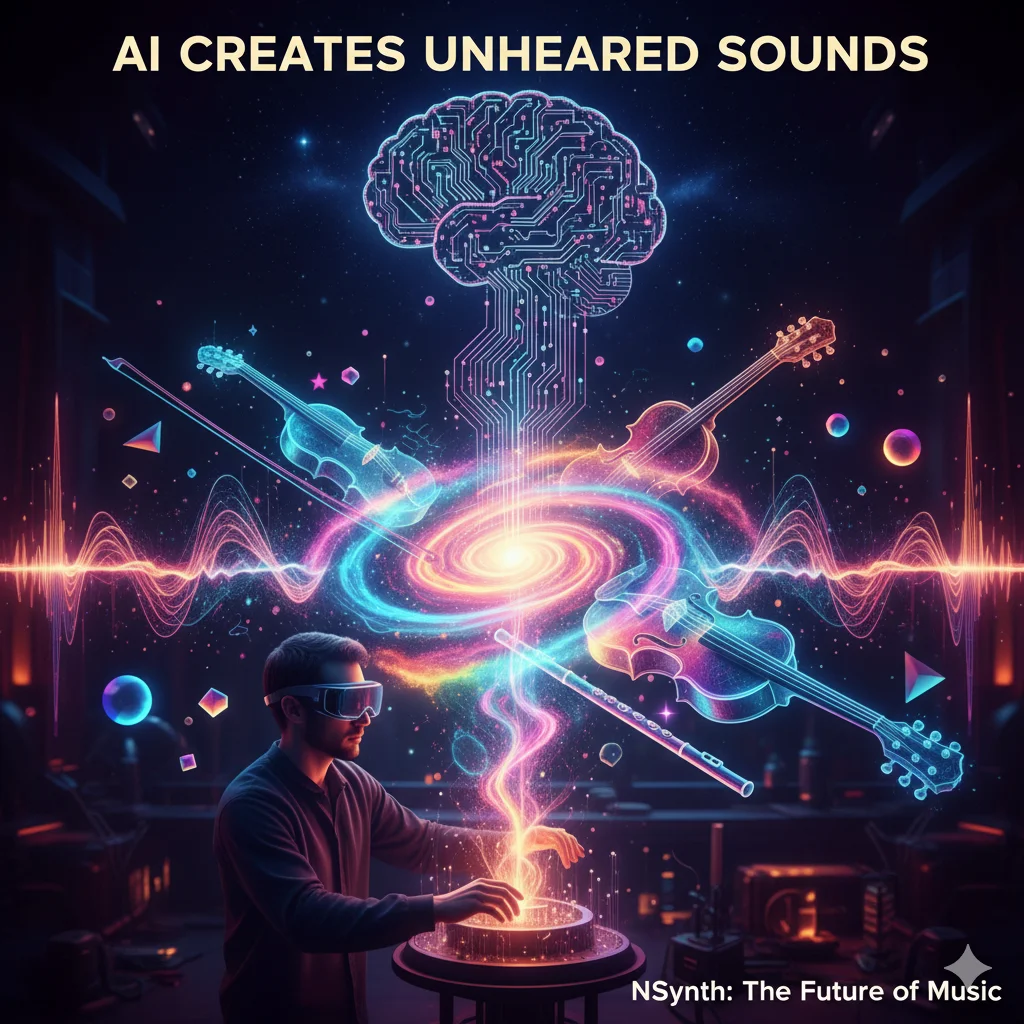
A revolutionary new technology called NSynth is now generating brand-new sounds and musical instruments that have literally never existed before. This isn't just about a computer playing a song; it’s about a machine inventing the very tools used to make it.
Beyond the Synthesizer: What is NSynth?
Developed by the Google Magenta team—a group of engineers and artists dedicated to the creative potential of AI—NSynth (Neural Synthesizer) is a total departure from traditional music technology.
In the past, if a musician wanted a new sound, they would use a synthesizer to layer sounds on top of each other. You might play a flute and a violin at the same time, but your ear would still hear two separate instruments.
NSynth is different. Instead of layering, it uses Deep Learning to understand the "soul" of an instrument. It analyzes the mathematical characteristics of over a thousand different sounds—from the breathiness of a flute to the pluck of a guitar string.
Creating "Hybrid" Instruments:
Because the AI understands the core characteristics of sound, it can perform a "mathematical blend" to create something entirely new.
Imagine an instrument that is 50% violin and 50% electric guitar. It doesn’t sound like two people playing together; it sounds like a single, cohesive instrument that has the resonance of wood but the grit of an amplifier. This gives musicians an almost infinite palette of "hybrid" instruments to play with, providing sounds that are physically impossible to create in the real world.
“NSynth provides artists with intuitive control over timbre and dynamics and the ability to explore new sounds that would be difficult or impossible to produce with a hand-tuned synthesizer,” says the Magenta team.
How Does It Work?
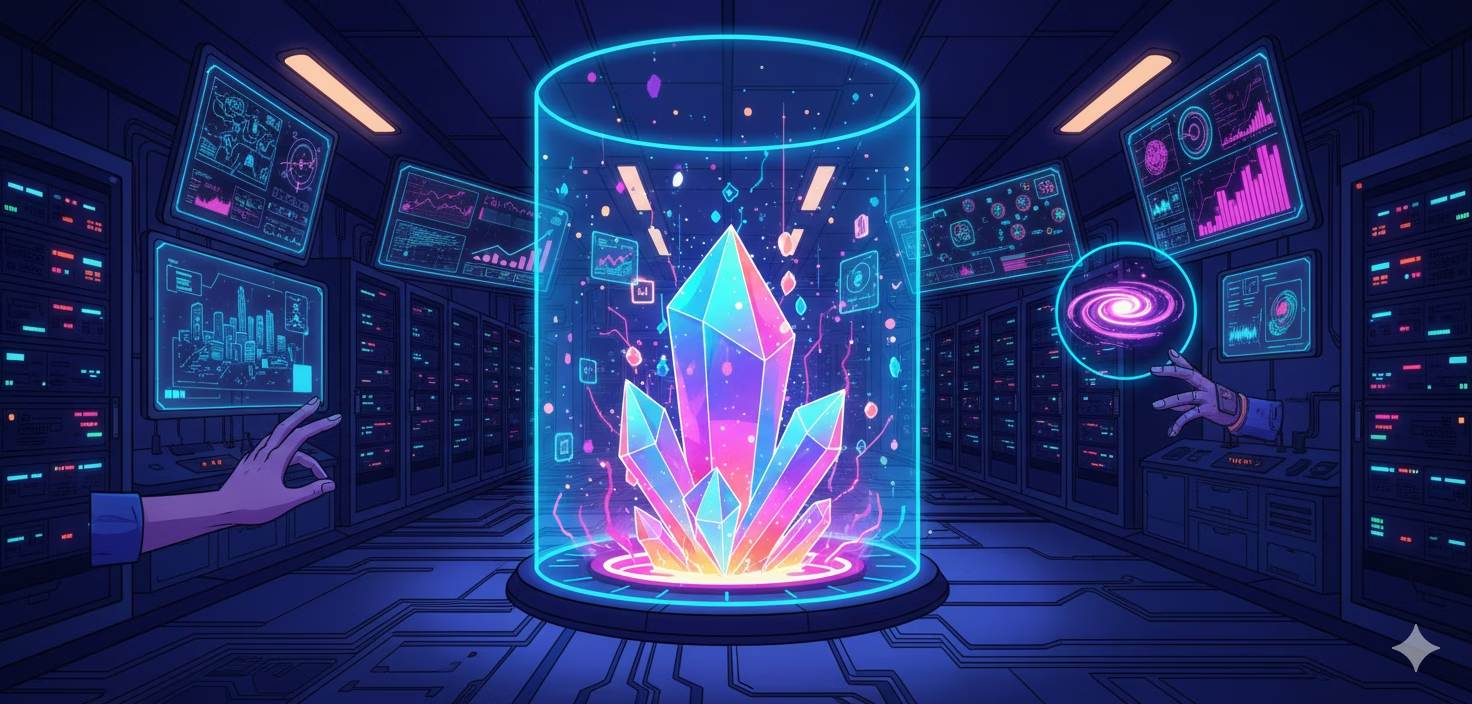
The secret sauce is Deep Learning, a technique modeled after the neural networks in the human brain.
-
Data Collection: The system "listens" to thousands of real-world audio samples.
-
Pattern Recognition: It identifies the tiny patterns that make a piano sound like a piano.
-
Synthesis: It uses those patterns to build new sounds from scratch.
While this type of math has existed for a while, we only recently gained the computing power to do it in real-time. Now, musicians can sit at a keyboard and generate these futuristic tones instantly as they play.
Why This Matters for the Arts:
Some might worry that AI is "replacing" musicians, but experts see it differently. This is a new form of human-AI collaboration. By handling the complex mathematics of sound creation, the AI acts as a digital laboratory, leaving the musician free to focus on the emotion and composition.
As the line between human artistry and machine intelligence blurs, we are entering a new era of auditory history. We are no longer limited by the physical properties of wood, wind, and brass.
The musicians of tomorrow won't just be playing the hits; they’ll be playing instruments that were "born" in a neural network—producing a symphony of sounds that the human ear is hearing for the very first time.