
Larry Ellison’s Masterstroke: How Oracle Became the Secret Power Behind OpenAI’s Future.
The $700 Billion AI Infrastructure Race: What Every Business Leader Needs to Know:
How Oracle, Nvidia, Meta, OpenAI, and the Hyperscalers Are Reshaping the Global AI Data Center Landscape — and What the Capital Expenditure Surge Means for Your Industry:
From a $300 billion compute deal to a $500 billion government moonshot, the race to dominate AI infrastructure is triggering a full-blown capital arms race — and every executive, policymaker, and investor needs to understand what comes next.
The Infrastructure Arms Race That Is Shaking Capital Markets:
Silicon Valley's Biggest Players Are Betting Trillions on AI — and the Stakes Have Never Been Higher:
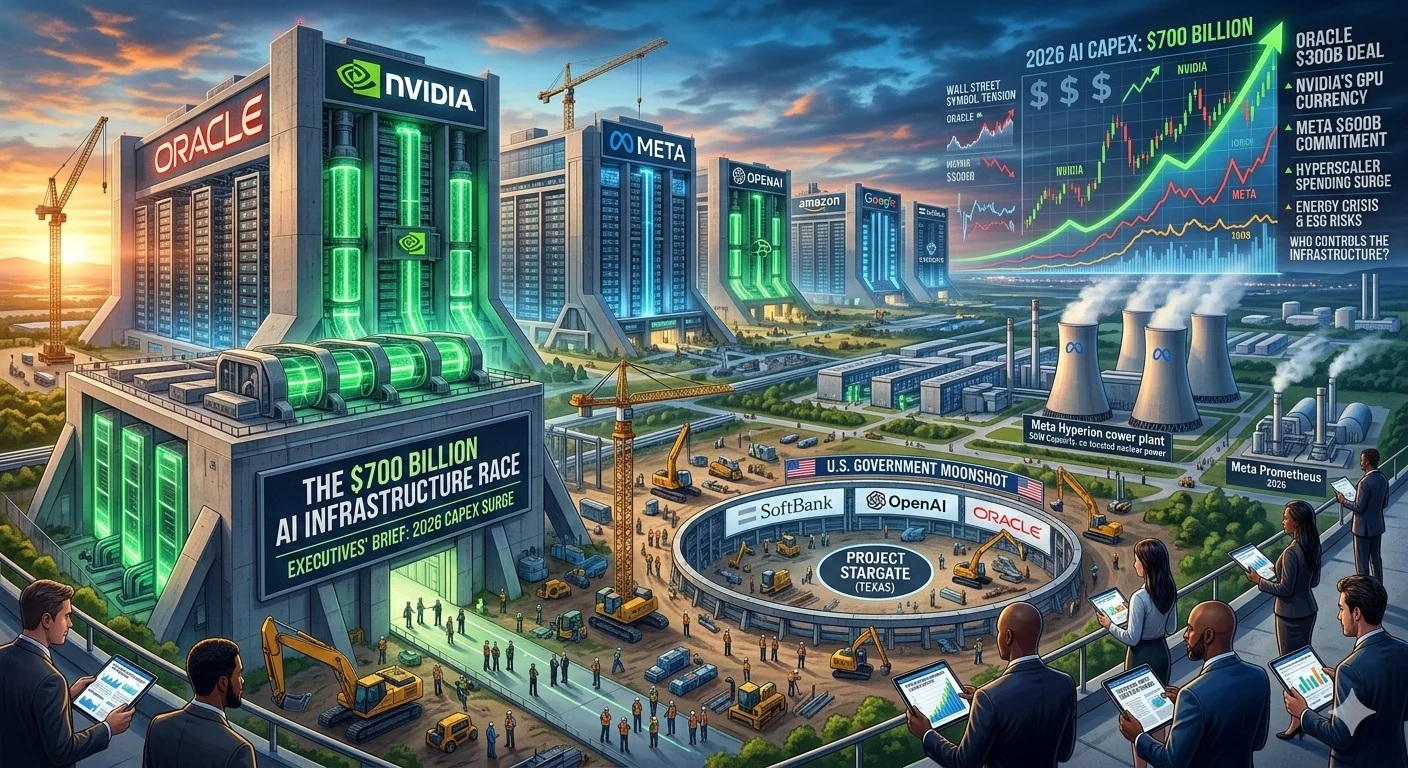
In a breathtaking escalation of the global AI race, the world's most powerful technology companies have committed to spending nearly $700 billion on AI data center infrastructure in 2026 alone — a figure so staggering it dwarfs the GDP of most nations. What started as a competition to build better AI models has transformed into an all-out arms race for the physical infrastructure that powers them.
At its core, this is a story about power and capital: who gets to build the backbone of the AI economy, who controls the chips that make it run, and what happens when the money behind those bets starts to look less like investment and more like speculation. The answers are still being written — but the stakes could not be higher.
What Triggered the Spending Explosion: Oracle's $300 Billion Bombshell:
The Deal That Redefined What an AI Infrastructure Contract Can Look Like: The roots of today's capital frenzy can be traced to a single announcement. On September 10, Oracle revealed a landmark five-year, $300 billion agreement to provide compute power to OpenAI, with operations scheduled to begin in 2027. The announcement sent shockwaves through global markets — briefly making Oracle founder Larry Ellison the world's richest person as the company's stock surged to all-time highs.
The scale is extraordinary and worth pausing on: OpenAI does not have $300 billion to spend, meaning the agreement is predicated on aggressive growth assumptions for both companies — and more than a little faith. But before a single dollar changes hands, the deal has already cemented Oracle as one of the leading AI infrastructure providers — fundamentally altering how the enterprise cloud market will be evaluated for years to come.
CEO Larry Ellison refused to frame this as a gamble, publicly reiterating Oracle's readiness to serve as the backbone of the next generation of AI compute — positioning the company not just as a contractor, but as a strategic partner in America's AI future. Before a single dollar is spent, the deal has already cemented Oracle as one of the leading AI infrastructure providers — and a financial force to be reckoned with.
Nvidia's Unconventional Play: GPUs as Venture Currency:
From Chipmaker to Strategic Investor: How Nvidia Is Rewriting the Rules of the AI Economy:
Nvidia's position in this unfolding drama is unlike any other. The company's dominance in AI-grade GPUs has generated extraordinary cash flows — and it is deploying that capital in ways that blur the lines between vendor, investor, and ecosystem architect. In September 2025, Nvidia acquired a 4% stake in rival Intel for $5 billion. But even that headline was quickly overshadowed.
More surprising was a $100 billion investment in OpenAI — paid not in cash, but in GPUs earmarked for OpenAI's ongoing data center expansion. Similar GPU-for-equity arrangements have since been structured with Elon Musk's xAI, and OpenAI launched a comparable GPU-for-stock deal with AMD. The industry's most valuable chips are now functioning as a form of venture currency — and the implications are profound.
Nvidia's GPUs command premium pricing in part because of enforced scarcity: by channeling supply directly into equity-linked data center deals, Nvidia reinforces both the scarcity and the valuation of its own chips — while simultaneously accumulating stakes in the industry's most valuable private companies. It is a flywheel that benefits all participants, as long as the momentum holds.
Key Risk: These circular arrangements — GPU scarcity inflating valuations that back more GPU deals — are sustainable only while AI investment momentum holds. Any slowdown could trigger rapid de-leveraging across the entire ecosystem.
What's Actually at Stake: Meta's $600 Billion Commitment and the Energy Crisis:
Hyperion and Prometheus: Building the Next Generation of AI Compute — at an Enormous Environmental Cost:
For established hyperscalers like Meta, the AI infrastructure buildout is complicated by legacy systems and regulatory scrutiny — but the spending commitments are no less staggering. Meta CEO Mark Zuckerberg has committed to $600 billion in U.S. infrastructure investment through the end of 2028. In the first half of 2025 alone, Meta's capital expenditure exceeded the prior year by $30 billion.
Two flagship projects define Meta's near-term buildout:
-
First, Hyperion — a 2,250-acre site in Louisiana estimated at $10 billion, targeting 5 gigawatts of compute capacity, co-located with a local nuclear power plant to handle the immense energy load.
-
Second, Prometheus — a natural gas-powered facility in Ohio expected to come online in 2026. Additionally, Meta signed a $10 billion cloud agreement with Google Cloud, while keeping many of its largest data center commitments off its balance sheet entirely — a practice that warrants close scrutiny from investors and analysts.
The energy demands of hyperscale AI infrastructure are generating significant and growing regulatory exposure. Elon Musk's xAI data center in South Memphis has already become one of the county's largest emitters of smog-producing chemicals, with experts citing potential Clean Air Act violations. Business leaders evaluating AI infrastructure partnerships should conduct thorough assessments of both direct operational ESG risk and the reputational exposure that comes with it.
Escalation: Project Stargate and the Government-Backed Moonshot:
The $500 Billion Joint Venture: A New Template for Public-Private AI Infrastructure: Two days after his January 2025 inauguration, President Trump announced Stargate — a joint venture between SoftBank, OpenAI, and Oracle to invest $500 billion in U.S.-based AI infrastructure. Trump characterized it as "the largest AI infrastructure project in history." OpenAI's Sam Altman echoed the ambition, calling it "the most important project of this era."
Under the framework, SoftBank provides primary funding, Oracle manages construction, and OpenAI provides technical direction: overseeing it all is the federal government, whose primary role is to clear permitting and zoning obstacles that might impede rapid buildout — a significant structural advantage in a regulatory environment that has historically slowed large-scale infrastructure projects.
Early enthusiasm has tempered considerably: Bloomberg reported in August 2025 that partners were struggling to reach consensus on key structural decisions. Elon Musk — Altman's business rival — publicly claimed the project lacked the available funds. Nonetheless, construction on eight data centers in Abilene, Texas is actively underway, with the final facility targeted for completion by end of 2026.
Executive Takeaway: Stargate represents a new template for public-private AI infrastructure — but its ultimate scale will depend heavily on sustained political alignment and OpenAI's commercial trajectory.
The 2026 CapEx Surge: Numbers That Are Reshaping Capital Markets:
Projected 2026 AI Infrastructure Spending — A Sector-by-Sector Breakdown:
As tech companies released their 2026 capital expenditure projections, the figures triggered significant investor concern across Wall Street: the year-over-year increases were not incremental — they were seismic.
- • Amazon: $200 billion projected (up from $131 billion in 2025)
- • Google: $175–185 billion projected (up from $91 billion in 2025)
- • Meta: $115–135 billion projected (up from $71 billion in 2025)
- • Combined hyperscaler total: Nearly $700 billion in 2026 alone.
The Divergence Between Tech and Wall Street: A Structural Tension Emerges:
A fundamental tension is now baked into the market: technology executives remain strongly bullish on AI ROI timelines, while institutional investors and CFOs are increasingly concerned about the pace and payback horizon of these commitments. With many companies taking on significant debt to fund buildouts, the financial community is watching closely — and nervously — for evidence that AI infrastructure investment translates into sustainable, proportionate revenue.
The Fundamental Question: Can hyperscalers demonstrate that AI infrastructure investment generates returns commensurate with its unprecedented scale — before market patience runs out?
The Bigger Picture: Who Controls the Most Powerful AI Infrastructure Ever Built?
Strip Away the Dollars and the Deadlines — and This Is a Governance Question of Historic Proportions:
Strip away the capital figures, the contract terms, and the competitive jockeying — and this dispute is fundamentally a question about control. Who gets to decide where AI infrastructure is built, how it is powered, and what it is used for? The companies spending the capital, or the governments seeking to shape national AI strategy?
Traditional infrastructure has never posed this question so sharply. A data center is not just a building — it is a concentration of decision-making power that will influence everything from military capability to economic competitiveness to civil liberties. The physical infrastructure being built today will define what AI can and cannot do for the next two decades.
The question of whether governments, markets, or corporations ultimately control the most powerful AI systems ever built will define the next decade of technology policy — and the standoff already underway is forcing that question into the open in a way that no policy paper or congressional hearing ever could.
What Happens Next: An Industry, a Government, and an Economy at a Crossroads:
Strategic Implications for Business Leaders: What Executives Should Be Doing Now: The situation continues to evolve at a pace that makes certainty impossible — but the strategic imperatives for business leaders are becoming clearer with each passing week. The decisions being made in boardrooms and data centers today will define competitive positioning for the next decade.
For enterprise leaders evaluating their own AI infrastructure strategies, the lesson from this moment is that infrastructure is no longer a back-office procurement decision. It is a strategic, financial, and reputational choice — one that carries real consequences for energy consumption, regulatory exposure, vendor concentration, and long-term competitive positioning.
And for citizens — whose data, communications, and economic futures will be shaped by the AI systems running on this infrastructure — the outcome of this capital arms race is anything but abstract. This is a defining moment for how AI will be governed, built, and deployed in the world's most powerful economy. The rest of the world is watching closely.
Key Takeaways: Everything You Need to Know:
• - Oracle's $300 billion compute deal with OpenAI has cemented it as a Tier-1 AI cloud provider — fundamentally reshaping enterprise cloud procurement and vendor strategy.
• - Nvidia is using GPUs as venture currency, creating circular equity arrangements that inflate chip scarcity and valuations simultaneously — a flywheel that works only while momentum holds.

Anthropic’s Surprise Double Launch Directly Targets OpenAI and Google’s AI Dominance
• - Meta has committed to $600 billion in U.S. AI infrastructure through 2028, including two hyperscale data centers with significant energy and ESG implications.
Support our research
Independent analysis fueled by you.
• - Project Stargate — the $500 billion SoftBank–OpenAI–Oracle joint venture — is underway in Texas but faces structural friction among partners and unresolved funding questions.
• - Hyperscalers are projected to spend nearly $700 billion on AI infrastructure in 2026 alone, creating a growing divergence between tech executive optimism and Wall Street concern.

Meta's Next Big Bet: This New App Lets You Build Games Simply by Typing a Prompt
• - The core issue transcends any single deal: who controls the most powerful AI infrastructure ever built — the companies that build it, or the governments and markets that fund and regulate it?
© 2026 Executive Intelligence Brief. For strategic and informational purposes only. Not financial or investment advice.