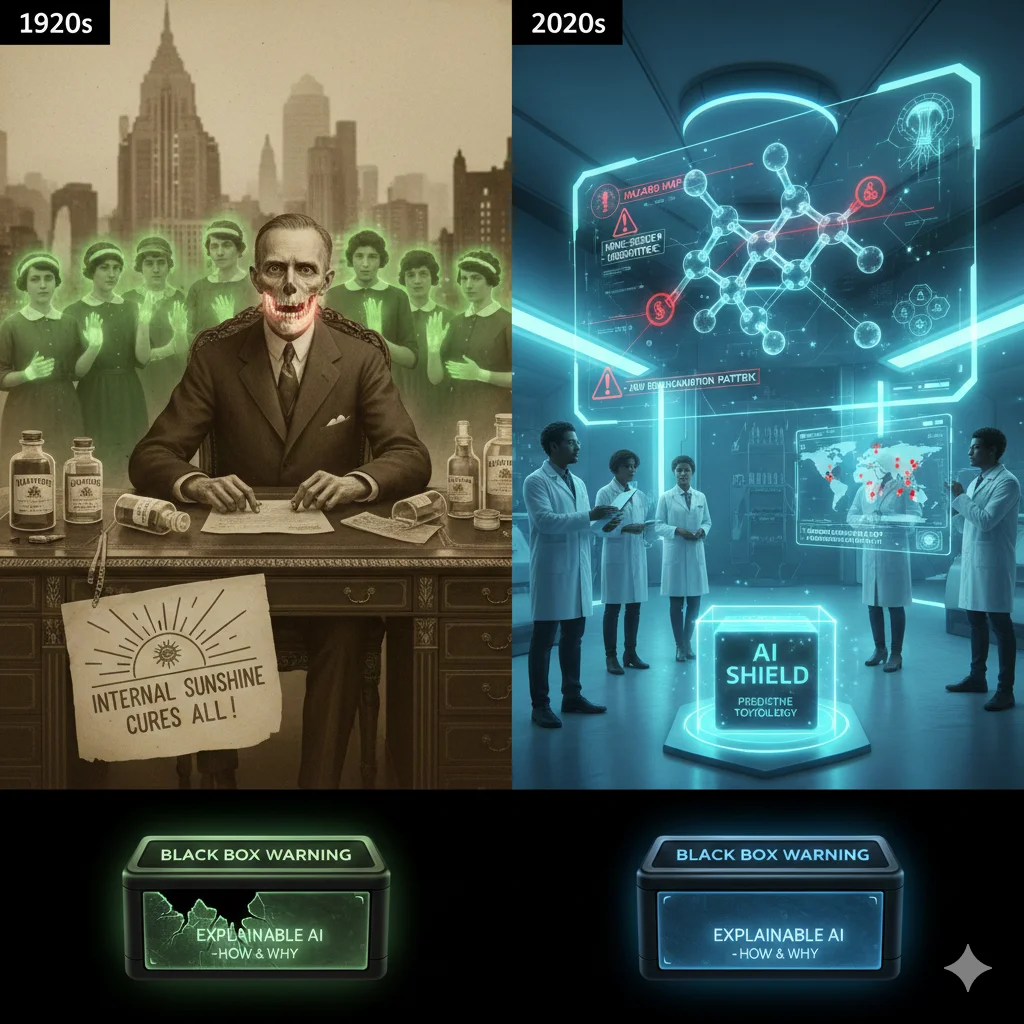

In the roaring 1920s, the world was obsessed with "progress."
Science was the new religion, and its most holy relic was Radium. Discovered by Marie and Pierre Curie, this glowing element was hailed as a miracle. Into this era of unchecked optimism stepped William Bailey, a college dropout and self-styled doctor who packaged slow-acting poison as a luxury health tonic. He called it Radithor.
Radithor was simple: a small bottle of distilled water infused with Radium-226 and Radium-228. It was marketed as "Internal Sunshine," promised to cure over 150 ailments, and was sold at a premium price—the 1920s equivalent of nearly $15 per bottle. However, the "sunshine" it provided was actually a relentless bombardment of alpha particles that would eventually turn its most loyal believers into "living ghosts."
The Gruesome Fall of Eben Byers:
The most famous victim was Eben Byers, a wealthy industrialist and champion golfer. After being prescribed Radithor for an injury, Byers became a zealot for the product. He consumed over 1,400 bottles, feeling "invigorated" as the radium began to replace the calcium in his bones.
By 1930, the energy faded. His teeth fell out. Then his entire lower jaw disintegrated. By the time he died in 1932, his bones were riddled with holes, a condition doctors called "radium jaw." His death was so high-profile that it forced the government to finally step in, but for Byers, the damage was permanent; when his body was exhumed for study in 1965, it was still dangerously radioactive.
How AI Prevents the Next "Radithor":
A century ago, the only way to know if a medicine was deadly was to wait for people to die. Today, the spirit of inquiry that once led to Radithor has been replaced by the rigorous, predictive power of Artificial Intelligence (AI). AI serves as a digital shield, ensuring that "miracle" marketing never outpaces biological reality again.
- Predictive Toxicology: Identifying "Bone-Seekers"
The tragedy of Radithor happened because no one understood that the body would mistake radium for calcium. Today, AI models like DeepTox or Tox21 use deep learning to perform "molecular fingerprinting."
-
Mechanism: An AI can analyze the chemical structure of a new compound and predict its "bio-accumulation" path.
-
The AI Advantage: If a modern supplement had the same "bone-seeking" signature as Radium, an AI algorithm would flag it in the simulation stage—years before a human ever took a sip.
- Digital Exhumation and In Silico Modeling: We no longer need to rely on the horrific physical evidence of victims like Eben Byers. Researchers now use AI-powered In Silico modeling—testing drugs on digital versions of the human body.
-
Virtual Trials: AI can simulate 40 years of exposure to a substance in just a few hours.
-
Legacy Learning: By feeding the historical data of the "Radium Girls" and Radithor victims into neural networks, AI has created a "Hazard Map" of how radiation interacts with human DNA. This data allows modern nuclear medicine to be incredibly safe, as the AI calculates the exact threshold where a treatment becomes a toxin.
- Real-Time Surveillance: The End of the "Silent Scandal" It took five years for the world to realize Eben Byers was dying. In 2026, a "miracle water" causing bone pain would be identified in weeks.
-
Signal Detection: AI algorithms monitor global health records, pharmacy reports, and even social media for "early signals" of adverse reactions.
-
The"Safety Net": If a pattern of jaw-related issues or bone degradation appeared in a specific region, AI-driven regulatory systems would automatically trigger an investigation, stopping a quack in their tracks before they could build an empire.
The New "Black Box" Warning:
The ultimate lesson of Radithor is that we must never treat science like magic. In 1925, the "Black Box" was the glowing vial of radium. In 2026, there is a risk that unregulated AI could become a new "Radithor"—providing health advice or medical "miracles" without a transparent "how" or "why."

Meta's Next Big Bet: This New App Lets You Build Games Simply by Typing a Prompt
Conclusion: From Toxic Glow to Digital Insight:
Radithor was a reflection of an era that worshipped progress but ignored the price. While we have traded the glowing bottles for digital screens, the human desire for a "miracle cure" remains. However, thanks to the integration of AI into toxicology and medical regulation, we finally have a tool capable of seeing the "invisible cannons" of a toxin long before they destroy a life.
The story of the radioactive "miracle water" is no longer just a ghost story; it is the data foundation upon which we build the safe, AI-guided medicine of tomorrow.
Support our research
Independent analysis fueled by you.