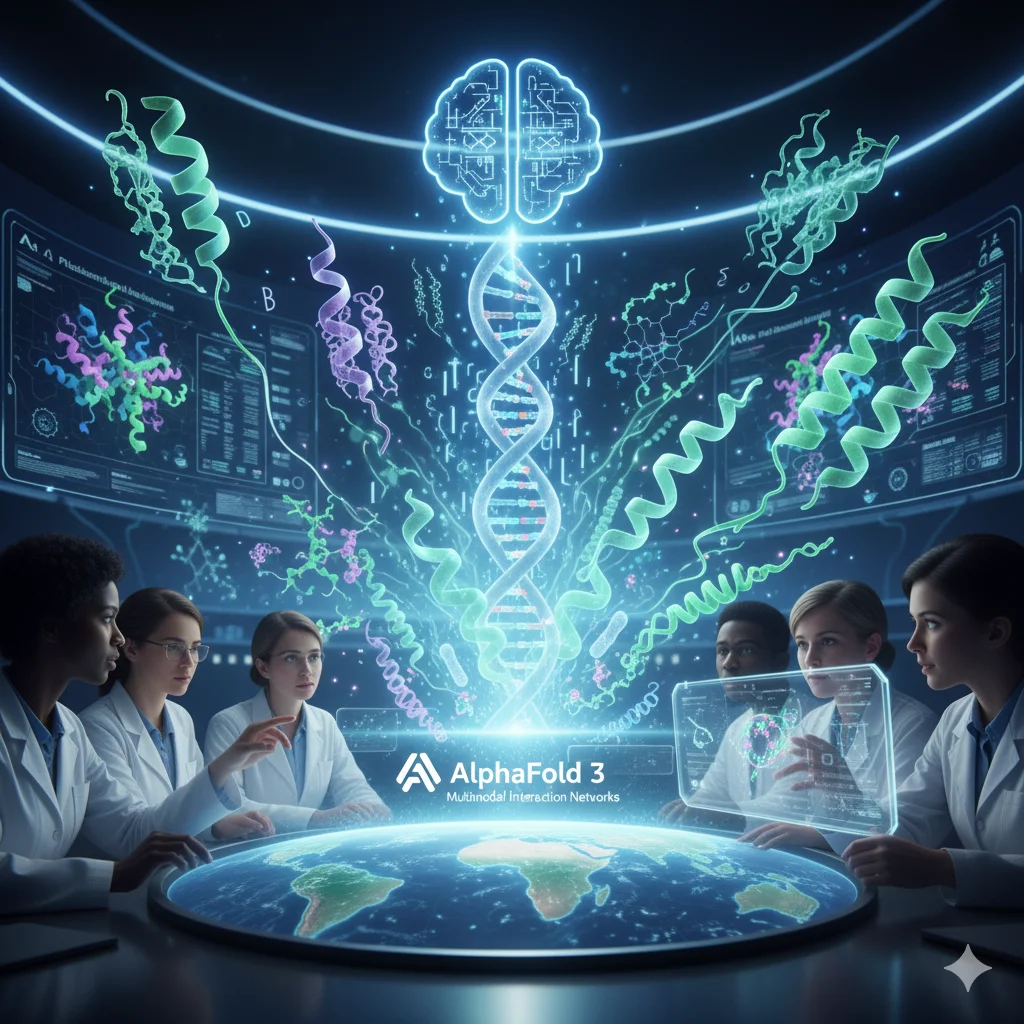

Biology has just witnessed its "moon landing"
moment—a milestone that has irrevocably redefined the landscape of life sciences. For over 50 years, scientists grappled with the "protein folding problem," a grand challenge that posed a deceptively simple question: Can we predict the intricate 3D shape of a protein purely from its genetic sequence?
For decades, the answer was a resounding "no." Unraveling the 3D structure of a single protein was a painstaking endeavor, often demanding months, even years, of costly experimental verification using techniques like X-ray crystallography or cryo-electron microscopy.
Today, that paradigm has shattered. In a monumental leap for science, DeepMind’s artificial intelligence system, AlphaFold, has successfully predicted the structures of nearly every known protein—a staggering 200 million of them—and, in an act of profound scientific generosity, made this "map of life" freely available to the world.
"Determining the 3D structure of a protein used to take many months or years — it now takes seconds," explained Eric Topol, a cardiologist at the Scripps Research Translational Institute. This isn't merely an incremental improvement; it is an exponential acceleration of biological discovery.
Decoding the Machinery of Life:
To grasp the true magnitude of this achievement, one must appreciate the protein itself. Proteins are the microscopic gears, motors, and levers that orchestrate all life. They are composed of long chains of amino acids, but these chains don't merely drift; they twist, fold, and interlock into incredibly complex and precise 3D forms.
It is this specific, intricate shape that dictates function. This form determines how a hormone binds to a receptor, how an antibody latches onto a virus, or how an enzyme meticulously breaks down food. Without knowing the shape, understanding the mechanism is a futile endeavor. DeepMind, in collaboration with the European Molecular Biology Laboratory’s European Bioinformatics Institute (EMBL–EBI), has now handed us the master keys to this biological kingdom.
The AlphaFold Database has expanded from an initial, partial release to a comprehensive atlas of life on Earth. It now encompasses the protein structures of plants, bacteria, animals, and humans, effectively illuminating the entire protein universe. "That hope has become a reality far quicker than we had dared to dream," said Demis Hassabis, CEO of DeepMind.
A Revolution in Drug Discovery and Beyond:
The ripple effects of this release are already reshaping the scientific landscape. With access to 200 million predicted structures, researchers can bypass the arduous "mapping" phase and plunge directly into the "solving" phase.
The impact is reverberating across diverse fields:
-
Malaria & Neglected Diseases: Scientists are harnessing AlphaFold to pinpoint new "sites" on parasite proteins where vaccines or drugs could strike, potentially accelerating treatments for diseases that disproportionately afflict the developing world.
-
Environmental Sustainability: In the urgent fight against pollution, researchers are searching for novel enzymes capable of breaking down single-use plastics. AlphaFold allows them to scan thousands of potential candidates in silico before ever setting foot in a wet lab.
- Antibiotic Resistance: As bacteria relentlessly evolve to resist our most potent drugs, AlphaFold is helping us decipher their defenses. By visualizing the structure of bacterial resistance proteins, we can design smarter antibiotics to circumvent them.
Samer Velankar, head of EMBL-EBI’s Protein Data Bank: underscored the explosion of activity: "In the past year alone, there have been over a thousand scientific papers using AlphaFold data... I’ve never seen anything like it. And that was just one million predictions. Imagine the impact of 200 million."
The Nuances of Prediction:
However, it is crucial to remember that AlphaFold provides predictions, not absolute certainties. Science thrives on nuance, and even the most advanced AI is not magic.
-
Accuracy Levels: According to EMBL-EBI, approximately one-third of the 200 million predictions are "highly accurate," rivaling the gold standard of experimental results. Nevertheless, for rarer or unstructured regions, the confidence naturally diminishes.
-
The Interaction Gap: Proteins rarely operate in isolation; they function in intricate complexes, dancing with other proteins, DNA, and RNA. The current AlphaFold data doesn't fully capture these dynamic interactions or how proteins behave in the chaotic, crowded environment of a living cell.
-
The Microbial Frontier: The database is colossal—23 terabytes—but it still misses vast swathes of microbial DNA found in soil and oceans, which are often rich sources of novel biological compounds.
Conclusion: An Unimaginable Leap:
Despite these important caveats, AlphaFold represents a monumental stride for humanity. We have transitioned from merely peeking through a keyhole to flinging open the grand doors of the biological universe. DeepMind has meticulously balanced this immense power with open access, ensuring that this "Google Earth for Biology" remains a public good, democratizing discovery for all.
As Dame Janet Thornton of EMBL–EBI presciently predicted, this will trigger "an avalanche of new and exciting discoveries."
We are standing at the threshold of a new era in biology—one where AI empowers us to perceive the invisible architecture of life with extraordinary clarity, enabling us to fundamentally rewrite the future of medicine, sustainability, and our understanding of existence itself.
Support our research
Independent analysis fueled by you.