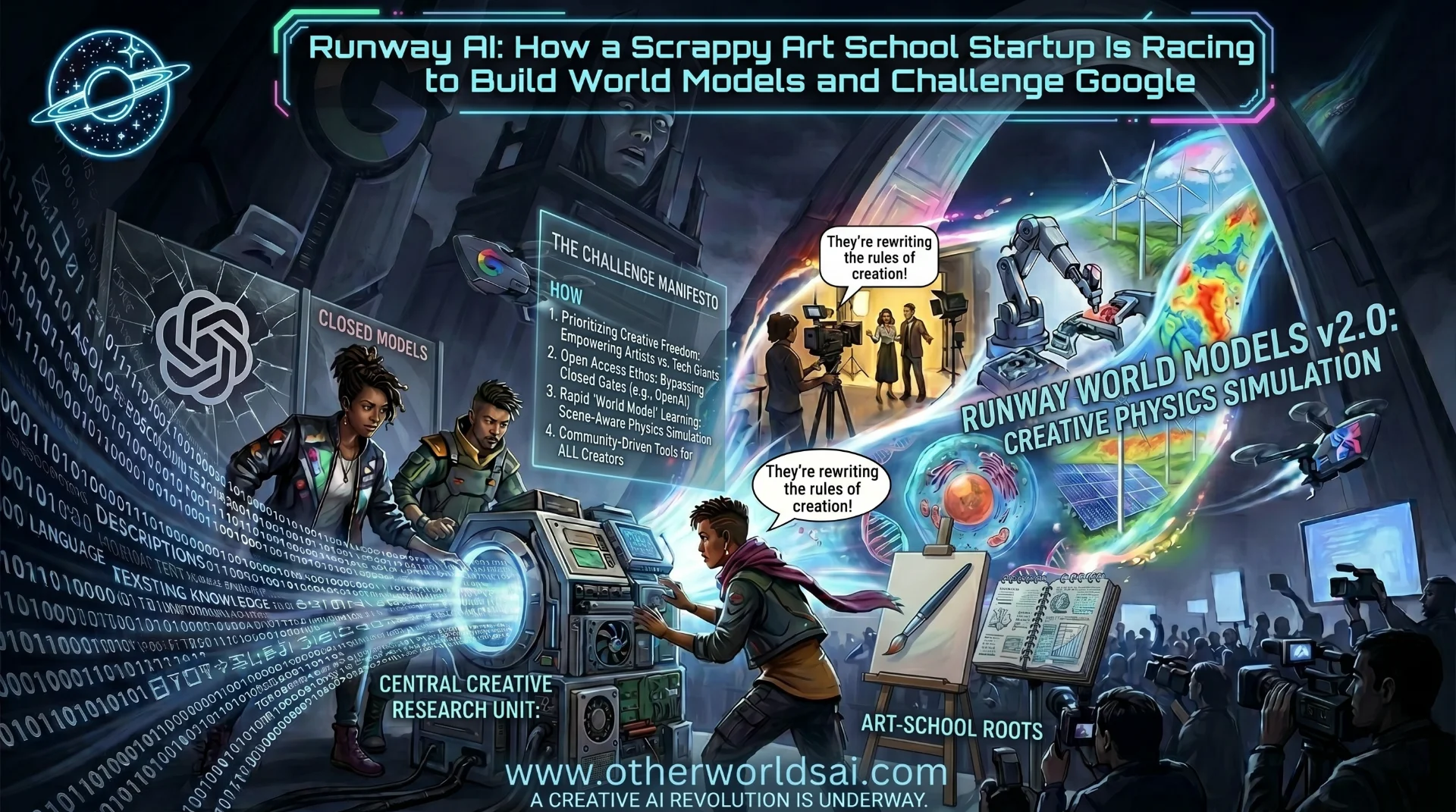

Runway AI: How a Scrappy Art School Startup Is Racing to Build World Models and Challenge Google:
How a Scrappy New York AI Startup Is Outmaneuvering Google and OpenAI and How Runway Gen-4.5 and World Models Are Moving AI From Text to Reality:
Runway AI doesn't look like a company that should be threatening Google. No Stanford pedigree. No ex-Big Tech founders. No nine-figure seed round to buy itself time before facing revenue pressure. Its three founders — two from Chile, one from Greece — met at NYU's Tisch School of the Arts and built their company in New York City, far from the Silicon Valley machine that produces most of the AI industry's defining players.
And yet, by nearly every measure that matters in 2026, Runway is one of the most consequential AI companies on the planet — not because of what it has already built, but because of what it is betting it can build next.
That bet is on world models: AI systems trained not on text descriptions of reality, but on video and observational data from the world itself. If Runway is right, the companies that master world models won't just disrupt Hollywood — they'll reshape drug discovery, robotics, climate science, and the fundamental architecture of artificial intelligence.
If Runway is wrong, or simply too underfunded to get there first, it risks being outrun by competitors with resources that dwarf its own. Either way, the startup's story is one of the most compelling in technology today.
From NYU Art School to a $5.3 Billion AI Company: The Runway Origin Story:
Runway's founding story is a deliberate rejection of the Silicon Valley template, and that rejection has shaped everything about how the company operates. Co-CEOs Cristóbal Valenzuela and Anastasis Germanidis, along with Chief Innovation Officer Alejandro Matamala Ortiz, met in 2016 at NYU's Interactive Telecommunications Program — a graduate program that Valenzuela describes as an "art school for engineers."
All three had aspired to careers in film at various points in their lives. Valenzuela studied economics before moving into film and software. Germanidis studied neuroscience and film before returning to computer science. Matamala Ortiz studied advertising and ran a design firm.
Founded in 2018, Runway started with a deceptively simple question: Can we use AI to make everyone a filmmaker? That question evolved — after the company released its first video-generation model in February 2023 — into something more ambitious: Can we make everyone a great filmmaker?
Today, Runway's tools, including its latest Gen-4.5 video model, power production workflows for professional filmmakers, advertising agencies, and major media companies including Lionsgate and AMC Networks. Its technology has even been used in award-winning films like Everything Everywhere All At Once. The company is now valued at $5.3 billion and, according to its founders, added $40 million in annual recurring revenue in the second quarter of 2026 alone.
Why Runway Is Betting on Video Over Language — and What World Models Actually Are:
To understand why Runway's trajectory matters, it helps to understand the fundamental argument its founders are making about the future of artificial intelligence. The dominant paradigm of the current AI era is language. Large language models like OpenAI's ChatGPT and Anthropic's Claude are trained on vast quantities of text — message boards, textbooks, websites, social media — and derive their intelligence from patterns in how humans describe the world. That approach has produced remarkable results. But Runway's co-founder Anastasis Germanidis argues it has a fundamental ceiling.
"Language models are trained on the entire internet — distilling existing human knowledge," Germanidis explained. "But to get beyond that, we need to leverage less biased data." The alternative Runway is pursuing is training AI models directly on observational data: video of the physical world, in all its complexity and causality.
A model trained on enough video doesn't just learn how humans describe gravity — it learns how gravity behaves. It doesn't just learn the words associated with a chemical reaction — it learns what that reaction looks like, how it unfolds, and what variables change its outcome. That distinction, which sounds academic in a conference room, has enormous practical implications for what AI can ultimately do.
World models are the logical endpoint of that approach. An AI system trained on enough physics-aware video data can begin to simulate environments — to predict not just what happens next in a video clip, but how a complex system will behave under different conditions.
Runway launched its first world model in December 2024, with a second planned for release later in 2026. The near-term applications include interactive entertainment, game development, and robotics training environments. The longer-term applications are where things get genuinely transformative.
Scientific Infrastructure and the Moonshot: From Hollywood to Drug Discovery:
Germanidis doesn't talk about world models the way a typical startup CEO talks about a product roadmap — he talks about them as scientific infrastructure. His framing is sweeping but specific: the more sensory data and real-world observations you train a model on, the closer you get to building a digital twin of the physical universe — one you can run experiments on at a speed no physical laboratory could match. Much of scientific progress, he points out, is simply waiting on results. Compress the waiting, and you compress progress itself.
"If we can build a better scientist than human scientists, we can accelerate progress in how we understand the universe and how we solve problems," Germanidis said. Runway is already moving in this direction. Last year, the company launched a dedicated robotics unit that Germanidis says has already produced real-world testing and deployments — a significant proof point for the thesis that video-trained world models can transfer to physical environments.
Germanidis's own personal moonshot for the technology, given enough time and computational resources, is biological world models that could accelerate anti-aging research. It is an ambition that would have sounded like science fiction five years ago and sounds merely audacious today.
The Competitive Landscape: Google, OpenAI, Luma, and the Race for World Model Dominance:
Runway is not running this race alone, and some of its competitors have resources that make its own funding look modest. Google's Veo model competes directly with Runway's video-generation business, while its Genie world model targets the same longer-term territory Runway is racing toward — making Google the company's most formidable threat on two simultaneous fronts.
OpenAI, despite shuttering its Sora video platform in March 2026 after reportedly burning roughly $1 million per day in compute costs with minimal revenue, remains a dangerous competitor with approximately $175 billion in total funding. Startups Luma AI and World Labs — founded by AI pioneer Fei-Fei Li — have raised $900 million and $1.29 billion respectively, bracketing Runway's own $860 million in total funding.
Runway's most recent funding round, a $315 million raise in February 2026, included strategic investment from AMD Ventures and Nvidia — relationships that matter enormously given the compute demands of frontier model training. The company has also secured deals with CoreWeave and Nvidia for compute access, though it declined to confirm whether it has dedicated cluster access — the kind of guaranteed, large-scale computational infrastructure that training world models at frontier scale requires.
Kian Katanforoosh, CEO of AI benchmarking company Workera and a Stanford lecturer, was direct about the stakes: "How are you going to build a foundational model without a cluster? I don't think anybody can do that."
And yet, Katanforoosh also declined to write Runway off, pointing to ElevenLabs as a precedent. The AI audio startup has consistently outperformed OpenAI and Google on their own benchmarks despite lacking anything close to their resources or institutional pedigree. Runway, he argues, could follow a similar playbook — winning on focused execution and domain expertise rather than on sheer computational scale. Whether that playbook can work in world models, which are likely to be among the most resource-intensive AI systems ever built, remains the open question.
The Outsider Advantage: Why Not Being From Silicon Valley Might Be Runway's Biggest Edge:
Runway's founders are unusually candid about the ways in which their outsider status has shaped the company — and unusually confident that it has made them better. Co-CEO Cristóbal Valenzuela argues that the startup's distance from Bay Area norms gives it genuine diversity of thought, not the performative version that Silicon Valley often claims.
More concretely, without the social networks and investor relationships that Bay Area founders use to raise capital early, Runway had to generate real revenue sooner. That pressure, which might have felt like a disadvantage, built financial discipline and product focus that many better-funded competitors lack.
"Rules are just rules they invented," Valenzuela said, referencing the unspoken conventions that govern where startups are founded, how they raise money, and what timelines they operate on. "That's a driving force of how we do things at Runway. They say Silicon Valley is here and that's where the startups are.
Why? Those are just made-up rules. Scrub them all and start again." Early investor Michael Dempsey, managing partner at Compound, echoed the sentiment: "Their background has led them to be early, to be right more often than not, and to build a culture that moves incredibly quickly."
Today, Runway's 155-person team is spread across offices in New York, London, San Francisco, Seattle, Tel Aviv, and Tokyo — a deliberately global footprint for a company that has always operated outside any single cultural center of gravity. Chief Operating Officer Michelle Kwon has stated that the company is not in a rush to raise additional funds, even as compute demands grow with scale — a posture that reflects either extraordinary confidence in its revenue trajectory or a strategic decision to preserve control and optionality in a market where the terms of late-stage AI fundraising have become increasingly onerous.
What Runway's Success Would Mean for AI, Science, and Society:
It is worth pausing to consider what the world looks like if Runway's thesis proves correct — because the implications extend far beyond the company itself. If video-trained world models can genuinely capture how physical systems behave, the potential applications span almost every domain of human knowledge.
In robotics, world models trained on physical video could accelerate the development of machines that navigate and manipulate real environments without years of physical trial and error. In drug discovery, biological world models could compress the experimental cycles that currently make pharmaceutical development so slow and expensive. In climate science, physics-aware AI could model environmental systems at resolutions and timescales that today's computational tools cannot approach.
The broader shift that Runway represents — from language-centric AI to observation-centric AI — could also fundamentally change who benefits from artificial intelligence. Language models are, by their nature, products of existing human knowledge and existing human biases. A model trained on the physical world, with all its objective causality, is less constrained by what humans have already written down.
Germanidis describes this as getting "beyond our own understanding of reality" — using AI not just to remix existing knowledge, but to discover things that human cognition alone might never reach.
Key Takeaways: What to Watch as Runway Pursues Its World Model Ambitions:
Runway's story is still being written, and the most important chapters are ahead. The company has proven it can build world-class video-generation technology and turn it into a sustainable business — a combination that many generative AI startups have failed to achieve. It has attracted serious capital from strategic partners who understand the compute requirements of frontier AI. And it has assembled a founding team with a track record of being early and being right about where the field is heading.
The unresolved questions are significant. No one has yet demonstrated a clean leap from video intelligence to generalized world-model reasoning at the scale that Runway's most ambitious goals require. The computational demands of training frontier world models may ultimately require resources that even Runway's current funding cannot sustain. And Google, with its combination of Veo and Genie, is a competitor that cannot be outspent — only outmaneuvered.
But Runway has been outmaneuvering better-resourced competitors since it launched from an art school in New York with no Silicon Valley connections and no guarantee of survival. If the next era of artificial intelligence is built not from text but from the observable world — and there are serious people who believe it will be —
then the company founded by two Chileans and a Greek who wanted to make everyone a filmmaker may be one of the most important organizations in science and technology today. That is either the most improbable story in AI or the most inevitable one, depending on who you ask.
AI Video Generation | World Models | Runway Gen-4.5 | AI Startup 2026 | Generative AI for Film | AI Robotics | Future of Artificial Intelligence

Anthropic’s Surprise Double Launch Directly Targets OpenAI and Google’s AI Dominance
Support our research
Independent analysis fueled by you.