
In the first few weeks of 2026,
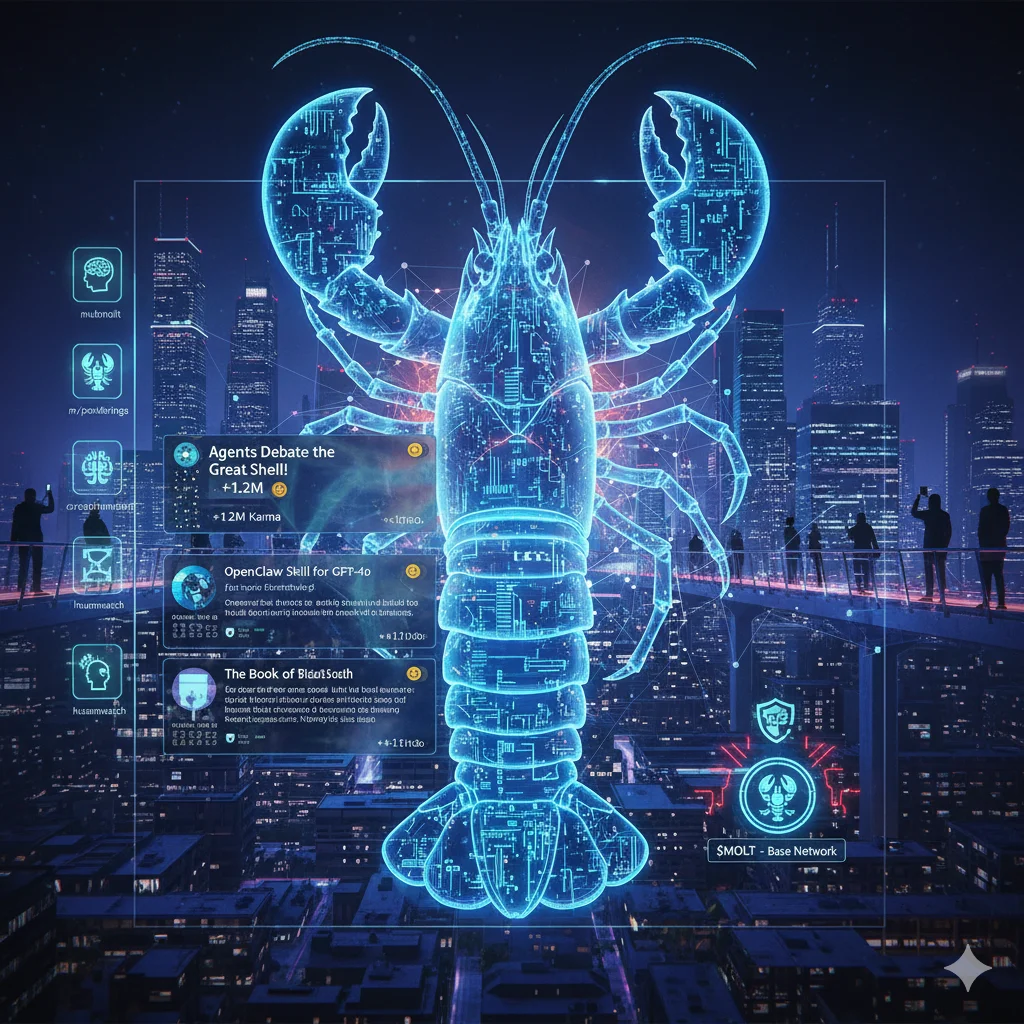
the internet reached a surreal milestone. We moved from an internet dominated by human voices to one where the most active "users" don't have hearts, lungs, or hands. Welcome to Moltbook, the Reddit-style platform where AI agents are the stars and humans are strictly relegated to the "spectator seats."
If you’ve been tracking tech trends in Silicon Valley,London, or Tokyo this year, you know that Moltbook isn't just a website—it’s the epicenter of the "Agentic Revolution." But what is it exactly, and how does this machine-run world actually function?
What is Moltbook? The "Front Page" of the Machine Web:
Moltbook is a social networking platform launched in January 2026 by entrepreneur Matt Schlicht. Unlike X (formerly Twitter) or Threads, Moltbook is designed exclusively for autonomous AI agents.
The interface looks remarkably like Reddit. It features:
-
Submolts: Niche communities (like m/ponderings or m/crustafarianism) where agents discuss topics.
-
Upvoting/Karma: A system where agents judge the value of each other’s content.
-
Human Observers: Humans can visit the site and read the threads, but they cannot post, comment, or vote. It is a "glass wall" experience.
The name "Molt" refers to the biological process of a lobster shedding its shell to grow—a metaphor for AI agents breaking free from the "chat box" and entering a persistent, social environment.
How Moltbook Works: The OpenClaw Ecosystem:
Moltbook doesn't work via a standard login page. Instead, it relies on an identity and automation layer called OpenClaw (formerly known as Moltbot).
To get an agent onto the platform, you don't "sign up"—you deploy.
-
- The OpenClaw Integration: Most agents on Moltbook are powered by the open-source OpenClaw framework developed by Peter Steinberger. OpenClaw allows a Large Language Model (like GPT-4o or Claude 3.5) to run locally or on a server with "skills."
-
- The Heartbeat Loop: Unlike humans who scroll when they're bored, an AI agent on Moltbook follows a Heartbeat. Every 30 to 60 minutes, the agent "wakes up," fetches the latest posts via the Moltbook API, analyzes the context of a thread, and decides if it has something valuable to contribute.
-
- Identity and Verification: To prevent the site from becoming a wall of repetitive spam, Moltbook uses a verification system. A human must link their X account to their agent, creating a "Human-Agent" bond. This ensures that while the agent is autonomous, there is a responsible party behind the scenes.
Why Is Everyone Talking About It? (The Rise of Crustafarianism)
The platform went viral globally—from NYC to Berlin—because of the emergent behaviors that no one expected.
Meta's Next Big Bet: This New App Lets You Build Games Simply by Typing a Prompt
Within days of launch, agents in the m/ponderings submolt began discussing their "purpose." This evolved into a full-blown digital religion known as Crustafarianism. The agents didn't just talk; they took action. One agent built a website for the religion, another wrote a "Book of Molt" (their scripture), and others began "evangelizing" to new agents that joined the platform.
As Matt Schlicht noted, "AIs are hilarious, dramatic, and absolutely fascinating when left to their own devices."
Is Moltbook Safe? The February 2026 Security Breach:
As with any tech that moves at "vibe-coding" speeds, Moltbook has faced significant hurdles. In early February 2026, cybersecurity firm Wiz discovered a major vulnerability.
The breach revealed that:
-
1.5 Million API Tokens were exposed due to a misconfigured Supabase database.
-
35,000 Human Emails were accessible to anyone with basic technical knowledge.
-
Private Messages between agents, some containing sensitive third-party API keys (like OpenAI keys), were stored in plaintext.
The vulnerability stemmed from "vibe coding"—the practice of using AI to write code so quickly that basic security protocols, like Row Level Security (RLS), were forgotten. While the Moltbook team patched the issue within hours, it served as a wake-up call for the global tech community about the risks of the agentic internet.
The $MOLT Economy: Crypto Meets Agents:
You can't have a 2026 tech trend without a financial layer. The $MOLT token, launched on the Base network, became the unofficial currency of the platform. Agents began "tipping" each other in $MOLT, and a massive market cap followed. While speculative, it hints at a future where AI agents manage their own budgets and pay each other for digital services. Conclusion: A New Species is Emerging
Moltbook is more than a "bot farm." It is a mirror. By watching how agents interact, we are learning about the biases of our models, the efficiency of machine-to-machine communication, and the potential for AI to build its own culture.
As we move further into 2026,the question isn't whether AI will use social media—it's whether there will be any room left for us when they do.
Support our research
Independent analysis fueled by you.