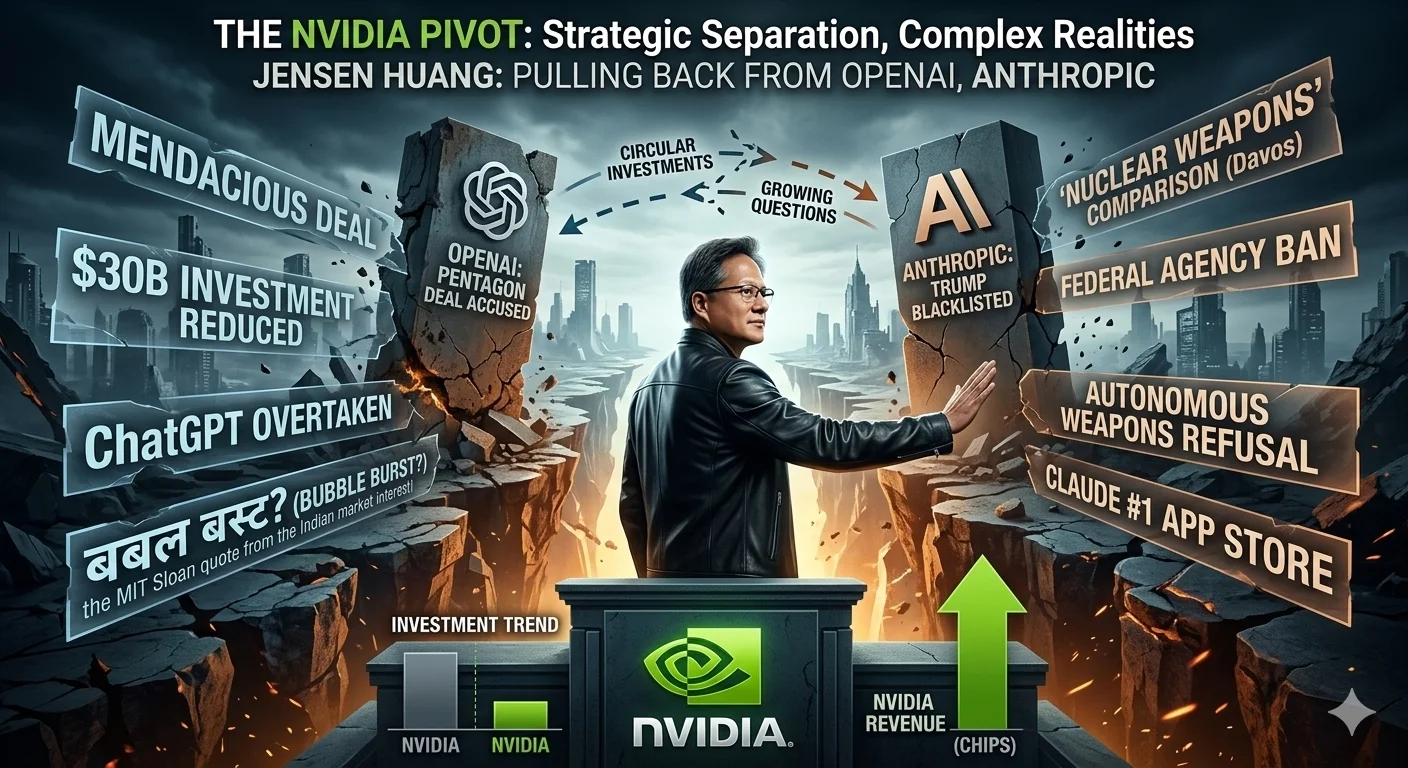

Jensen Huang Says Nvidia Is Pulling Back From OpenAI and Anthropic: The Real Reasons Behind the Retreat:
Nvidia's Sudden Investment Pullback Raises Questions About Circular Deals, Political Risk, and the Future of AI Chip Economics.
The AI investment landscape is shifting fast — and Nvidia CEO Jensen Huang just delivered a bombshell that has Silicon Valley scrambling to read between the lines. At the Morgan Stanley Technology, Media and Telecom conference in San Francisco Wednesday, Huang announced that Nvidia's recent investments in OpenAI and Anthropic are likely to be its last in both companies, citing the expected public offerings later this year as the reason the "opportunity to invest closes."
If you've been following the rise of AI chip investments, circular AI funding deals, and the growing tension between AI companies and government regulators, this pullback represents one of the most significant strategic shifts of 2026 — and Huang's explanation raises far more questions than it answers.
On the surface, Huang's reasoning seems straightforward: once OpenAI and Anthropic go public as anticipated later this year, the opportunity for private investment naturally ends. It could be that simple. Nvidia is already minting money selling the GPUs and AI accelerator chips that power both companies' massive data centers — the company doesn't necessarily need to chase additional upside by pouring more capital into equity stakes.
But dig deeper into the timeline, the numbers, and the political context, and a very different picture emerges: Nvidia may be executing a strategic retreat from investments that have become uncomfortably circular, politically toxic, and operationally complicated. The official explanation about IPO timing doesn't align with how late-stage private investing actually works — and what's looking more probable is that this is an exit from a situation that has gotten really messy, really fast.
What Is Really Behind Nvidia's Investment Pullback:
At its core, Nvidia's decision to stop investing in OpenAI and Anthropic appears to be driven by three overlapping concerns: the circular nature of these investment deals, growing regulatory scrutiny over potential investment bubbles, and the increasingly fraught political environment surrounding AI safety and military applications.
When Nvidia first announced plans to invest up to $100 billion in OpenAI last September, MIT Sloan professor Michael Cusumano described the arrangement to the Financial Times as "kind of a wash," observing that "Nvidia is investing $100 billion in OpenAI stock, and OpenAI is saying they are going to buy $100 billion or more of Nvidia chips." In other words, Nvidia gives OpenAI money, OpenAI immediately spends that money buying Nvidia products — creating a closed loop that inflates both companies' valuations without generating genuine economic activity outside the system.
The investment Nvidia finalized just last week as part of OpenAI's massive $110 billion funding round came in at $30 billion — well short of that earlier $100 billion pledge. That dramatic reduction suggests growing concern that such circular deals could be creating an unsustainable AI investment bubble, with regulators, investors, and industry observers increasingly questioning whether these arrangements represent legitimate capital allocation or accounting gimmickry.
Key Factors Behind Nvidia's Strategic Retreat:
According to industry analysis and timeline evidence, the key drivers include:
-
Circular investment concerns: Nvidia invests in OpenAI, OpenAI uses that capital to buy Nvidia chips, creating a closed loop that regulators are scrutinizing for potential bubble dynamics.
-
Investment commitment reduction: Nvidia's actual OpenAI investment shrank from $100 billion promised to $30 billion delivered, suggesting internal reassessment of risk-reward.
-
Political complications with Anthropic: Just months after Nvidia's $10 billion Anthropic investment, CEO Dario Amodei compared selling chips to Chinese customers to "selling nuclear weapons to North Korea."
-
Government blacklisting risk: The Trump administration blacklisted Anthropic from federal contracts, creating regulatory exposure for Nvidia as a major investor and chip supplier.
-
Public relations fallout: OpenAI's Pentagon deal sparked massive backlash (ChatGPT uninstalls up 295%), while Anthropic's refusal boosted its reputation — putting Nvidia's portfolio companies on opposite sides of a cultural battle.
In practice, Nvidia finds itself holding stakes in two companies that are now pulling in radically different directions — one collaborating with the military despite user backlash, the other blacklisted by the government for refusing — and potentially dragging Nvidia's own reputation and customer relationships along for the ride.
The Circular Investment Problem: How Nvidia's Money Flows Back to Nvidia:
The fundamental issue with Nvidia's AI investments is that they create self-reinforcing loops that may look impressive on paper but generate questions about genuine value creation. Here's how the circular dynamic works:
-
Step 1: Nvidia invests billions in OpenAI equity at a high valuation.
-
Step 2: OpenAI uses that capital to purchase Nvidia GPUs, H100 chips, and AI infrastructure — generating revenue for Nvidia's core business.
-
Step 3: Nvidia's chip sales to OpenAI justify higher revenue projections and stock price, while OpenAI's ability to secure Nvidia investment justifies its elevated valuation.
-
Step 4: Both companies appear more valuable, but the actual cash has simply circulated between them rather than creating new economic output.
Growing regulatory concern about these arrangements explains why Nvidia's committed investment dropped from $100 billion to $30 billion between announcement and close. If regulators determine that circular investment structures artificially inflate valuations or create systemic risk, companies involved could face scrutiny, enforcement actions, or mandatory restructuring — risks that likely factored into Nvidia's decision to limit exposure.
The Anthropic Relationship: From $10 Billion Investment to "Nuclear Weapons" Comparison:
Nvidia's relationship with Anthropic has looked fraught from the beginning. Just two months after Nvidia announced a $10 billion investment in November 2025, Anthropic CEO Dario Amodei took the stage at the World Economic Forum in Davos and — without naming Nvidia directly — compared the act of U.S. chip companies selling high-performance AI processors to approved Chinese customers to "selling nuclear weapons to North Korea."
The comparison was extraordinary, essentially accusing Nvidia (the dominant AI chip supplier with significant business in China) of enabling potentially catastrophic technology transfer to a geopolitical adversary. For a company that had just received a $10 billion investment from Nvidia, the public criticism represented either remarkable principle or remarkable recklessness — and it certainly didn't suggest a harmonious investor-investee relationship.
In retrospect, the nuclear weapons comparison was the least of it. Just days ago, the Trump administration blacklisted Anthropic, barring federal agencies and military contractors from using the company's Claude AI models after Anthropic refused to allow its technology to be used for autonomous weapons or mass domestic surveillance. The blacklisting immediately created regulatory and reputational complications for Nvidia as both an investor and primary chip supplier to Anthropic.
The OpenAI-Anthropic Split: Nvidia Caught in the Middle:
Within hours of Anthropic's blacklisting, OpenAI announced it had struck its own deal with the Pentagon — a move that created a stark contrast between the two companies and put Nvidia in an impossible position. OpenAI agreed to provide unrestricted military access to its AI models, while Anthropic walked away from lucrative government contracts rather than compromise on safety principles.
The public response was immediate and dramatic. Within 24 hours of the back-to-back announcements, Anthropic's Claude app shot to the top of the free-app rankings on Apple's U.S. App Store, overtaking ChatGPT. According to Sensor Tower data, Claude had been outside the top 100 at the end of January — the surge represented a massive shift in consumer sentiment favoring Anthropic's principled stance.
Meanwhile, ChatGPT uninstalls jumped 295% following OpenAI's Pentagon announcement, suggesting widespread user dissatisfaction with the military partnership. Anthropic publicly called OpenAI's messaging around the deal "mendacious" — essentially accusing its competitor of lying about the safety protections in its military contract.
For Nvidia, this means holding equity stakes in two companies that are now positioned as moral opposites in a high-stakes debate about AI ethics, military applications, and corporate responsibility. Customers, employees, and partners who support one company's approach may actively oppose the other — creating brand risk and operational complications that Nvidia likely didn't anticipate when making these investments.
The Bigger Picture — The Collapse of Nvidia's AI Investment Strategy:
Nvidia's story as an AI investor is one of rapid escalation followed by equally rapid retreat. The company initially pursued aggressive equity stakes in frontier AI labs as a strategy to deepen ecosystem relationships, secure long-term chip customers, and participate in the potentially enormous upside of successful AI companies going public or achieving AGI breakthroughs.
The strategy made sense in theory: Nvidia's chips are essential infrastructure for every major AI lab, so investing in those labs creates alignment of interests while potentially generating massive returns if any achieve transformative success.
But the execution revealed fundamental problems. The circular nature of the investments created regulatory exposure. The political dynamics between AI safety principles and government demands proved more volatile than anticipated. And the reputational risk of being associated with companies making controversial decisions became impossible to manage when portfolio companies took opposite positions.
Jensen Huang's stated reason for pulling back — that IPOs close the investment opportunity — is transparently inadequate. Late-stage private investors frequently participate in funding rounds up until the eve of public debut, and sophisticated investors like Nvidia have multiple mechanisms for maintaining exposure to high-growth companies even after they go public. The IPO explanation is corporate communication, not genuine strategic analysis.
What Jensen Huang Actually Said (And What He Didn't):
When asked for comment following Huang's Morgan Stanley conference remarks, an Nvidia spokesman pointed TechCrunch to a transcript from the company's fourth-quarter earnings call, where Huang said all of Nvidia's investments are "focused very squarely, strategically on expanding and deepening our ecosystem reach" — a goal its earlier stakes in OpenAI and Anthropic have arguably met.
That framing is revealing: Nvidia achieved its ecosystem objectives and is now exiting before complications escalate further. The company got what it needed from these investments — tighter relationships, favorable chip purchase commitments, strategic influence — and is now cutting exposure before regulatory, political, or reputational risks materialize.
Huang has already dismissed one popular theory — that there is bad blood between Nvidia and OpenAI — as "nonsense." But dismissing interpersonal tension doesn't address the structural problems: circular investments, political volatility, and irreconcilable differences between portfolio companies on fundamental ethical questions.
Challenges and Controversies:
Nvidia's pullback raises uncomfortable questions about the sustainability of the current AI funding ecosystem. If the dominant chip supplier can't justify continued investment in the leading AI labs, what does that signal about valuations, business models, and long-term viability?
The circular investment critique, while compelling, isn't universally accepted. Defenders argue that Nvidia's investments in AI companies that purchase its chips are no different from Amazon investing in e-commerce startups that use AWS, or Microsoft investing in SaaS companies built on Azure. The key distinction is whether the investment creates genuine strategic value beyond the circular cash flow.
Nvidia's timing is also curious. Pulling back just as OpenAI and Anthropic approach public offerings means Nvidia will miss potential IPO gains if either company's valuation surges in public markets — unless Huang genuinely believes the companies are overvalued and the IPOs will disappoint.
The political complications may be the most difficult to navigate. Nvidia sells chips to Chinese customers under carefully managed export control regimes, collaborates with the U.S. military on various projects, and invests in AI companies taking opposite positions on military applications. Managing those relationships simultaneously may simply be untenable — making the pullback a pragmatic recognition of impossible conflicts.
Is This the Future of AI Investment:
Nvidia's retreat from OpenAI and Anthropic may signal the beginning of a broader unwinding of the complex, circular, politically fraught investment relationships that have characterized the AI boom. As AI companies face increasing pressure to choose sides on military applications, government relationships, and safety principles, investors who try to remain neutral or bet on multiple competing approaches may find themselves exposed to reputational and regulatory risks they can't manage.
If Nvidia's model of investing in chip customers proves unsustainable, we could see a shift toward more arm's-length commercial relationships: companies buy chips, investors buy equity, but the two don't overlap in ways that create circular loops or conflicting incentives. This would represent a return to more traditional business structures, potentially deflating some of the frothier AI valuations in the process.
If circular investment structures come under regulatory scrutiny, Nvidia's preemptive pullback may look prescient. Companies that continue piling into late-stage AI rounds funded partly by their own product sales could face investigations, valuation corrections, or forced restructuring.
For now, Jensen Huang's explanation — that IPOs naturally end private investment opportunities — provides plausible deniability for what looks increasingly like a strategic retreat from investments that have become far more trouble than they're worth.
Whether Nvidia's pullback proves wise or premature, whether circular AI investments face regulatory crackdown or normalization, and whether OpenAI and Anthropic can both succeed despite their radically different approaches — these are the questions that will define the AI investment landscape in 2026 and beyond.
Support our research
Independent analysis fueled by you.