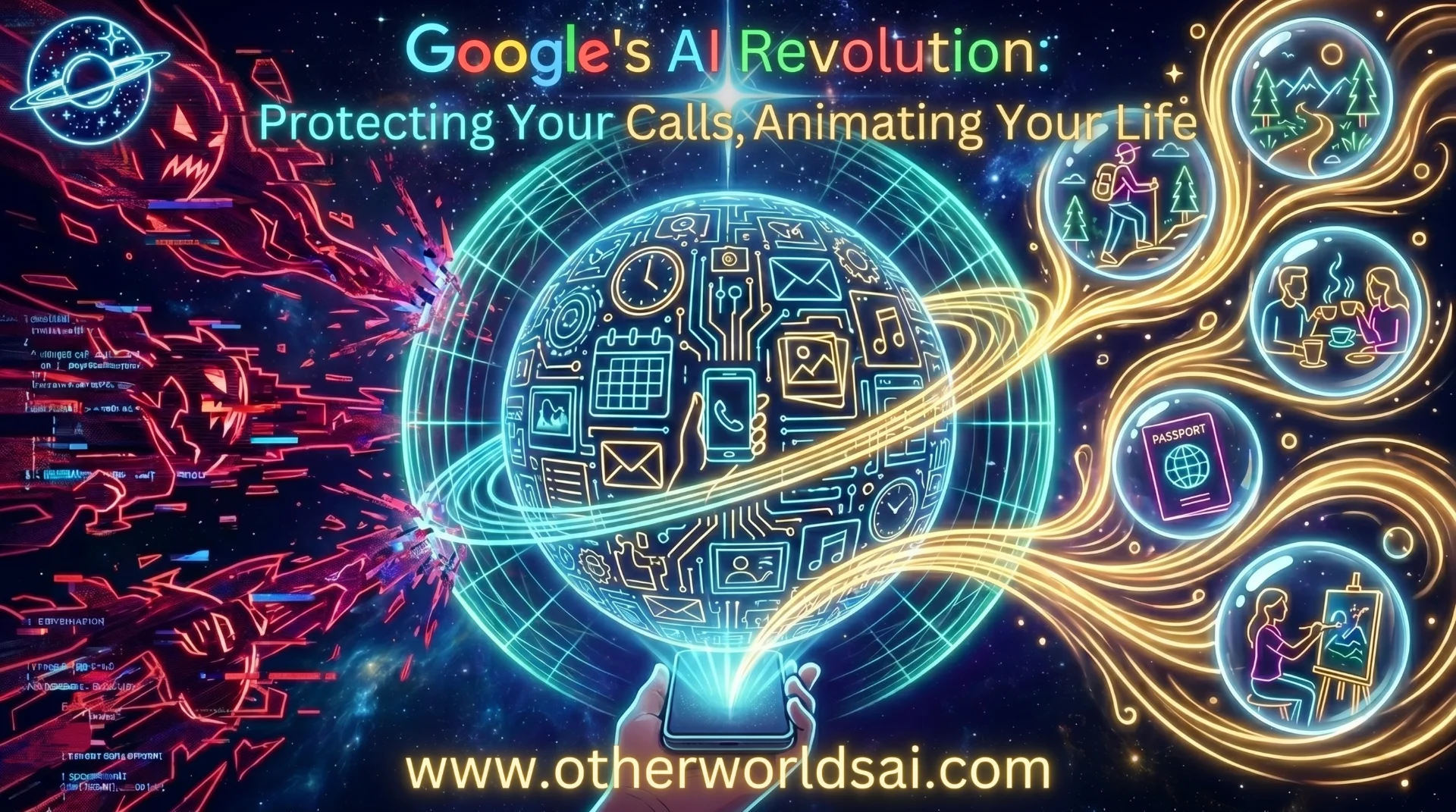

Google's AI Revolution: Protecting Your Calls, Animating Your Life:
How Fake Call Detection and Dreambeans Are Redefining How We Stay Safe — and Stay Inspired — in the Age of AI:
Introduction: Google Doubles Down on AI — For Protection and Inspiration:
Artificial intelligence is rapidly reshaping how we interact with the world around us — and Google is making sure it shapes that future on two very different fronts. In a single week, the tech giant unveiled two headline-grabbing AI features that together tell a fascinating story about where mobile technology is headed.
The first is a fake call detection system for Android — a powerful, privacy-preserving shield against the rising tide of AI deepfake phone scams. The second is Dreambeans, a whimsically named but seriously clever AI lifestyle app from Google Labs that turns your own Google data into a curated daily dose of inspiration.
Taken together, these two launches capture the dual nature of AI in 2026: a tool that can be weaponised by bad actors, and a tool that — in the right hands — can quietly improve your daily life. Google is clearly positioning Android not just as a smartphone platform, but as an intelligent, always-on companion that keeps you safe from scams while helping you discover what to do next. Here's everything you need to know.
The Threat Is Real: AI Deepfake Impersonation Scams Are on the Rise:
Before diving into Google's solution, it's worth understanding the scale of the problem it is trying to solve. As more people have learned to screen unknown numbers, scammers have evolved. Today's most sophisticated phone fraudsters don't call from random digits — they spoof trusted caller IDs, making it appear as though the call is coming from your bank, your doctor's office, or even a family member. Worse, they now layer in AI voice cloning technology to sound convincingly like the person they are impersonating.
The results can be devastating. Imagine receiving a call that shows "Mom" on your screen, and the voice on the other end sounds exactly like her — the same cadence, the same accent, the same warmth. She's in trouble and needs money urgently. You send it. But it wasn't your mother at all. It was a generative AI deepfake voice scam, and you've just become one of millions of victims. These AI phone impersonation scams are not hypothetical — they are costing consumers billions of dollars annually and growing more convincing every month.
Google's Answer: Fake Call Detection Launches on Android 12+
Google's new fake call detection feature is one of the most meaningful Android security updates in years, and it works elegantly in the background without requiring any action from users. Rolling out globally this month to Android 12+ devices via Phone by Google — starting with Pixel — the feature is on by default and operates completely automatically. Most importantly, it doesn't require you to do anything differently. It just works.
The technical foundation is clever and draws on existing infrastructure. Google describes the system as a kind of "digital handshake between devices." When a contact in your phone calls you, and both of you are using Phone by Google, their device transmits a silent verification signal to yours, confirming that the call is genuinely originating from their handset. Think of it as a cryptographic caller authentication layer built on top of the standard phone call.
The magic happens when that verification signal is absent. If a scammer attempts to spoof your contact's number, their device cannot generate the authentic confirmation signal. Google explains the response clearly: "Your device will instantly notice this and ping your contact's actual device to double-check. If their real device says, 'I'm not making a call right now,' you'll get a warning on your screen advising you to hang up immediately." The result is a real-time, on-device AI scam call warning that appears before you've been deceived.
The feature is built on top of Rich Communication Services (RCS) — a key decision that signals Google's ambitions beyond its own ecosystem. By grounding fake call detection in RCS, Google has made the underlying technology available for other apps and companies to adopt. If widely implemented, this could become an industry-wide standard for phone call authentication and AI impersonation protection — a meaningful step toward a safer mobile communications ecosystem for everyone.
More Android Updates: Smart Outfit Search, Google Photos Wardrobe & Play Books:
The fake call detection launch arrived alongside a wave of other Android feature updates that showcase Google's broader AI-first product strategy. For fashion-conscious users, Google Photos is gaining a new AI wardrobe feature that scans your photo library, identifies the clothing you wear in your images, and creates a browsable catalog of your outfits.
Users can then mix and match items virtually — essentially turning their phone into a personal AI stylist. This feature rolls out next week in the U.S., India, and Brazil for Android 10+ devices.
Circle to Search — one of Android's most loved AI features — is also getting a meaningful upgrade. Previously, users could circle a single item in a photo to search for it. Now, the Circle to Search outfit detection update can identify and search every item in an entire outfit simultaneously, eliminating the need to search piece by piece. This update is now live on all Android 14+ devices that support Circle to Search.
Book lovers will also find something to celebrate in this update cycle. Google Play Books is rolling out a "Catch me up" AI recap feature that generates a contextual summary of where you left off in a story, making it easy to re-engage after time away. Users can also highlight any passage to ask questions directly — a feature that transforms passive reading into an interactive, AI-assisted experience. Both features are available today for select English titles.
Meet Dreambeans: Google's Weirdest-Named — and Most Intriguing — New AI App:
While fake call detection protects you from the darker side of AI, Dreambeans represents something altogether more optimistic: an AI app designed to make your daily life richer, more inspired, and less addicted to your phone. Launched by Google Labs — the company's experimental product incubator — Dreambeans is a new AI-powered lifestyle app available on both Android and iOS. Its premise is simple but powerful: use your own Google data to generate a curated collection of AI-illustrated daily stories that inspire real-world action.
The app draws on a remarkable breadth of personal data — with explicit user consent. According to product lead Gozde Oznur, Dreambeans uses what Google calls Personal Intelligence to connect information from Gmail, Google Calendar, Google Photos, YouTube, and Search History. From this data mosaic, it generates stories that might include local restaurant recommendations, travel prep tips based on an upcoming calendar trip, news articles aligned with your interests, or lifestyle suggestions based on life events you've noted in your calendar.
The anti-doomscrolling philosophy baked into Dreambeans is one of its most distinctive design choices. Rather than delivering an infinite, algorithmically optimized feed, Dreambeans limits users to just 10 to 14 stories per day. The app is explicitly designed as a phone addiction antidote — give users a moment of meaningful, personalised inspiration, then encourage them to put the phone down and go live. Oznur put it plainly: the goal is to get "a few inspirational ideas and then go out and live your life."
Why Is It Called Dreambeans? The Name Actually Makes Sense:
In a world of forgettable app names, Dreambeans stands out — and not necessarily for the right reasons at first glance. But Oznur's explanation is surprisingly poetic. The name has two distinct components, both of which reflect how the app actually works.
The "dream" in Dreambeans is literal. While the user sleeps, the app runs quietly in the background, processing data from across all connected Google services. "The dream part is literal, because while you sleep, the app is working through everything across your connected apps, because, as you can imagine, it's a lot of data that it is distilling," Oznur explained.
The "beans" in Dreambeans is a coffee metaphor — and a rather elegant one. Just as coffee beans are roasted and ground overnight to produce a concentrated morning brew, Dreambeans processes your entire digital life into a "concentrated drop of inspiration in the morning." By the time you wake up and open the app, your personalised stories are ready — freshly brewed, so to speak. It's an unusually thoughtful naming convention for what is, functionally, a personal AI intelligence briefing delivered each morning.
Privacy and Data: What Google Does — and Doesn't — Do with Your Information:
Any app that draws on Gmail, Calendar, Photos, and Search History is going to raise legitimate privacy questions — and Google has tried to address them directly. According to Oznur, only the user has access to their Dreambeans stories. There is no social sharing, no advertiser targeting based on story content, and no sharing of personalised story data with third parties.
Users can also delete their data at any time and choose precisely which Google services they want to connect to the tool. Granular data control settings allow users to opt specific services in or out.
The fake call detection feature also comes with strong privacy credentials. Because the system is built on RCS and operates as a peer-to-peer device verification rather than a centralised call-monitoring service, Google is not recording or analysing the content of calls. The on-device AI scam detection system works without sending audio data to Google's servers, making it a privacy-respecting approach to a very real safety problem.

Anthropic’s Surprise Double Launch Directly Targets OpenAI and Google’s AI Dominance
Availability: Who Can Access These Features Right Now:
Rollout timelines and eligibility vary across these launches, so here is a clear breakdown. Fake call detection is rolling out globally this month to all Android 12+ devices running Phone by Google, starting with Pixel. It is on by default and requires no setup. Google Photos wardrobe rolls out next week to eligible users in the U.S., India, and Brazil on Android 10+.
Circle to Search outfit detection is live now on all Android 14+ devices with Circle to Search. Google Play Books recap and highlights features are available today for select English titles.
Support our research
Independent analysis fueled by you.
Dreambeans has the most restricted rollout of the group. It is currently available only to U.S.-based Google AI Ultra subscribers on Android and iOS. However, Google has opened a Dreambeans waitlist to any user with a personal Google account, suggesting a broader rollout is planned. Given its experimental origins in Google Labs, the feature set and availability will likely evolve quickly.
The Bigger Picture: Google's AI Strategy in 2026:
Viewed in isolation, fake call detection and Dreambeans might seem like unrelated product launches. But together, they illustrate a coherent strategic vision that Google is executing across its entire product portfolio. The company is embedding ambient AI intelligence into every layer of the Android experience — from the security layer (call verification) to the content layer (personalised stories) to the camera layer (wardrobe AI) to the search layer (Circle to Search).
What connects all of these features is that they are designed to work quietly, without requiring the user to actively engage with AI. Fake call detection fires a warning when needed; you never know it's running otherwise. Dreambeans generates stories while you sleep. The wardrobe feature catalogues your clothes as a background process.
This is passive AI — intelligence that serves you without demanding your attention, a meaningful counterpoint to the engagement-maximising AI feeds that dominate most social platforms.
Google's AI strategy in 2026 is less about flashy demos and more about weaving intelligence into the fabric of everyday life — and these two launches are a compelling proof of concept.
Meta's Next Big Bet: This New App Lets You Build Games Simply by Typing a Prompt
Conclusion: Two Sides of the Same AI Coin:
The story of AI in 2026 is not a simple one. It is a technology that arms scammers with deepfake voice cloning tools capable of impersonating your mother — and the same technology that powers Google's defense against those very scams. It is an algorithm that can trap you in an endless scroll — and the same intelligence that Dreambeans is using to liberate you from it.
Google's latest Android updates sit squarely at this intersection, and they are better for it. Fake call detection addresses one of the most insidious real-world harms that AI has enabled, using smart on-device verification to create a meaningful line of defense. Dreambeans asks a more ambitious question: what if your phone's AI, rather than competing for your attention, actually helped you pay attention to the things that matter?
Both answers are works in progress. But they are the right questions to be asking — and Google, for now, is asking them louder than anyone else.
Published: June 2026 | Category: Google AI, Android Features, Mobile Technology, AI Safety