
SAP and Google Cloud Just Rebuilt Enterprise Commerce From the Ground Up — With AI Agents Running the Entire Stack:
How Google Gemini and SAP Just Permanently Solved the E-Commerce Inventory Lag:
78% of businesses say AI is essential for customer retention in 2026. Fewer than two in five actually share data across their own platforms. SAP and Google Cloud's new agentic commerce architecture is engineered to close that gap — permanently.
78%: Businesses Calling AI Essential for Retention (2026)
37%: Share Data Across CX Platforms
39%: Share Data Across CRM Systems
0-copy: Bidirectional Data Architecture
1: The Data Fragmentation Problem That Is Breaking Enterprise Commerce:
The numbers are striking in their contradiction. SAP's own research reveals that 78 percent of businesses now consider AI essential for retaining customers in 2026 — and yet fewer than two in five of those same organizations actually share customer data across their customer experience platforms (37%) or CRM systems (39%). Companies are racing to adopt AI while leaving the data infrastructure that powers it deliberately siloed.
This is not a minor inefficiency — it is a structural failure that shows up in ways customers experience directly. Promotional emails arrive for products that are out of stock. Support agents cannot see the order a customer is calling about. A shopping cart built on one device disappears on another. A loyalty record that exists in the CRM is invisible to the checkout flow. Every one of these failures traces back to the same root cause: enterprise data that does not move, does not synchronize, and does not serve the customer in real time.
SAP and Google Cloud's expanded partnership is a direct intervention against this structural failure. Rather than layering AI capabilities on top of broken data architecture, the joint solution restructures the underlying infrastructure — unifying data, AI, engagement, and commerce operations into a single coherent system capable of executing the full retail sequence autonomously.
78% of businesses say AI is essential for customer retention. Fewer than two in five share data across their own CX or CRM platforms. SAP and Google Cloud built their agentic commerce architecture to resolve exactly that contradiction.
2: The Universal Commerce Protocol — Standardising the Agentic Commerce Layer
Most enterprise digital commerce infrastructure is built on fragmented APIs that were never designed to communicate with autonomous agents. Individual systems — inventory management, payment gateways, customer data platforms, marketing automation — each have their own interfaces, data formats, and authentication requirements. Getting them to work together requires custom integration work that is expensive to build, brittle to maintain, and slow to extend.
SAP Commerce Cloud's adoption of the Universal Commerce Protocol addresses this at the foundation level. The protocol standardizes data exchange among retailers, payment gateways, and autonomous AI agents, creating a shared language that allows software to independently execute the complete retail sequence — from initial product search through transaction processing to post-sale issue resolution — without requiring human intervention at each handoff point.
For engineering teams, the practical impact is significant. Direct integrations between intelligent agents and commerce platforms become structurally simpler. Integration costs fall. Onboarding into AI-driven channels accelerates. Retailers do not need to rebuild existing infrastructure to participate — the protocol works with what they already have, extending its capabilities rather than replacing them.
The commercial surface area this creates is equally notable. SAP is collaborating with Google to ensure that merchant products surface organically within the Gemini application and Google Search, specifically incorporating AI Mode functionality. Consumers interact with these interfaces naturally while the backend architecture — operating through the Universal Commerce Protocol — handles inventory checks, cart management, and payment processing invisibly in the background.
The Universal Commerce Protocol allows software to independently execute the full retail sequence — from initial search through transaction processing to post-sale resolution — without requiring human intervention at each handoff point.
3: The Shopping Assistant — Unifying the Customer Experience Across Every Touchpoint
SAP Commerce Cloud integrates Google Gemini capabilities to power a designated Shopping Assistant that brands deploy directly to their customers. The assistant supports chat, voice, and text interactions, and maintains state retention throughout the complete shopping cycle — meaning it remembers who the customer is, what they have looked at, what they have purchased, and what their current intent appears to be, across every interaction in the session.
What makes this technically distinct from conventional recommendation engines is the data it ingests in real time. The Shopping Assistant combines live behavioral inputs, current warehouse capacities, and active marketing data to assemble product pairings that are not just relevant to the customer's expressed preferences but physically fulfillable at the moment of suggestion. This is a deliberate design choice that targets one of enterprise commerce's most persistent failure modes.
The failure mode in question is familiar to anyone who has run enterprise promotional campaigns at scale: a marketing team launches a campaign, demand spikes beyond what inventory can satisfy, and the frontend interface — having no real-time connection to warehouse systems — continues showing products as available right through the checkout moment. Customers click promotional emails, load the associated app or website, and encounter out-of-stock notices at the payment stage. Fulfillment updates lag severely, leaving support agents without a coherent operational picture when customers call to complain.
The SAP and Google Cloud architecture targets this cascade specifically. The Shopping Assistant actively queries live warehouse records before displaying any product. Physical supply is verified against the consumer's request before a suggestion appears. The architecture also eliminates the friction of repeated data entry — rather than requiring customers to re-submit information they have already shared, the system recognizes the user and their precise context instantly across all digital properties. Support staff gain access to unified records, enabling efficient issue resolution rather than disconnected case management.
Live: Warehouse Queries Before Every Suggestion
Unified: Customer Context Across All Touchpoints
Zero: Infrastructure Rebuild Required by Retailers
Full: Post-Sale Resolution Coverage
4: Bidirectional Data Flows — How BigQuery and SAP Business Data Cloud Power the Engine
Effective AI-driven marketing requires data pipelines that are not just accurate but current. SAP Engagement Cloud partners with Google Cloud to deliver an autonomous multi-agent framework built on a bidirectional, zero-copy data link between SAP Business Data Cloud and Google BigQuery, secured by strict administrative controls. Zero-copy architecture means data remains in place rather than being duplicated across systems — dropping storage expenses and network latency simultaneously.
The data flowing through this architecture combines external signals with internal behavioral context at a granularity that manual campaign management cannot match. BigQuery ingests live external variables — weather conditions, precise geographic location, active advertising interaction rates — while SAP Customer Experience solutions supply the internal behavioral layer: customer profiles, exact transaction histories, specific service interactions, and consented engagement records. SAP Engagement Cloud activates the combined intelligence, deploying autonomous agents to orchestrate personalized interactions across the customer lifecycle.
The inventory synchronization consequence of this architecture is direct and consequential. Routing information through the Business Data Cloud while BigQuery handles the analytics logic forces immediate inventory synchronization at the moment of customer interaction. There is no lag between the warehouse state and what the customer sees. Stock levels, fulfillment availability, and product viability are checked and confirmed before a recommendation surfaces — not after.
Zero-copy bidirectional data architecture means vast data stores are linked rather than duplicated — dropping storage costs and network latency while giving autonomous agents access to live inventory, behavioral context, and external signals simultaneously.
5: Generative Execution in Production — How Gemini Powers Localised Campaign Output
The front end of the system — what customers actually receive — is driven by advanced generative models that respond dynamically to the data flowing through the bidirectional pipeline. Google Gemini models provide specialized agentic capabilities that generate localized messaging, customized imagery, and campaign variations based on the exact specifications assembled from the live data flow. Marketing output is not templated and batch-distributed — it is generated fresh for each engagement context.
Google Rich Communication Services upgrades the delivery channel itself. Standard SMS messages are transformed into immersive, interactive interfaces capable of carrying rich media, interactive product displays, and embedded commerce actions. Advertising creatives evolve continuously based on incoming engagement data — the system processes each interaction, evaluates the response against the user's profile, and instructs the generative model to adjust the next communication accordingly.
For marketing departments, this represents a fundamental shift in how campaigns are managed. Rather than configuring rigid campaign parameters and manually adjusting them based on performance reports, teams establish business goals and grant the SAP Engagement Cloud access to enterprise data. The autonomous agents handle the operational execution: segmenting audiences using Google BigQuery analytics, generating content variations through Google Gemini, distributing through Rich Communication Services channels, measuring responses, and refining the next cycle — without requiring direct human intervention between iterations.
Campaign performance improves continuously as a result. The multi-agent framework evaluates the success of each generated message, adjusts the relevant variables, and applies those adjustments before the next automated dispatch. The system is learning and improving within the production environment, not in a controlled test environment separate from real customer interactions.
6: What the SAP–Google Architecture Signals for Enterprise AI — And How Agent+ Delivers It Today:
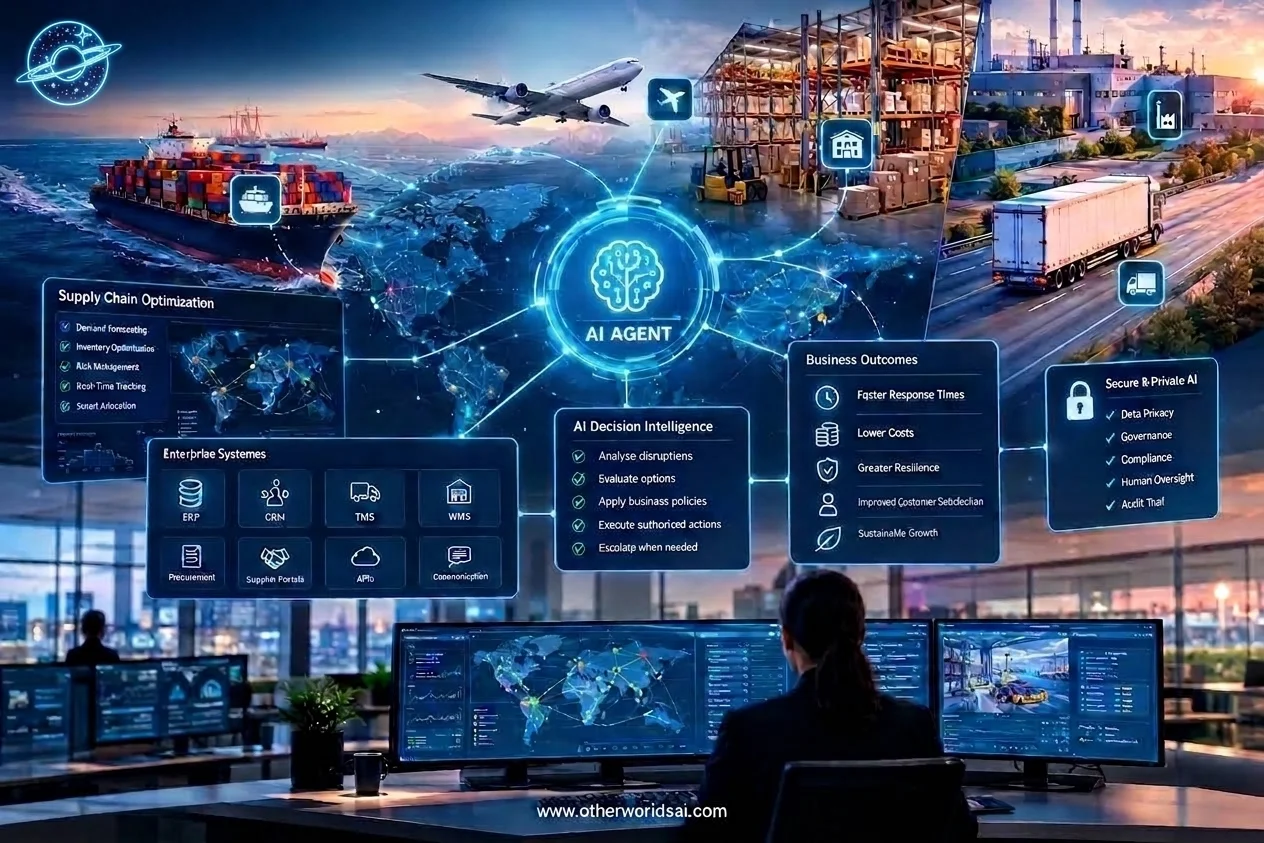
The SAP and Google Cloud agentic commerce deployment is one of the clearest demonstrations yet of what enterprise AI infrastructure looks like when it is built correctly. Not a chatbot layered onto an existing website. Not an AI tool connected to a single data source. A unified architecture where autonomous agents have real-time access to the full operational picture — inventory, customer history, behavioral context, external signals — and can execute end-to-end workflows without human intervention at each step.
The gap this closes is not a technology gap — it is an architecture gap. Most enterprise organizations already have the data. They have the customer records, the transaction histories, the behavioral data, the inventory systems. What they lack is the connective infrastructure that allows AI agents to access all of it simultaneously, act on it in real time, and maintain context across every customer touchpoint. That is precisely the problem this joint deployment solves at the infrastructure level.
For organizations that cannot wait for a hyperscale infrastructure overhaul, Otherworlds AI's Agent+ Business AI Platform delivers the same architectural principles today — starting at $297/month. Agent+ is built around the same core insight that drives the SAP–Google deployment: AI agents are only as powerful as the data infrastructure beneath them. The platform connects your existing business systems, activates automated workflow execution across your customer lifecycle, and maintains the operational context that makes every agent action relevant rather than generic.
Whether your organization operates in retail, financial services, healthcare, or any other data-intensive vertical, the Agent+ automated workflow engine gives your teams the autonomous execution capability that SAP and Google Cloud are building at enterprise scale — without requiring a multi-year infrastructure transformation to access it.
And for organizations with more complex requirements — custom data architectures, compliance-sensitive environments, or bespoke AI workflows — Otherworlds AI's Enterprise custom AI builds deliver end-to-end solutions tailored to your operational reality. The same agentic commerce intelligence, architected around your systems, your data governance requirements, and your business model.
The future of enterprise commerce is agentic, autonomous, and data-unified. Visit otherworldsai.com to explore how Agent+ and Otherworlds AI's enterprise solutions can put your organization at the front of that shift — not years from now, but today.