
Digg Is Back — This Time as an AI News Aggregator Powered by Real-Time Signal Detection:
A Lifeline for Publishers? Why Digg’s New AI Aggregator Could Fight Back Against Google AI Overviews.
Kevin Rose's relaunched platform ditches the Reddit-clone playbook and bets on AI-powered content ranking, X-based sentiment analysis, and influencer signal detection to surface what actually matters.
Digg is back from the dead — and this time, it looks nothing like what came before. The once-iconic link-sharing site founded by Kevin Rose, which dominated the early social web before losing ground to Reddit, has relaunched as an AI-powered news aggregator with a fundamentally different premise: instead of hosting community discussions, the new Digg ingests real-time signals from across the web — primarily X (formerly Twitter) — and uses AI sentiment analysis, content clustering, and AI signal detection to surface the news stories that actually matter.
It is a pivot as dramatic as any in recent tech history, and it raises a genuinely interesting question: in an era of information overload, can an AI news ranking platform do what no algorithm, RSS reader, or social feed has yet managed to do — help people find the signal in the noise?
From Reddit Rival to AI News Platform: How Digg Got Here:
The road to this relaunch has been anything but smooth. The most recent version of Digg — designed as a direct competitor to Reddit — launched publicly in January 2026 and shut down just two months later, in March, after the company found itself unable to effectively manage bot traffic flooding the platform. More fundamentally, the product had not differentiated itself enough from Reddit or other community forum platforms to attract and retain a loyal audience. The company laid off staff and announced it was going back to the drawing board.
Rose, a partner at True Ventures, returned to work full-time on a reimagined version of Digg in April 2026. By May, he was previewing a link to the newly redesigned site at di.gg/ai — a product that shares almost nothing visually or functionally with its Reddit-rival predecessor. What emerged instead is closer to the original spirit of Digg: a ranked news aggregator built for readers who want to know what matters most right now, without having to wade through an entire social media feed to find out.
How the New Digg Works: AI-Powered Content Ranking and Real-Time Signal Detection:
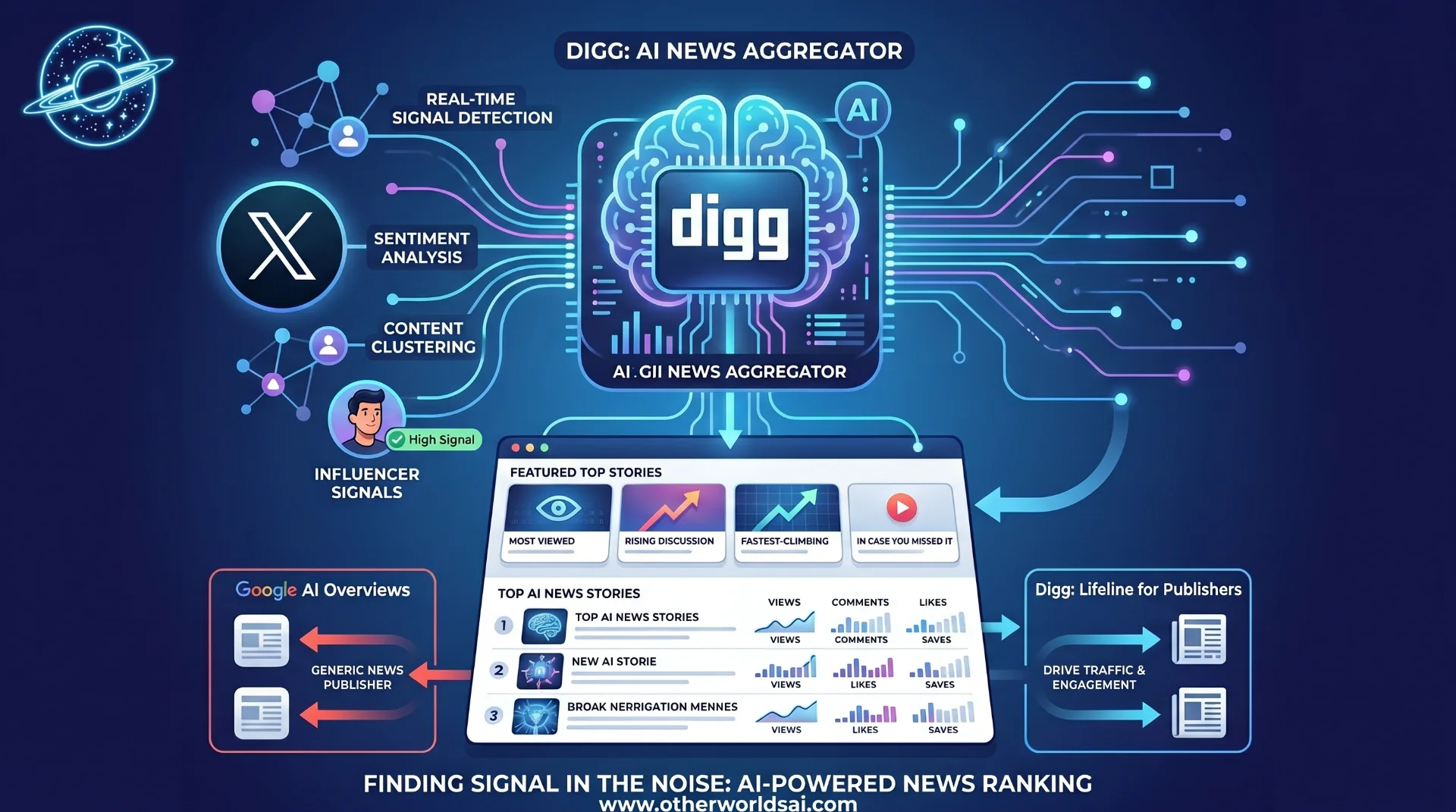
The core mechanic of the new Digg is unlike anything currently offered by mainstream news platforms. Rather than hosting its own community metrics, the platform ingests content from X in real time and applies a multi-layered analytical stack — including AI sentiment analysis, topic clustering, and AI-powered signal detection — to identify which stories are genuinely driving conversation versus which ones are simply generating noise.
The homepage is structured around four featured stories at the top: the most viewed story of the moment, a story seeing rising discussion, the fastest-climbing story, and an "In Case You Missed It" headline for important stories that may have been overlooked. Below that is a ranked list of the day's top AI news stories, complete with engagement metrics — views, comments, likes, and saves — all drawn not from Digg's own platform but from X's real-time activity.
The influencer signal layer is one of the most distinctive features. As Rose noted publicly, when OpenAI CEO Sam Altman engages with a story about AI, it almost invariably triggers a chain reaction of deeper discussion and wider propagation across X. The new Digg is designed to detect and surface exactly that kind of influencer-driven content amplification — tracking not just what is being discussed, but who is driving the discussion and how fast it is spreading. The platform also ranks the top 1,000 people involved in AI, alongside the top companies and politicians focused on AI policy and development.
For data-driven readers, this is genuinely novel territory. Digg exposes the mechanics of viral AI content distribution through charts and graphs, giving users a transparent view of how AI news trending on X actually propagates — which voices matter, which topics are accelerating, and what the broader conversation looks like beneath the surface-level churn of a social feed. For those who lack the time to monitor X continuously for breaking AI industry news, Digg positions itself as a curated, algorithmically ranked alternative.
The Opportunity: AI News Aggregation in a Fragmented Media Landscape:
The timing of Digg's pivot is not accidental. The media landscape that news aggregators operate within has been dramatically reshaped by two forces: the fragmentation of online discussion across platforms, and the decimation of publisher web traffic by AI-generated search summaries. Google's AI Overviews — the AI-generated summaries displayed atop search results — have substantially reduced click-through rates to news publishers, cutting off a revenue stream that many outlets had relied upon for years. In this environment, a platform that successfully drives readers to quality journalism could fill a meaningful gap.
AI is a strategically well-chosen starting vertical for several reasons. Unlike most other news topics, AI industry news and discussion still takes place predominantly on X, where founders, researchers, executives, and journalists actively post and debate in public. The AI news aggregator use case maps cleanly onto the platform's signal-detection approach. The audience most interested in real-time AI news is also the audience most likely to appreciate a data-driven, algorithmically ranked interface over a traditional editorial feed.
If Digg can establish itself as the authoritative destination for ranked AI news, it has a credible path to expanding into adjacent verticals — technology, finance, science, policy — where similar dynamics of concentrated expert discussion and high-value signal exist. The company has confirmed that AI is the initial test case, with broader topic expansion planned if the model proves out.
The Challenges: Engagement, Platform Dependency, and the X Concentration Risk:
The new Digg launches into a landscape littered with the wreckage of previous news aggregation attempts. And while the product is distinctive, it faces several real structural challenges that will determine whether it achieves sustainable traction.
The most immediate question is one of user behavior. There is currently no discussion happening on Digg's own platform — the site surfaces ranked content but does not yet host a community around it. For casual readers, this raises a legitimate question: why navigate to Digg rather than simply opening a preferred news app, RSS reader, or the X "For You" feed directly?
The platform's value proposition is strongest for users who find X's feed too noisy to parse efficiently and who want a pre-ranked, AI-curated news feed instead. Whether that niche is large enough to sustain a standalone product remains to be seen.
The X dependency is also a meaningful concentration risk. Digg's entire signal layer is built on real-time data ingested from X — meaning that any change to X's API access policies, data licensing terms, or platform dynamics could materially disrupt the product. This is not a hypothetical concern: X has repeatedly altered its API structure and pricing since Elon Musk's acquisition, making it a less reliable platform dependency than it once was.
There is also a deeper structural question about whether the X-as-signal model will scale beyond AI. The tech and AI communities are among the last remaining large, active public conversations happening on X. Many other verticals — lifestyle, entertainment, local news, sports commentary — have migrated to Threads, Bluesky, private Discord communities, or off the public internet entirely. Digg's signal-detection model may be uniquely well-suited to AI now, but it will face a much harder data environment if and when it expands to other categories.
What Digg's Relaunch Signals for the Future of AI-Powered Media:
Regardless of whether Digg succeeds as a standalone product, its relaunch is a meaningful indicator of where AI-powered media curation is heading. The old model of news aggregation — human editors, upvote communities, or raw algorithmic ranking based on clicks — is giving way to a more sophisticated stack: real-time AI content ranking, sentiment analysis for news, influencer network mapping, and automated AI news curation that can distinguish genuine signal from manufactured engagement.
For publishers, Digg's model represents a potential lifeline — or at least a new distribution channel. As Google AI Overviews reduce search traffic and traditional social referrals decline, platforms that successfully surface quality journalism and drive readers to original sources could become increasingly valuable. The publisher ecosystem has been searching for new traffic sources; an AI news aggregator that genuinely rewards high-signal reporting could prove to be one.
For the broader AI industry, the new Digg is a live experiment in whether AI tools can solve one of the internet's most persistent problems: helping people find the stories that matter, from the voices that matter, at the moment they matter. The beta is raw, the product is still being refined, and the audience is still forming. But the question Digg is trying to answer — how to surface real signal in an age of AI-generated noise — is one of the defining challenges of the current media moment.
The Bottom Line: A High-Risk, High-Upside Bet on AI-Curated News:
Digg's third act is its most ambitious — and its most clearly differentiated. By abandoning the Reddit-rival playbook and betting instead on AI-driven news ranking, real-time content signal detection, and X-based engagement analytics, Kevin Rose is attempting something that no major news platform has yet fully cracked: a ranked, transparent, AI-powered news discovery platform built for the information density of 2026.
The challenges are real — platform dependency, limited on-site community, and questions about scalability beyond AI as a topic. But so is the opportunity. In a media environment where AI search overviews are eroding publisher traffic, where social feeds are increasingly algorithmically opaque, and where the demand for high-quality, curated AI industry news has never been higher, Digg has identified a real gap.
Whether it can fill that gap — and build a sustainable business doing so — is the question its beta will spend the next several months answering.
Support our research
Independent analysis fueled by you.