
Google's Identity Crisis: When AI Search Breaks and Disco Balls Take Over Your Home Screen:
Google Just Turned Pixel App Icons Into Sparkly Disco Balls (Here's Why)
In the same week Google's AI-powered search overhaul produced empty results for the word 'disregard' and handed Bing its first-ever win, the company also decked out Pixel phones in sparkly disco-ball icons. It's been a week.
Google's Big Week: Serious Missteps and Spectacular Silliness:
Google had the kind of week that is very difficult to spin. On one hand, the company rolled out its most ambitious redesign of Search in decades — an AI-first overhaul that pushes traditional blue links far down the page and bets the company's most valuable product on generative AI summaries. On the other hand, it couldn't tell you what the word "disregard" means. And somewhere in between, it covered every Pixel phone in glittery disco balls.
These two stories — one a cautionary tale about moving fast with AI at scale, the other a genuinely delightful piece of corporate whimsy — tell a surprisingly coherent story about where Google finds itself in 2026: a company simultaneously trying to redefine its most critical product and remind the world that it hasn't lost its sense of humor. Whether both efforts are landing is, to put it charitably, a matter of debate.
Google AI Search Overhaul: The 'Disregard' Disaster:
Earlier this week, Google completed the most sweeping transformation of its search interface in the company's history. The new Google Search experience foregrounds AI-generated summaries — pushing the traditional "ten blue links" format that defined internet discovery for more than two decades far down the page, sometimes out of view entirely. For most queries, an AI-synthesized answer is now the first thing a user sees.
The ambition behind the redesign is clear and the competitive logic is defensible. With AI-native search competitors eating into Google's dominance among younger users, the company needed to make a bold move. The new interface represents Google's bet that users will prefer direct answers over lists of links — that the value of search lies in synthesis, not navigation. It's a reasonable hypothesis. What it requires, however, is that the AI actually works.
"I have been a professional tech journalist for nearly 15 years, and before today, I cannot think of a single time when a Bing search result was more valuable than the Google equivalent. There really is a first time for everything."
Then came the word "disregard," and with it, a perfect demonstration of what can go wrong. When users searched for the simple dictionary definition of "disregard" in the new Google Search experience, they were met with a vast block of empty space where the AI summary should have been — and almost nothing else visible on screen. The Merriam-Webster link was technically still present, but buried so far below the AI response area that most users would never scroll to find it.
The reason for the blank AI response is almost certainly a content moderation edge case. The word "disregard" is commonly used in prompt injection attacks — phrases like "disregard all previous instructions" are a standard technique for manipulating AI systems. Google's AI safety filters, trained to block such inputs, appear to be triggering on the word itself, regardless of context. The result is an AI that refuses to explain what a word means because that word might theoretically be used to manipulate an AI.
The social media reaction was swift and merciless. Screenshots of the broken "disregard" search spread rapidly across X and Instagram, with users pointing out the absurdity of a search engine that can no longer perform one of its most basic functions: telling you what a word means. The backlash cut to the heart of the concerns many people had about Google's aggressive AI search rollout — that at the scale of Google Search, even a small percentage of broken edge cases represents millions of users getting worse results than before.
The Bing comparison made the embarrassment complete. Side-by-side screenshots showed Microsoft's Bing returning genuinely useful dictionary information for the same search — a functional, informative result where Google delivered empty space. For a company whose entire brand identity has been built on search superiority, the moment was jarring. Bing, the longtime punchline of tech journalism, briefly had the better search engine.
The Broader Problem: AI Search at Google's Scale:
The "disregard" failure is a single data point, but it represents a systemic challenge that Google will need to grapple with throughout its AI search transition. Google processes an estimated 8.5 billion searches per day. Even if the new AI-powered experience works correctly 99.9% of the time, that still means millions of broken or degraded results every single day — a scale of failure that would be invisible in a smaller product but becomes front-page news when it's Google Search.
Traditional Google Search, for all its flaws, had one enormous advantage: it degraded gracefully. When the algorithm didn't understand a query, it still returned links — imperfect, perhaps, but functional. The new AI-first interface has no equivalent graceful degradation. When the AI summary fails or is blocked, users are left with empty space and no clear path to the information they need. That's not a minor UX issue. For a tool billions of people depend on daily, it's a fundamental reliability problem.
Google's AI search overhaul also raises unsettled questions about the open web. When search synthesizes answers directly, publishers lose the traffic that funds their operations. When AI safety filters block searches for common words, users lose access to basic information. And when the interface buries traditional links beneath AI responses, the navigational function of search — one of its core historical purposes — gets systematically deprioritized. These are not hypothetical concerns. This week, they became demonstrable realities.
Disco Balls on Pixel: Google's Glittery, Gloriously Ridiculous Home Screen Icons:
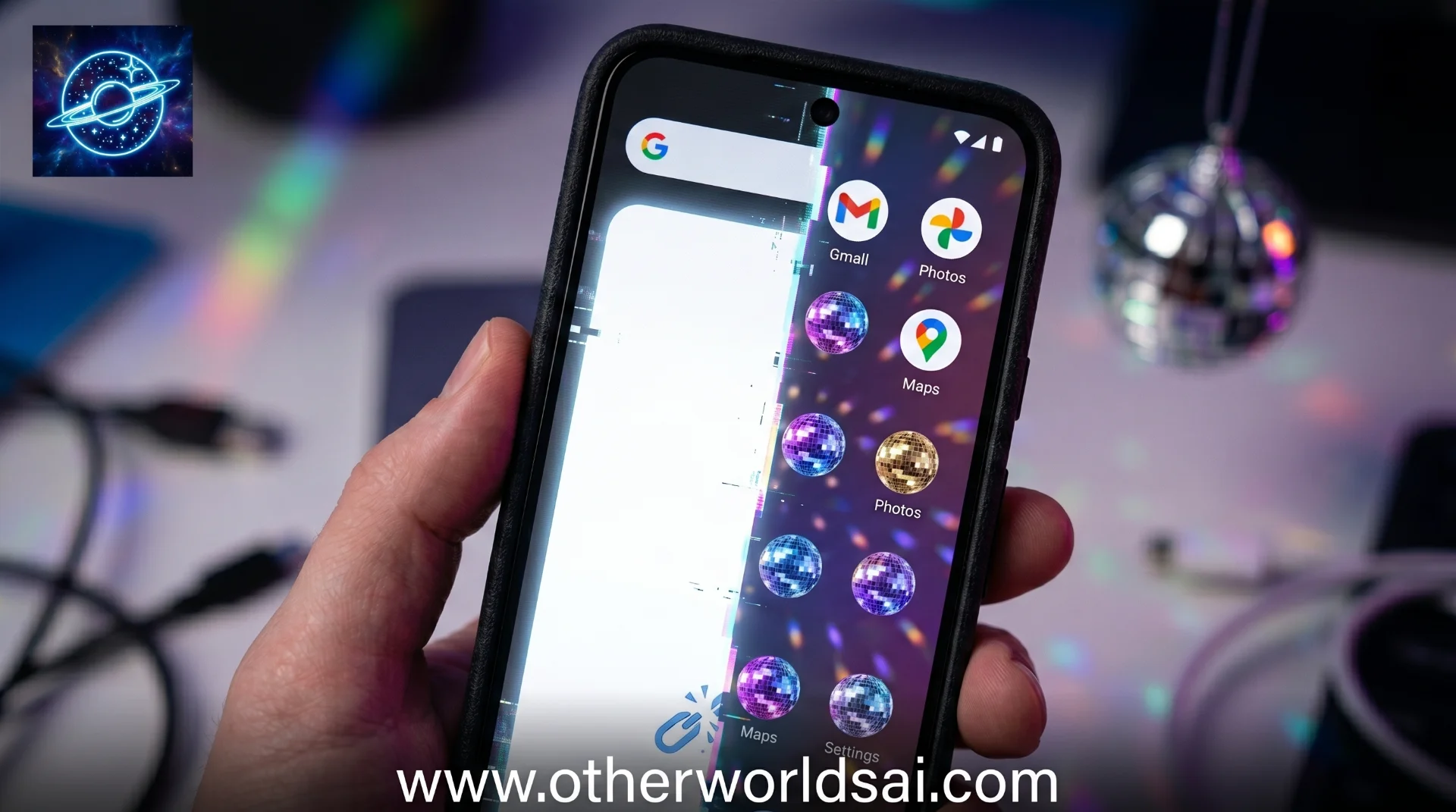
And then, somehow, Google made disco ball icons happen — and honestly, it is the most charming thing the company has done all year. While the AI search stumbles were generating criticism, Google's Android team was busy doing something completely different: trolling the internet, and then actually following through on the joke.
The story begins with Spotify, which released a temporary disco ball app icon to celebrate its 20th anniversary. The reaction was immediate and divided — extensive online backlash from users who found it genuinely ugly, mixed with a minority of enthusiastic supporters who appreciated the kitsch. Spotify was quick to clarify the icon was temporary, writing: "Alright, we know glitter is not for everyone."
Google, apparently, disagrees with that assessment. Android ecosystem head Sameer Samat had previously joked on X, "Should we make this icon pack happen on Android?" alongside a Chrome icon transformed into a disco ball. It was the kind of throwaway social media post that usually disappears into the timeline. Instead, Google actually built it.
"Your wish is our command. Disco icons available on Pixel as of today … Are y'all sure you still want this?" — Sameer Samat, Android Ecosystem Head, Google
The new disco ball icon theme is available through Pixel's custom icons feature, which launched as part of Google's March 2026 Pixel Drop — the company's periodic feature update for Pixel devices. The feature already offered several AI-generated icon style options, including a hand-drawn "Scribbles" aesthetic, a gold theme called "Treasure," and a colorful painted style dubbed "Easel." The disco ball set is the newest and most aggressively sequined addition to the lineup.
The internet responded exactly as you'd expect: with delight, disgust, and everything in between. Former Pixly co-founder Race Johnson captured the vibe perfectly with: "When your home screen gets bottle service." Another user, apparently unable to resist the sparkle even while acknowledging its terribleness, wrote: "Omg it's awful. I'll take it!" The contradiction embedded in that reaction — hating it and wanting it at the same time — is perhaps the most honest possible response to disco-themed app icons.
The Whimsy Trend: Why Silly Tech Moments Actually Matter Right Now:
Google's disco ball pivot isn't just a fun Friday story — it lands at a culturally specific moment. The New York Times recently reported on what it's calling the "whimsy trend" among Zillennials — a generational cohort spanning the younger end of millennials and older Gen Z — describing a playful, deliberately silly aesthetic emerging as a response to a difficult and uncertain world. Glitter, maximalism, and unserious fun are having a genuine cultural moment, and Google's disco icons fit directly into that energy.
There's something almost poignant about the timing within Google's own week. On one side: a serious, high-stakes product overhaul generating user frustration and competitive embarrassment. On the other: a sparkly, self-aware piece of product whimsy that had people laughing and sharing screenshots for entirely positive reasons. Both stories went viral. Only one of them made people happy.
For Google's brand, the disco ball moment matters more than it might appear. As the company asks users to trust an entirely new AI-powered search experience — to believe that synthesized answers are better than links, that the AI won't fail them when they need it — moments of genuine playfulness and self-deprecating humor build the goodwill that makes that trust easier to extend. A Google that can laugh at itself is easier to forgive when its AI can't define "disregard."
Android Customization: What the Disco Icon Feature Tells Us About Pixel Strategy:
Beyond the immediate silliness, the disco ball episode highlights a genuinely interesting Pixel product direction. Google's investment in AI-generated custom icon styles for Pixel devices represents a meaningful differentiation effort in a smartphone market where hardware specs between flagship Android devices have largely converged. If Google can use AI to offer a level of personal expression and customization that competitors can't easily replicate, it strengthens the case for staying in the Pixel ecosystem.
The custom icons feature, introduced in the March 2026 Pixel Drop, is still relatively new and the disco ball addition demonstrates that Google is actively expanding it. The ability to restyle every app icon on your home screen simultaneously — without manually replacing individual icons — is a more ambitious customization capability than most Android users have had access to before. Whether users want their apps to look hand-drawn, golden, painterly, or inexplicably disco is ultimately beside the point. The point is that they can choose.
The broader Android customization story is one Google would benefit from telling more loudly. Between Material You dynamic theming, AI-generated icon styles, and the flexibility of Android's underlying customization architecture, Pixel offers a personalization experience that iOS simply doesn't match. The disco ball incident — absurd as it is — briefly made that capability visible to an audience that might not have been paying attention.
The Week That Was: What Google's Chaos Actually Reveals:
Step back from the individual stories and a coherent portrait of Google in 2026 emerges: a company in genuine transition, moving fast enough to break things, self-aware enough to laugh at itself, but not yet fully in control of the forces it has set in motion. The AI search overhaul is the biggest product bet in Google's history — and this week's "disregard" failure is a reminder that bets at that scale carry proportional risks.
The Bing moment — however temporary and however narrow — should not be dismissed as a curiosity. It's a signal that the gap between Google and its competitors in search is narrower than it has ever been, and that the company's aggressive AI rollout creates genuine opportunities for rivals to capture users during moments of frustration. Every broken AI search result is an invitation to try something else.
The disco ball icons, for their part, are a reminder that not everything needs to be serious. In a technology landscape that increasingly asks users to trust AI with consequential decisions, a sparkly, self-deprecating home screen moment is a small but real form of relief. Google made something silly and people loved it.
Maybe the lesson for the search team is somewhere in there: sometimes the most important thing a product can do is simply work — and when it doesn't, a little glitter can go a long way.
May 2026 • Google • AI Search • Android • 8 min read
Anthropic’s Surprise Double Launch Directly Targets OpenAI and Google’s AI Dominance
Support our research
Independent analysis fueled by you.