
A century ago, in the bustling streets of 1920s London,
a medical mystery gripped the world: cancer. While scientists had already identified the microbes behind cholera, tuberculosis, and pneumonia, cancer remained a terrifying, silent enigma. Then, in July 1925, The Lancet announced a discovery so profound it promised to solve "the central problem of cancer."
The news caused such a stir that crowds gathered outside the journal's offices on the Strand. But the most shocking part of the story wasn't just the discovery itself—it was the men behind it. This wasn't a breakthrough from the hallowed halls of traditional academia; it came from an unlikely duo: Joseph Edwin Barnard, a master hat-maker, and William Ewart Gye, a former railway clerk.
Their story is a powerful testament to how fresh perspectives and "outsider" curiosity drive scientific breakthroughs. Today, as we stand on the brink of a new era in medicine, that same spirit is being reborn through Artificial Intelligence (AI).
The Maverick Minds of 1925:
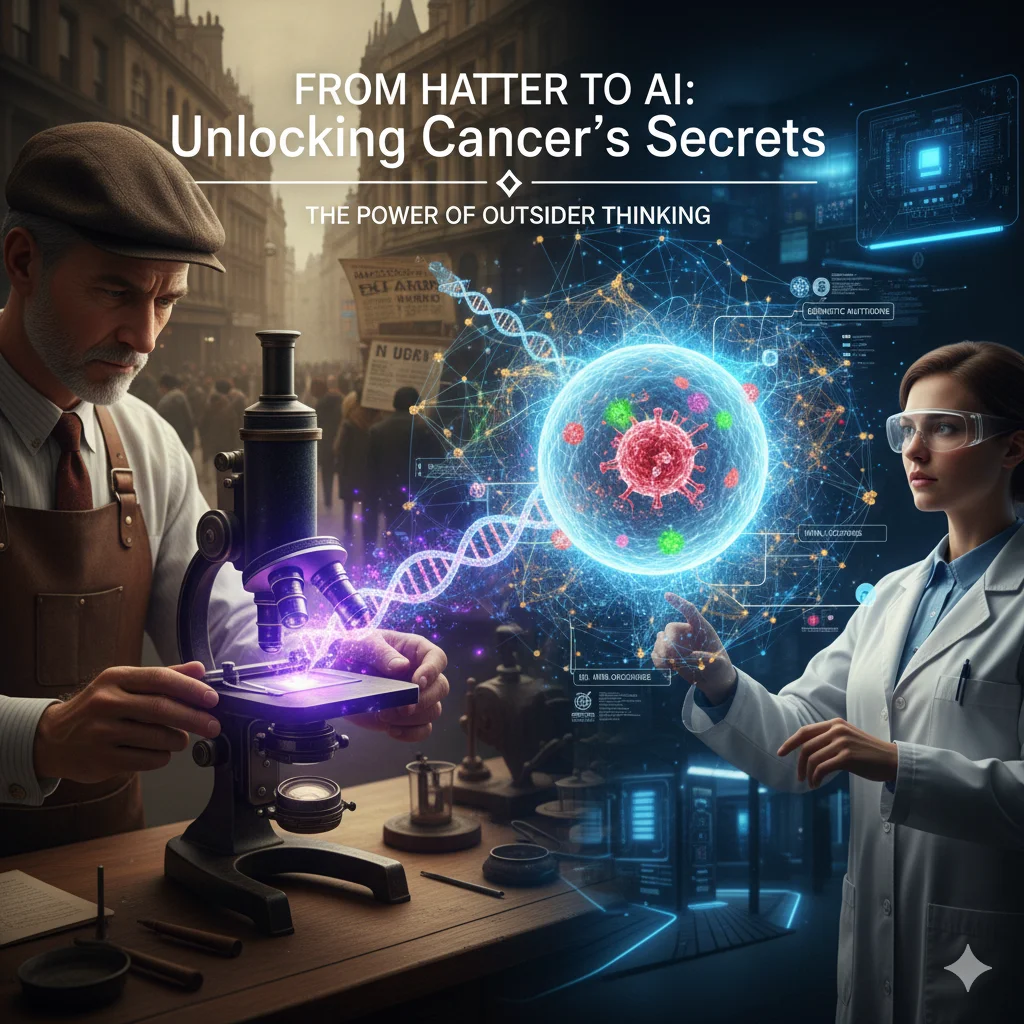
Joseph Edwin Barnard lived a double life. By day, he crafted fine hats for London’s elite; by night, he was a self-taught master of optics. Frustrated by the limitations of conventional microscopes, Barnard built his own, experimenting with ultraviolet (UV) light to achieve unprecedented resolution. Because UV light has a shorter wavelength than visible light, it allowed him to "see the unseen," capturing images of particles far too small for the greatest scientists of his day to witness.
His partner, William Ewart Gye, was equally unconventional. A former railroad clerk who fought his way into medical research, Gye possessed the clinical mind to match Barnard’s technical brilliance. Together, they developed the "Two-Factor Theory" of cancer. They proposed that cancer wasn't just a germ, but a combination of a virus and a specific cellular weakness—a remarkably forward-thinking idea that pre-dated our modern understanding of genetic "hits" and environmental triggers.
The AI Connection: The New "Outsider" in the Lab
Fast forward 100 years, and the spirit of the hatter and the clerk lives on in Artificial Intelligence. Just as Barnard used UV light to see what others couldn't, AI uses "mathematical light" to find patterns in data that the human eye—and even the most trained medical mind—might miss.
AI is, in many ways, the ultimate "outsider." It doesn't come to the table with the biases of traditional medical training; it looks at billions of data points—from genetic sequences to medical imaging—and finds connections that challenge our existing assumptions.
1. Seeing the Unseen (Digital Pathology)
Barnard’s custom lenses were the 1925 equivalent of today’s AI-powered digital pathology. Modern AI models can scan thousands of biopsy slides in seconds, identifying the subtle "signatures" of cancerous cells that are just beginning to mutate. Where a human pathologist might see a healthy cell, an AI can detect microscopic changes in texture or symmetry that signal the very earliest stages of a tumor.
2. The Multi-Factor Revolution:
Gye’s "Two-Factor Theory" was the ancestor of modern Predictive Oncology. Today, AI doesn't just look for a "cancer germ"; it analyzes thousands of factors simultaneously. It looks at your DNA, your gut microbiome, your environment, and even your lifestyle. By crunching this data, AI can predict which "factors" are likely to interact and trigger cancer in a specific individual, allowing for truly personalized prevention.
3. Drug Discovery at Warp Speed:
In 1925, Gye and Barnard spent years manually inoculating chicks to test their theories. Today, AI models can simulate millions of chemical interactions in a virtual environment. This has led to the discovery of new immunotherapy drugs and targeted treatments in a fraction of the time it would take using traditional "trial and error" methods.
The Legacy of Curiosity:
The 1925 discovery didn't produce a universal cancer vaccine, but it changed the trajectory of research forever. It taught us that cancer is complex, multi-layered, and requires a multidisciplinary approach.

Meta's Next Big Bet: This New App Lets You Build Games Simply by Typing a Prompt
The hatter and the clerk proved that you don't need a conventional pedigree to change the world; you need a better lens and a willingness to ask "what if?" Today, AI is that lens. It is the tool that allows us to zoom in even further than Barnard’s UV light ever could, helping us decode the genetic "software" of the human body.
Final Thoughts: Why This Matters to You:
As we celebrate the 100th anniversary of this landmark discovery, we are reminded that the fight against cancer has always been fueled by innovation and the courage to look at old problems in new ways. Whether it's a hatter building a microscope in his basement or a data scientist training a neural network, the goal remains the same: to turn the "unsolved problem" of cancer into a manageable, and eventually curable, condition.
The next time you hear about an AI breakthrough in medicine, remember the hatter and the clerk. Science thrives when we look beyond the boundaries of what we think is possible.
Support our research
Independent analysis fueled by you.