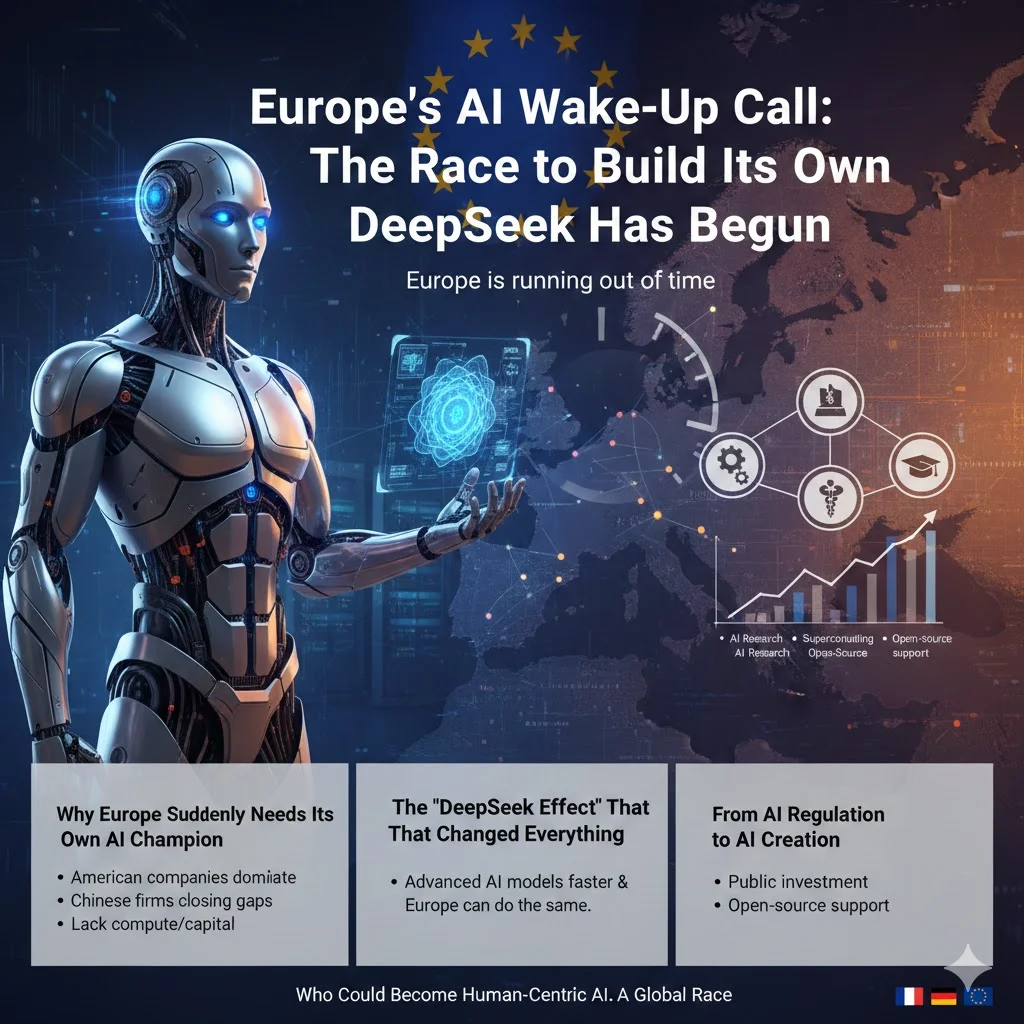

Europe is running out of time.
As the global race for artificial intelligence accelerates, the continent is confronting a hard truth: the future of AI is being shaped elsewhere. For years, Europe relied on the United States for cloud infrastructure, foundation models, and advanced AI hardware—while China quietly built domestic alternatives like DeepSeek, proving that powerful large language models no longer require Silicon Valley–scale budgets.
Now, as political tensions rise and trust in transatlantic tech dependence weakens, Europe has reached a turning point. The race to build a homegrown AI model capable of rivaling DeepSeek is officially on—and it could redefine the continent’s economic and geopolitical future.
Why Europe Suddenly Needs Its Own AI Champion:
Artificial intelligence is no longer just a technology trend. It is the backbone of modern economies, shaping productivity, national security, healthcare, education, and industrial competitiveness.
Yet today, Europe’s AI ecosystem depends heavily on foreign providers:
-
American companies dominate cloud platforms and foundation models.
-
Chinese firms are rapidly closing performance and cost gaps.
-
European startups often lack access to large-scale compute and capital
This dependence has become a strategic liability.
If AI becomes the operating system of society, then relying on external powers means surrendering control over data, infrastructure, and innovation. For European leaders, the lesson is clear: AI sovereignty is no longer optional.
The “DeepSeek Effect” That Changed Everything:
DeepSeek’s emergence sent a clear message to the world: advanced AI models can be built faster and cheaper than previously assumed. By focusing on efficient architectures, targeted training, and real-world usability, DeepSeek challenged the assumption that only trillion-dollar companies can compete at the frontier.
For Europe, this was a wake-up call.
If China can produce competitive large language models under tight constraints, then Europe—home to world-class researchers, universities, and industrial expertise—should be able to do the same.
The challenge is no longer whether Europe can build its own DeepSeek, but how fast it can do so.
From AI Regulation to AI Creation:
Europe has long been the global leader in AI governance. Laws like GDPR and the EU AI Act have set international standards for privacy, transparency, and ethical technology. But regulation alone does not create innovation.
Recognizing this imbalance, the European Union has begun shifting its strategy:
-
Billions of euros allocated to AI research and supercomputing.
-
Public investment in semiconductor manufacturing and edge AI.
-
Support for open-source European foundation models.
-
Cross-border collaboration between governments, universities, and startups.
This marks a fundamental shift—from policing AI to building it.
Who Could Become Europe’s DeepSeek?
Rather than betting on a single national champion, Europe is pursuing a distributed AI ecosystem.

Meta's Next Big Bet: This New App Lets You Build Games Simply by Typing a Prompt
-
France: The Early Front-Runner: France has emerged as a central player, with startups like Mistral AI attracting global attention for their open, high-performance models. Strong government backing and elite academic talent give France an early advantage.
-
Germany: Industrial AI Powerhouse: Germany’s focus is less on chatbots and more on applying AI to manufacturing, robotics, automotive systems, and engineering—areas where Europe already dominates globally.
-
EU-Wide Collaboration. The European Commission is funding shared compute infrastructure and AI research hubs to prevent fragmentation and ensure smaller countries can participate. Instead of one DeepSeek, Europe may build many interconnected ones.
The Biggest Obstacles Ahead:
Despite growing momentum, Europe faces serious challenges.
-
Compute and Chips: Europe still lacks sufficient domestic AI chip production. Without reliable access to advanced compute, AI sovereignty remains fragile.
-
Talent Drain: Top European AI researchers are frequently recruited by US firms offering faster scaling and higher compensation.
-
Speed vs. Caution: Europe’s emphasis on safety and ethics is a strength—but excessive caution risks falling behind faster-moving competitors.
The balance between responsibility and speed may determine whether Europe succeeds or stalls.
Why This Matters Beyond Europe:
A world where AI power is concentrated in only two regions—the US and China—is inherently unstable. Europe offers an alternative path: open, accountable, human-centric AI.
Support our research
Independent analysis fueled by you.
If successful, European AI models could become the preferred choice for:
-
Governments seeking data sovereignty.
-
Enterprises avoiding vendor lock-in.
-
Healthcare and education systems prioritizing privacy.
-
Developers looking for transparent, open platforms.
This is not just Europe’s race—it’s a global one.
Europe’s AI Moment Has Arrived:
The race to build the “DeepSeek of Europe” is about more than competition. It is about control over the next technological era.
Europe can no longer afford to be a spectator in the AI revolution. By combining open research, strategic investment, and democratic values, the continent has a rare opportunity to shape a third AI superpower—one built on trust, efficiency, and long-term resilience.

Move Over Nvidia: Anthropic and Samsung Team Up to Break the AI Chip Monopoly
-
The question is no longer if Europe will act.
-
It’s whether it can move fast enough.