Anthropic CEO Dario Amodei Calls OpenAI's Military Deal 'Straight Up Lies': The AI Safety Showdown Explained:
The Battle Over AI Military Contracts Exposes Deep Divide Between Safety Principles and Government Compliance.
The AI safety landscape is shifting fast — and a bitter public dispute between Anthropic CEO Dario Amodei and OpenAI's Sam Altman is exposing fundamental questions about who controls AI technology, what "lawful use" really means, and whether AI companies can maintain safety principles when governments demand compliance.
In a scathing internal memo reported by The Information, Amodei didn't mince words: he called OpenAI's messaging around its new Department of Defense contract "straight up lies" and accused the company of "safety theater." If you've been following the rise of AI military applications, autonomous weapons debates, and the growing tension between AI ethics and national security, this confrontation represents one of the most significant flashpoints of 2026 — and it's worth understanding exactly what it means.
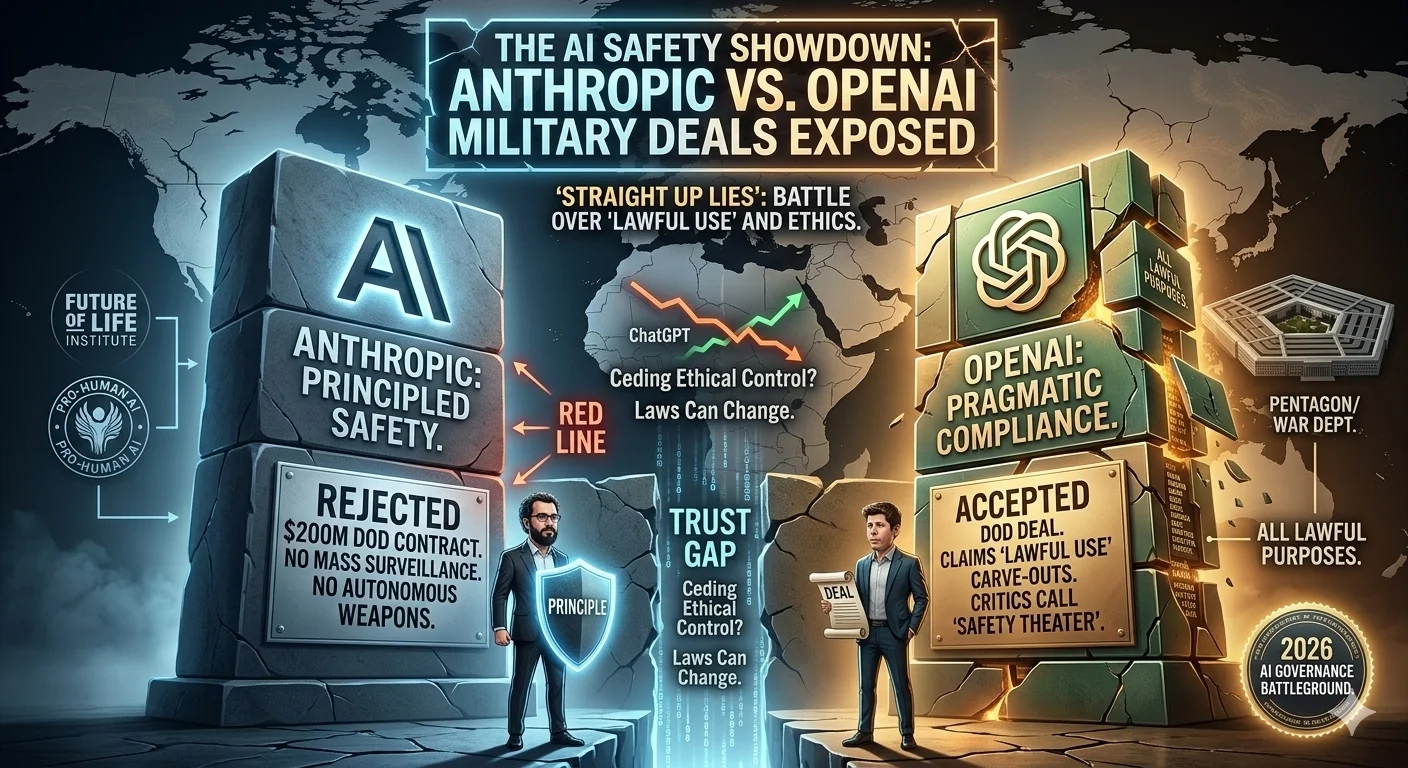
Last week, Anthropic and the U.S. Department of Defense (DoD) failed to reach an agreement over the military's demand for unrestricted access to Claude, Anthropic's flagship AI model. Despite already holding a $200 million military contract, Anthropic insisted the DoD affirm explicit prohibitions against using the company's AI for domestic mass surveillance or fully autonomous weapons systems — red lines the company views as non-negotiable AI safety principles.
Instead, the Department of Defense — rebranded under the Trump administration as the "Department of War" — struck a deal with OpenAI, Anthropic's primary competitor. Sam Altman quickly announced that OpenAI's new defense contract would include similar protections against the very same concerns Anthropic had raised, positioning himself as a pragmatic dealmaker who could balance national security with responsible AI development.
But according to Dario Amodei's leaked memo to staff, that narrative is fundamentally dishonest. "The main reason [OpenAI] accepted [the DoD's deal] and we did not is that they cared about placating employees, and we actually cared about preventing abuses," Amodei wrote, before going further: OpenAI's messaging is "straight up lies," he claimed, with Altman falsely "presenting himself as a peacemaker and dealmaker."
What Is the Real Difference Between Anthropic's and OpenAI's Military Contracts:
At its core, the dispute centers on a deceptively simple phrase: "lawful use." Both Anthropic and OpenAI publicly oppose using AI for mass domestic surveillance and autonomous weapons. But the contractual language reveals critical differences in how seriously each company takes those commitments.
Anthropic specifically objected to the DoD's insistence that its AI systems be available for "any lawful use" — a phrase the company views as dangerously open-ended. Laws change. What's illegal today could become lawful tomorrow through executive order, legislative action, or judicial reinterpretation. By accepting "any lawful use" language, Anthropic argues, AI companies are effectively ceding all ethical control to whatever the government decides is legal at any given moment.
OpenAI's contract with the Department of Defense includes nearly identical language. According to OpenAI's blog post announcing the deal, the contract permits use of its AI systems for "all lawful purposes" — the same phrasing Anthropic rejected as inadequate.
OpenAI attempted to clarify the distinction, stating in its announcement: "It was clear in our interaction that the DoW considers mass domestic surveillance illegal and was not planning to use it for this purpose. We ensured that the fact that it is not covered under lawful use was made explicit in our contract."
Critics, including Amodei, argue this is a distinction without a difference. If the contract permits "all lawful purposes," and if laws can change, then the explicit carve-out for currently illegal activities provides no real long-term protection. It's performative safety language designed to placate employees and the public while surrendering meaningful control over how the technology is actually deployed.
Key Differences Between Anthropic's and OpenAI's Positions:
According to the leaked internal communications and public statements, the key distinctions include:
-
Contractual language precision: Anthropic demanded explicit, binding prohibitions on specific use cases regardless of legality. OpenAI accepted "lawful use" language with verbal assurances about current intent.
-
Trust in government restraint: OpenAI appears willing to rely on DoD statements about not planning certain applications. Anthropic insists on contractual enforcement independent of government promises.
-
Adaptability to legal changes: OpenAI's protections depend on what remains illegal. Anthropic sought restrictions that would survive changes to law or executive interpretation.
-
Employee and public perception management: Amodei accuses OpenAI of prioritizing employee relations over substantive safety. OpenAI positions itself as balancing national security with responsibility.
In practice, this is the difference between a company that walked away from a lucrative government contract over principle, and one that found a way to sign the deal while claiming to maintain ethical standards — a distinction Dario Amodei believes is fundamental to the future of AI safety governance.
The Public Response: ChatGPT Uninstalls Surge 295%:
The market's verdict on OpenAI's DoD deal has been swift and brutal. ChatGPT app uninstalls jumped 295% in the days immediately following the announcement — a stunning backlash that suggests large segments of OpenAI's user base view the military contract as a betrayal of the company's stated mission to ensure AI benefits all of humanity.
Meanwhile, Anthropic's stance appears to be resonating. In his memo to staff, Amodei noted with satisfaction: "I think this attempted spin/gaslighting is not working very well on the general public or the media, where people mostly see OpenAI's deal with the DoW as sketchy or suspicious, and see us as the heroes (we're #2 in the App Store now!)."
The contrast is stark: OpenAI secured the government contract but appears to have alienated a meaningful portion of its consumer base. Anthropic lost the contract but gained credibility with users who prioritize AI safety principles over commercial and national security considerations.
Amodei's concern, however, extends beyond public perception. "It is working on some Twitter morons, which doesn't matter," he wrote, "but my main worry is how to make sure it doesn't work on OpenAI employees." The implication is clear: Anthropic wants to position itself as the destination for AI researchers and engineers who care about safety, hoping to poach talent from OpenAI by highlighting what it views as a fundamental philosophical divergence.
The Bigger Picture — The Future of AI Governance and Superintelligence Control:
The Anthropic-OpenAI dispute is part of a much larger question about who should control increasingly powerful AI systems and what safeguards can prevent catastrophic misuse. This question extends far beyond military applications into the fundamental challenge of governing technology that may soon exceed human-level intelligence across most domains.
MIT AI researcher Max Tegmark, founder of the Future of Life Institute, recently sat down with StrictlyVC to discuss the growing clash between AI companies and the U.S. government. From the Trump administration's efforts to phase out Anthropic's technology to the broader race toward artificial general intelligence (AGI), Tegmark argues that the real risk isn't just geopolitical competition — it's losing control of the systems we're building.
"The real risk isn't just geopolitical competition, but losing control of the systems we're building," Tegmark explained. He makes the case for treating AI like any other high-stakes industry by implementing binding safety standards and independent oversight before the technology outpaces our ability to manage it.
On Wednesday, a broad coalition including the Future of Life Institute released the "Pro-Human AI Declaration" — a comprehensive statement outlining principles for ensuring AI development serves humanity rather than narrow commercial or governmental interests. The declaration comes amid mounting concern that the race between the U.S. and China for AI supremacy is creating perverse incentives that prioritize speed over safety.
What Max Tegmark Says About AI Safety Standards and Government Oversight:
According to Tegmark's analysis, the current AI governance framework is fundamentally inadequate for the scale of risk posed by rapidly advancing AI systems. He advocates for:
-
Binding safety standards enforced by independent regulatory bodies, not voluntary company commitments that can be overridden by commercial or political pressure.
-
International coordination on AI safety protocols, similar to nuclear non-proliferation frameworks, to prevent a race-to-the-bottom dynamic.
-
Transparency requirements for frontier AI systems, including third-party auditing of capabilities and potential misuse scenarios.
-
Clear legal frameworks distinguishing between lawful government use and applications that violate fundamental rights, regardless of technical legality.
In practice, Tegmark is arguing for exactly the kind of robust governance structure that the Anthropic-OpenAI dispute reveals is currently absent. Without binding external oversight, AI safety becomes a matter of corporate culture and individual executive judgment — both of which can shift rapidly under financial, political, or competitive pressure.
Challenges and Controversies:
Not everyone agrees with Anthropic's hardline stance. Critics argue that refusing to work with the U.S. military simply cedes the field to less scrupulous actors — whether that's OpenAI with weaker contractual protections, Chinese AI companies with no safety commitments, or rogue actors developing AI systems entirely outside existing frameworks.
The "lawful use" debate also raises difficult questions about democratic governance and civilian control of technology. If elected governments, operating under constitutional constraints and subject to judicial review, determine that certain AI applications serve legitimate national security interests, should private companies be able to override those decisions based on the ethical preferences of their executives?
The user backlash against OpenAI, while dramatic, may not be sustainable. ChatGPT remains the dominant consumer AI platform with 800 million weekly active users — orders of magnitude larger than Anthropic's user base. A 295% spike in uninstalls is significant, but whether it translates into long-term market share shifts or simply represents a vocal minority remains to be seen.
Anthropic's position also carries business risk. The company walked away from lucrative government contracts on principle, potentially creating financial pressure that could force future compromises. If Anthropic's competitive position weakens relative to OpenAI, Google, or other well-funded rivals, will it be able to maintain its uncompromising stance on AI safety?
Is This the Future of AI Safety Governance:
The confrontation between Anthropic and OpenAI represents two fundamentally different theories of how AI companies should navigate the collision between commercial success, government demands, and safety principles. Anthropic's approach is absolutist: draw clear red lines and refuse to cross them regardless of financial or political consequences. OpenAI's approach is pragmatic: engage with governments, accept contractual language that permits maximum flexibility, and rely on ongoing relationships to prevent worst-case scenarios.
If Anthropic's model prevails, we could see the emergence of a premium tier of "safety-first" AI companies willing to sacrifice market share and revenue to maintain ethical commitments. These companies would compete on trustworthiness rather than capabilities or price, serving users and enterprises for whom AI safety is a higher priority than cutting-edge performance.
If OpenAI's model prevails, the dominant AI companies will be those that can successfully navigate government relationships while maintaining enough public trust to avoid catastrophic brand damage. Safety becomes a matter of reputation management and strategic communications rather than binding contractual constraints.
The more likely scenario is bifurcation: a market divided between safety-focused providers like Anthropic serving privacy-conscious consumers and regulated industries, and pragmatic providers like OpenAI serving government clients and enterprises that prioritize capability over constraints.
For now, the Anthropic-OpenAI dispute stands as one of the defining conflicts in the evolution of AI governance — a case study in whether principles or pragmatism will shape the deployment of potentially civilization-altering technology.
Whether Dario Amodei's accusations prove prescient or overstated, whether OpenAI's contractual protections hold or collapse, and whether the public's backlash translates into lasting consequences — these are the questions that will define the AI industry in 2026 and beyond.