
For decades, the narrative surrounding identical twins separated at birth
has been a cornerstone of the "nature vs. nurture" debate. These remarkable individuals, sharing 100% of their DNA but raised in different environments, were thought to be the ultimate proof that intelligence was largely hard-wired into our genes. The prevailing belief was that, despite different upbringings, their IQs would remain strikingly similar.
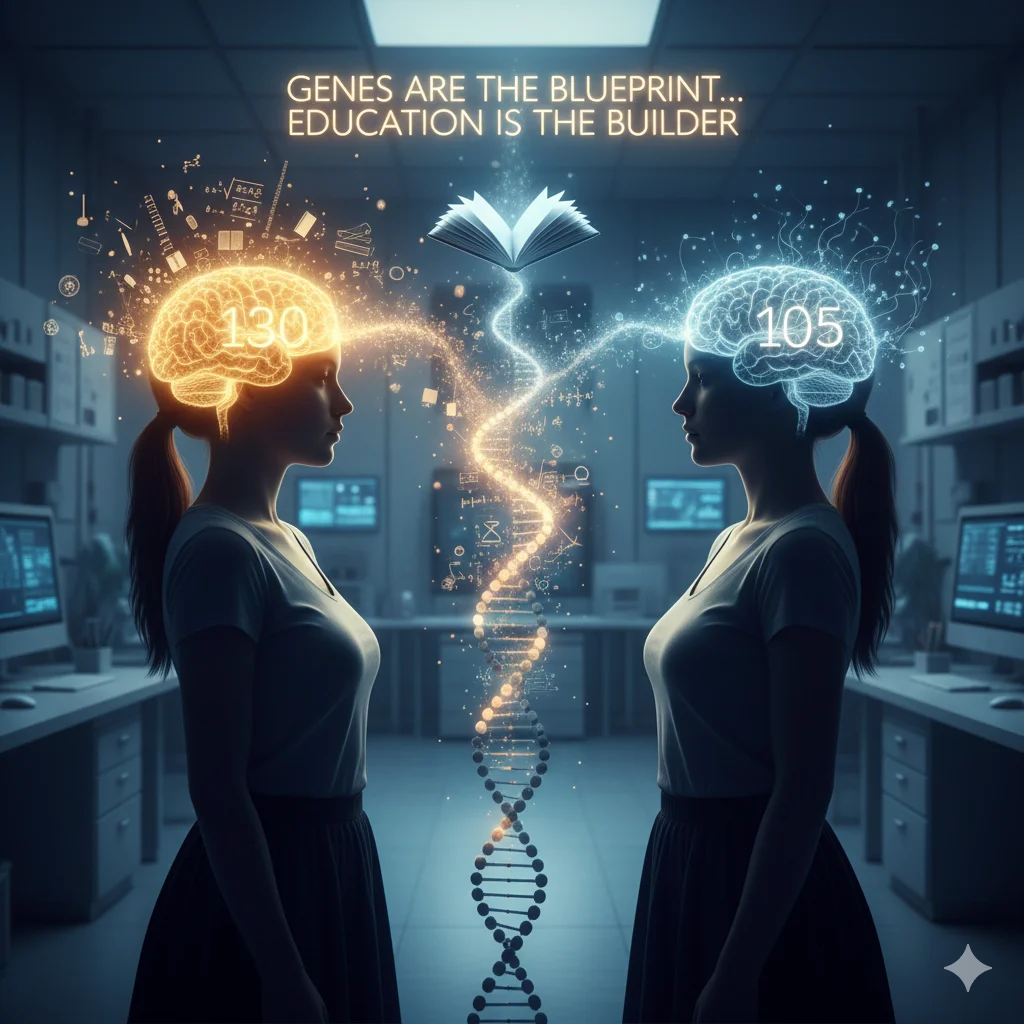
However, a groundbreaking study by cognitive neuroscientist Jared Horvath and developmental researcher Katie Fabricant is profoundly challenging this long-held assumption. Their research reveals that identical twins can exhibit IQ differences as substantial as 15 points—a gap equivalent to that between two unrelated individuals.
The surprising, yet incredibly empowering, factor driving this divergence? The quality and nature of their schooling. This isn't just a fascinating anecdote; it's a testament to the immense, often underestimated, power of environment, a power that AI is increasingly helping us understand and harness.
The Twin Myth, Revisited: Education as a Cognitive Sculptor:
Horvath and Fabricant meticulously reanalyzed data from 87 pairs of identical twins who were raised apart. While earlier research often focused on the similarities, this new study zoomed in on the differences, especially when accounting for educational backgrounds. ** The results were stark:**
-
Twins who experienced significantly different educational environments—ranging from varying school quality to distinct teaching philosophies—demonstrated substantial IQ gaps.
-
The more pronounced the differences in schooling, the larger the discrepancy in their IQ scores became. This suggests that the classroom isn't just a place to acquire facts; it's a dynamic environment that actively shapes cognitive development.
This finding adds significant weight to the Flynn Effect, the observed phenomenon of a steady, worldwide increase in IQ scores over the past century. If intelligence were solely a matter of genetics, such a consistent rise across generations would be inexplicable. Instead, the Flynn Effect, now bolstered by studies like Horvath and Fabricant's, points to the transformative impact of improved education, nutrition, and environmental enrichment.
How AI is Illuminating the Mind-Education Connection:
The original study provides the "what," but Artificial Intelligence (AI) is rapidly revealing the "how." AI technologies are revolutionizing our understanding of neuroplasticity—the brain's ability to change and adapt—and are providing unprecedented insights into how learning sculpts our cognitive abilities, potentially overriding genetic predispositions.
-
- AI in Neuroimaging and Connectomics Mapping Brain Plasticity Advanced AI algorithms are now processing vast amounts of data from fMRI, EEG, and other neuroimaging techniques. These "AI connectomics" tools can map subtle changes in neural pathways and brain connectivity in response to different learning stimuli.
AI can identify specific brain regions that become more efficient or form new connections after focused educational interventions. This research shows that high-quality, stimulating education doesn't just fill the brain with knowledge; it literally re-wires it, building more robust and efficient cognitive architecture that can directly influence what we measure as "IQ."

Meta's Next Big Bet: This New App Lets You Build Games Simply by Typing a Prompt
-
- Personalized Learning Platforms and Predictive Analytics: Tailoring Education for Cognitive GrowthAI-driven adaptive learning platforms are demonstrating the power of tailored education in real-time. These systems analyze student performance, learning styles, and even emotional responses to identify the most effective pedagogical approaches for each individual. If a student struggles, AI doesn't just flag it; it dynamically adjusts the curriculum, content delivery, and pacing.
This personalized approach, guided by AI, maximizes engagement and comprehension, proving that perceived "innate" learning difficulties can often be overcome by simply finding the right educational key for each unique cognitive lock. This directly supports the idea that the quality and appropriateness of schooling are paramount.
-
- AI and Epigenetics: The Environmental Switch for Genes: Perhaps the most cutting-edge connection lies in AI's role in epigenetics. This field explores how environmental factors can "turn on" or "turn off" specific genes without changing the underlying DNA sequence.
AI algorithms are now being used to analyze complex datasets, cross-referencing environmental factors (including educational experiences, social enrichment, and even stress levels) with patterns of gene expression. Emerging AI research suggests that high-quality education might actually activate genetic pathways associated with cognitive function, allowing individuals to unlock their full genetic potential in ways that passive or poor education might suppress.
A Shifting View of Human Potential and the Future of Education:
Horvath and Fabricant's findings, bolstered by the analytical power of AI, offer a profoundly optimistic and equitable view of human intelligence. It fundamentally shifts our perspective from IQ as a fixed genetic inheritance to a dynamic capacity heavily influenced by external factors, especially education.
The implications for policy, pedagogy, and social justice are immense. If a 15-point IQ difference can be attributed to schooling differences between identical twins, imagine the cognitive potential being unlocked—or stifled—across entire populations due to educational disparities. This research underscores that investing in high-quality, accessible education for all is not just an ethical imperative; it's a direct investment in global cognitive advancement.
The Takeaway:
Your DNA provides the incredible blueprint for your potential, but the quality of your education, now more measurable than ever with AI, is the master builder.
It shapes the very architecture of your mind, proving that what happens in the classroom can influence who you become, intellectually, far more profoundly than we once dared to believe.
Support our research
Independent analysis fueled by you.