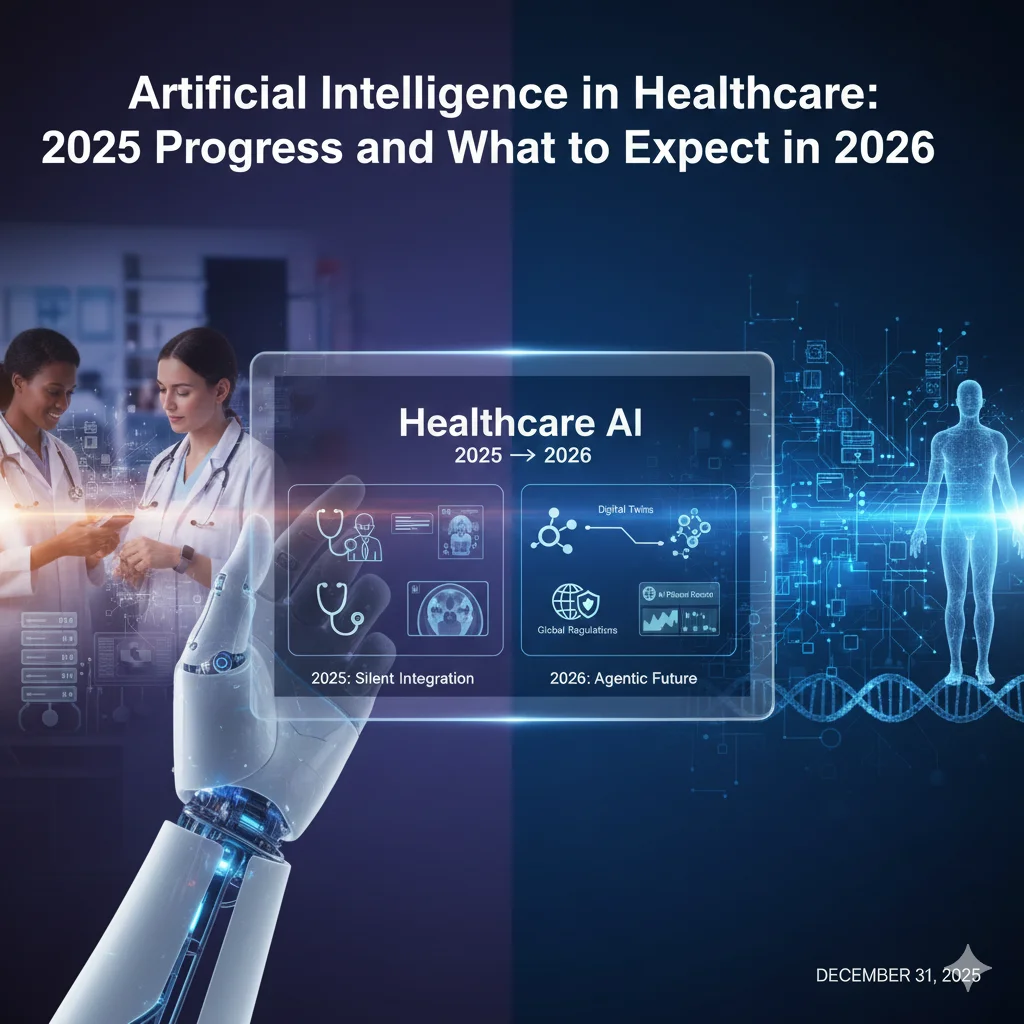

Artificial intelligence (AI) has transitioned from a promising technology to a transformative force in healthcare.
By 2025, AI is no longer experimental — it is actively reshaping clinical care, operational efficiency, diagnostics, personalized medicine, and patient engagement. With continued innovation and regulatory developments, the landscape in 2026 is expected to expand both in sophistication and scale. This blog outlines where AI stands today and what key advancements lie ahead.
Part I — AI in Healthcare: Progress in 2025-
1. Clinical Diagnostics and Predictive Medicine:
AI-augmented diagnostics have become mainstream tools in 2025. Algorithms powered by deep learning and computer vision are now routinely integrated into imaging workflows. They assist in identifying conditions such as strokes, tumors, and fractures with greater speed and accuracy than manual review alone, significantly improving triage outcomes and time-to-treatment.
Breast Cancer Screening Trials: involving NHS clinics have begun integrating AI to detect abnormalities more accurately than standard method.
New disease subtype discovery, such as in multiple sclerosis (MS), demonstrates how AI combined with blood tests and MRI improves subtype classification, allowing for more tailored care pathways.
2. AI-Enabled Clinical Tools:
Researchers and healthcare startups are creating novel diagnostic and monitoring devices:
-
An AI stethoscope capable of diagnosing major heart conditions within 15 seconds, enhancing early detection and follow-up care.
-
Large predictive AI models like Delphi-2M can assess susceptibility to over 1,000 diseases years before onset, opening new avenues for preventive medicine.
3. AI in Education, Training, and Workforce Readiness:
Educational bodies are promoting AI literacy among clinicians:
- Organizations such as NBEMS are offering free online courses on AI in medical education, aiming to equip practitioners with tools to integrate AI into clinical practice. The trend highlights a growing recognition that AI fluency is essential for modern healthcare professionals.
4. Operational and Administrative Transformation:
AI is transforming the administrative backbone of healthcare:
-
AI engines automate clinical documentation, billing, prior authorization, scheduling, and claims processing — reducing overhead, errors, and delays.
-
Pilot programs like the WISeR model in the U.S. Medicare system begin requiring AI-supported prior authorization, though they spark debate about impact on care access.
5. Centers of Excellence & Research Infrastructure:
-
Institutes around the world are creating dedicated hubs for AI healthcare research:
-
New facilities, such as AI Innovation Labs in hospitals and academic centers, are accelerating innovation, translating research into practice.
These laboratories aim to bridge academic expertise with clinical application.
6. Personalized and Preventive Healthcare:
AI tools now synthesize medical history, genomic data, and lifestyle information to recommend personalized treatment plans, reducing unnecessary testing and enhancing care precision.
7. Market Growth and Adoption Rates:
Industry forecasts project strong growth metrics for AI in healthcare:
- Market data indicates a robust compound annual growth rate (CAGR) for AI in healthcare, reflecting escalating investment and adoption.
Despite this growth, adoption percentages within healthcare organizations still trail other sectors, emphasizing room for broader integration.
Part II — AI Trends and Expectations for 2026:
As the technology matures, the following projected developments are expected to shape the healthcare industry in 2026 and beyond:
1. Ambient Clinical Intelligence as Standard:
AI systems will routinely capture and structure clinician–patient conversations, reducing documentation burden and clinician burnout. These tools will become a standard component of electronic health records (EHRs).
2. AI-Augmented Patient Records & Predictive Analytics:
“AI patient records”, which continuously analyze clinical, imaging, and biometric data, will redefine real-time risk prediction, enabling proactive interventions rather than after-the-fact reviews.
3. Expanded Use of Generative AI:
- Generative AI will significantly accelerate:
- Drug discovery, screening billions of molecular candidates. Simulation of health outcomes and design of clinical trials.
- Synthetic datasets that help train diagnostic models while preserving privacy.
4. Virtual Hospital and Remote Care Ecosystems:
AI will underpin virtual hospitals that provide remote diagnosis, continuous monitoring via wearables/IoT devices, and tele-ICU services — critical in regions with clinician shortages.
5. Operational AI Agents Across Workflows:
Multi-agent AI platforms capable of system-to-system reasoning will automate prior authorization, coding, and smart scheduling even further.
6. Robotics and Smart Hospital Automation:
Robotics — from surgical assistants to autonomous delivery systems — will become more prevalent, improving precision, safety, and operational efficiency.
7. Regulatory and Ethical Maturation:
Healthcare regulators and international bodies (e.g., FDA, WHO, EU AI Act) are expected to refine guidelines, ensuring fairness, explainability, and governance in clinical AI deployment.
8. Workforce Training and AI Governance:
With AI integration deepening, training programs for clinicians and administrators will be critical, focusing on ethical use, clinical integration, and compliance with new health AI standards.
Part III — Challenges and Strategic Considerations:
- 1. Data Governance & Privacy: Balancing robust AI performance with privacy protection and secure data handling will remain a strategic imperative.
- 2. Ethical AI and Bias Mitigation:
Ensuring AI systems do not entrench existing biases or create unintended disparities will be a major focus of regulation and corporate governance.
- 3. Integration and Interoperability:
Connecting AI systems across EHR platforms and health IT infrastructure requires investment in standards and interoperability frameworks.
Key Metric Comparison: 2025 vs. 2026
| Column 1 | Column 2 | Column 3 |
|---|---|---|
| Feature | 2025 (Current Status) | 2026 (Projected Trend) |
| Primary AI Use | Administrative Scribing | Semi-Autonomous AI "Agents" |
| Data Focus | Generative (Text/Images) | Multimodal (Bio-signals + Genomics) |
| Drug Discovery | 40% time reduction | "Undruggable" targets unlocked |
| Wearables | Wellness tracking | Clinical-grade diagnostic frontline |
Table data for "Key Metric Comparison: 2025 vs. 2026": Feature (Column 2: 2025 (Current Status), Column 3: 2026 (Projected Trend)); Primary AI Use (Column 2: Administrative Scribing, Column 3: Semi-Autonomous AI "Agents"); Data Focus (Column 2: Generative (Text/Images), Column 3: Multimodal (Bio-signals + Genomics)); Drug Discovery (Column 2: 40% time reduction, Column 3: "Undruggable" targets unlocked); Wearables (Column 2: Wellness tracking, Column 3: Clinical-grade diagnostic frontline).
The Rise of Sovereign AI: How Mistral AI Built a Regulatory Moat Against U.S. Tech Giants
Conclusion:
By the end of 2025, AI has already reshaped several core aspects of healthcare — from diagnostics and personalized medicine to clinical workflows and administrative efficiency. As we move into 2026, the pace of innovation is projected to accelerate, with AI increasingly woven into everyday clinical practice and health systems operations.
The overarching trends point toward predictive, personalized, and preventive care powered by AI, supported by smarter automation, stronger governance, and deep integration within clinical ecosystems. These innovations promise to improve outcomes, reduce costs, and expand access — but not without careful attention to ethical, regulatory, and societal risks.
Support our research
Independent analysis fueled by you.