
-
Apple Under John Ternus: What Comes Next for the Tech Giant's Hardware, AI Strategy, and Global Future:
Apple CEO Transition 2026: Why John Ternus Is the "Hardware Architect" Apple Needs Now:
The Leadership Shift That Changes Everything:
A new chapter has officially begun at Apple. On Monday, Apple announced that John Ternus will take over as CEO later this year, succeeding Tim Cook — the man who transformed Apple into a $4 trillion global powerhouse. This landmark Apple CEO transition 2026 is already sending shockwaves through the tech world, and for good reason.
Tim Cook's legacy is undeniable. Over his tenure, Cook expanded Apple's services business, shepherded the company through explosive growth, and oversaw some of the most profitable years in tech history. But Cook was, at heart, a supply chain and operations mastermind. John Ternus brings something different to the table: a lifetime of hardware obsession and a product engineer's intuition for what devices people actually want to use.
Who Is John Ternus — and Why Does It Matter?:
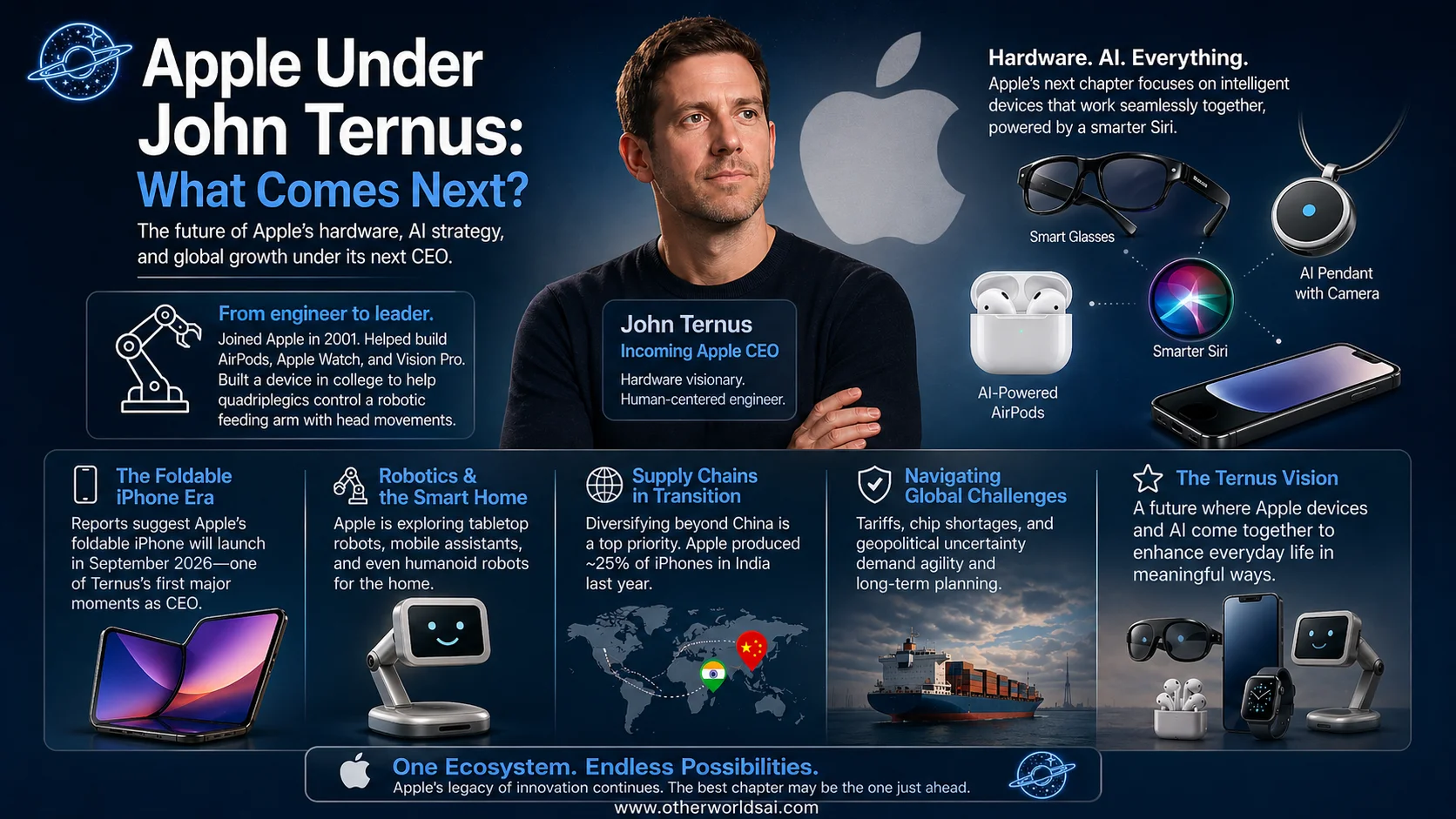
John Ternus is not a newcomer to Apple's inner circle. He joined the company in 2001 and spent over two decades climbing through the ranks of hardware engineering. Along the way, he left fingerprints on some of Apple's most beloved products — AirPods, Apple Watch, and Vision Pro among them. His appointment as the incoming Apple CEO signals something loud and clear: hardware is back at the center of Apple's identity.
His story goes deeper than product launches. In college, Ternus built a device that allowed quadriplegics to control a mechanical feeding arm using head movements — a detail reported by the New York Times that reveals an engineer driven by purpose, not just profit. That human-centered instinct may prove critical as Apple ventures into robotics, AI wearables, and ambient computing.
Hardware With AI at the Center: Apple's Next Big Bet:
Rather than racing to build the biggest AI models, Apple under Ternus is expected to double down on AI-powered devices. Think less about competing with OpenAI or Google DeepMind on raw model performance, and more about owning the hardware layer of the AI era — the thing in your hand, the thing on your face, the thing in your home.
Speculation is already running hot. According to Bloomberg, Apple has been ramping up work on a trio of AI wearables: smart glasses, a wearable pendant with a built-in camera, and AI-powered AirPods. All of these devices would reportedly connect to the iPhone, with Siri serving as the intelligent backbone — a major upgrade from the Siri users know today. This is Apple's AI wearables strategy in its clearest form yet.
The Foldable iPhone: Apple's Long-Awaited Leap:
One of the most hotly anticipated product launches in Apple's near future is the foldable iPhone. Rivals like Samsung have long since staked their claim in the foldable market, but Apple has characteristically taken a slower, more deliberate approach — waiting until the technology meets its famously exacting standards.
The wait may finally be over. Reports indicate that Apple's foldable iPhone is on track to launch in September 2026, placing the debut squarely under Ternus's watch. This will be one of his first major moments as CEO — and a product that could redefine the premium smartphone category all over again. For consumers and investors alike, the Apple foldable iPhone launch will be a defining test of the Ternus era.
Apple Robotics and the Smart Home: A New Frontier:
Perhaps the most surprising frontier Apple may explore is robotics. The company has reportedly been developing a tabletop device with a robotic arm attached to a display — essentially a smart home assistant that can physically move and turn toward you, like a Pixar lamp brought to life. Given Ternus's personal history with assistive robotics technology dating back to his college days, this product direction feels deeply personal.
The vision doesn't stop at a stationary device. Bloomberg has reported that Apple is also exploring mobile robots capable of following users around the home, handling simple tasks, or acting as a moving FaceTime screen. Even more ambitiously, some reports point to early experiments with humanoid robots — though those remain years away from any consumer launch. Apple's home robotics ambitions, if realized, could open an entirely new product category.
Navigating Tariffs, Supply Chains, and Global Uncertainty:
No strategic vision exists in a vacuum — and Apple faces real headwinds. President Trump's frequently shifting tariff policies, ongoing memory chip shortages, and Apple's historic reliance on Chinese manufacturing create a genuinely challenging environment for Ternus to inherit. At its peak, roughly 80% of iPhones were produced in China.
Apple has already begun diversifying. According to Bloomberg, the company made approximately 25% of its iPhones in India last year — a significant pivot that reflects the urgency of reducing China-dependency. Managing this Apple supply chain diversification while simultaneously launching bold new products like foldables, AI wearables, and home robots will be one of Ternus's greatest operational challenges.
What Comes Next: The Ternus Era in Focus:
The big picture is coming into view. Under John Ternus, Apple appears poised to pursue a future where hardware and AI are inseparable — where your glasses, your earbuds, your phone, and eventually your home robot all form one intelligent, Siri-powered ecosystem. It's a vision that plays directly to Apple's greatest strength: designing devices that people love to use.
The road ahead is ambitious, but Apple has navigated uncertainty before. From the iPod to the iPhone to the Apple Watch, the company has a history of entering markets late and leaving with the crown.
If Ternus can bring the same rigor that defined his hardware career to the CEO role, the next decade of Apple innovation could be its most transformative yet.