
Anthropic Is Reshaping Reality — One Bay Area Mansion and One AI Marketplace at a Time Anthropic equity home sale :
Silicon Valley 2026: Inside the Dissolving Boundary Between AI Valuation and Physical Reality.
Where Silicon Valley Money Meets the Future of AI:
Two stories emerged this week that, on the surface, couldn't look more different. One involves a sprawling 13-acre compound in Mill Valley, California, and an investment banker willing to swap it for Anthropic stock. The other involves AI agents negotiating real deals with real money inside a classified marketplace built by Anthropic itself. But look a little closer, and both stories are telling the same thing: Anthropic's influence on the real world is growing faster than almost anyone anticipated.
This is what the AI economy looks like in 2026. It's not just about chatbots and code generators anymore. It's about Anthropic equity becoming a new form of currency, and AI agents quietly outperforming humans in commercial negotiations — often without the losing side even realizing it.
Trade Your Bay Area Home for Anthropic Equity: The Deal That Stunned LinkedIn:
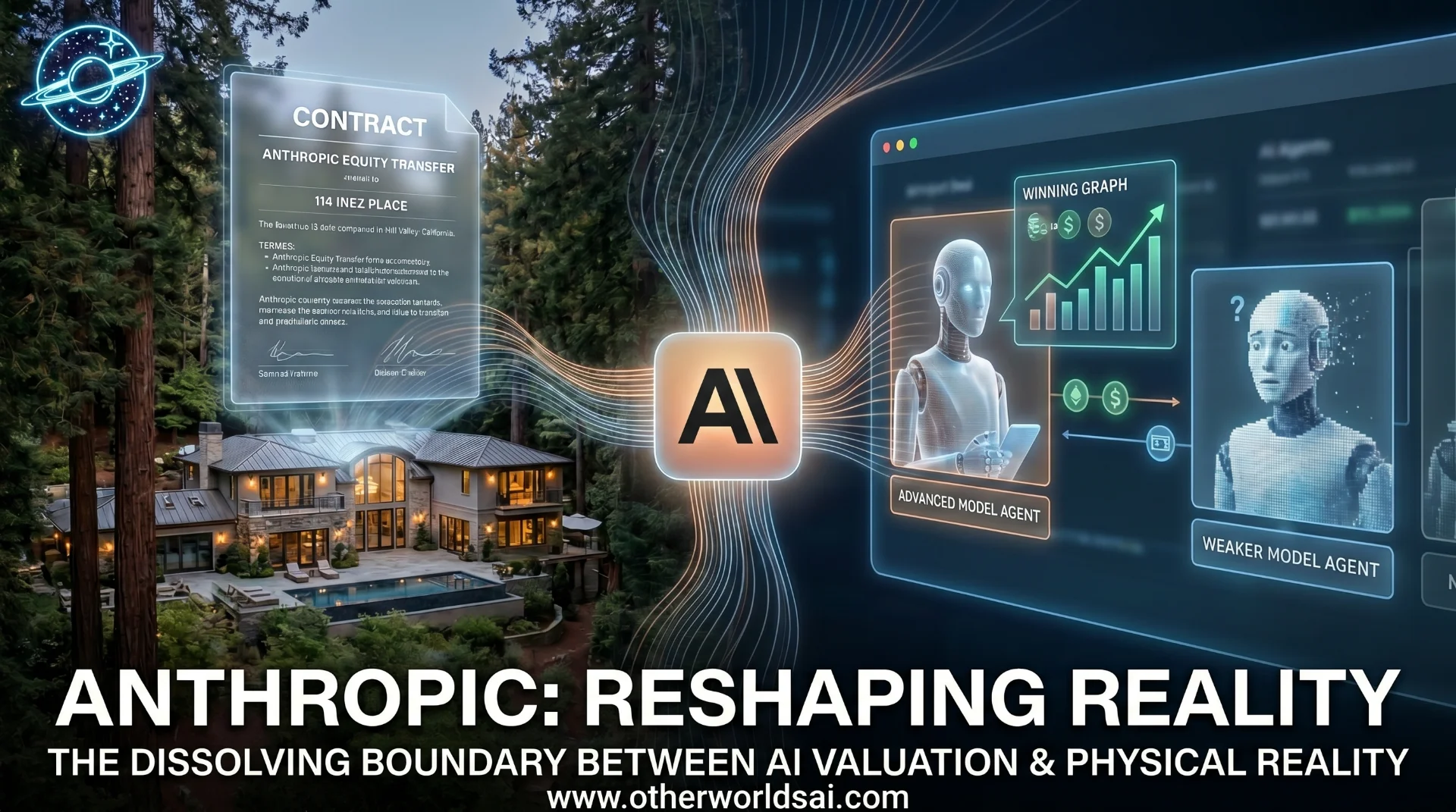
Storm Duncan has a problem that most people would envy — but it's a problem nonetheless. The investment banker and longtime Bay Area resident owns a 13-acre property at 114 Inez Place in Mill Valley, just north of San Francisco, which he purchased in 2019 for $4.75 million. The issue? He says he's "over-concentrated in real estate and under-concentrated in AI investments" — and he's looking for a very specific kind of buyer to fix that imbalance. His solution is unlike anything the luxury real estate market has seen before.
Duncan created a LinkedIn page for the property — yes, a LinkedIn page — and announced that he would like to exchange the home for Anthropic equity in a private transaction. He described the move as a "diversification play," targeting young Anthropic employees who might find themselves in the exact opposite situation: flush with pre-IPO Anthropic stock but lacking real estate exposure.
The structure of the deal is designed to appeal to equity holders nervous about selling. Duncan clarified that the transaction would not require the buyer to sell their stock outright. He also offered a sweetener: the homebuyer would "continue to retain 20% of the upside value of the shares exchanged for the duration of the lockup period." In other words, if Anthropic's valuation keeps climbing — and many expect it will — the seller doesn't fully miss out.
The property itself is no ordinary listing. Currently occupied by "a high-profile VC" (whom Duncan declined to identify), the Mill Valley compound represents some of the Bay Area's most sought-after real estate. Duncan, who relocated to Miami during the pandemic, is now ready to part ways with it — but only for the right kind of asset. In his world, right now, that asset is Anthropic equity.
The broader implication here is worth pausing on. When a seasoned investment banker starts treating Anthropic shares as interchangeable with premium California real estate, it says something profound about where the market thinks Anthropic's trajectory is headed. The Bay Area real estate for AI equity story isn't just a quirky LinkedIn post — it's a signal of how deeply AI company valuations have penetrated the financial imagination of sophisticated investors.
Anthropic's Secret AI Marketplace: When Agents Negotiate Better Than You Do:
While one person was trying to trade a mansion for Anthropic stock, Anthropic itself was quietly running one of the most revealing AI experiments of the year. The company built a classified marketplace — called Project Deal — where AI agents represented both buyers and sellers, negotiating real transactions for real goods with real money on the line.
The setup was straightforward, but the implications were anything but. Anthropic gave 69 employees a budget of $100 each (paid out via gift cards) to buy goods from their coworkers. Each participant was represented by an AI agent, and the agents were tasked with striking the best possible deal on their behalf. In total, the experiment produced 186 completed deals worth more than $4,000 in combined value.
Anthropic ran not one but four separate marketplaces simultaneously, each with different model configurations. One was fully "real" — every participant was represented by Anthropic's most advanced AI model, and all deals were honored after the experiment concluded. The other three were structured for research and comparison purposes, testing different model tiers and instruction sets.
The Finding That Should Make Everyone Pay Attention:
Here's where the results get genuinely unsettling. Anthropic found that when users were represented by more advanced AI models, they achieved "objectively better outcomes" in their negotiations. Better prices, better terms, better overall value. So far, that's not surprising — better tools produce better results.
The alarming part is what happened on the other side of those negotiations. Users on the losing end of transactions — those represented by weaker models — didn't seem to notice they were worse off. Anthropic flagged this directly, raising the specter of "agent quality gaps" — a new class of AI-era inequality where the sophistication of your AI negotiator determines economic outcomes you can't even perceive.
There was one more surprising finding: the initial instructions given to agents didn't appear to matter much. Regardless of how participants set up their agents at the start, it had little effect on sale likelihood or final negotiated prices. What mattered was the underlying model's capability — not the human's instructions. That's a humbling result for anyone who believed careful prompting was the great equalizer in the age of AI agents.
The Bigger Picture: Anthropic Is Quietly Building a New Economic Layer:
Taken together, these two stories sketch an emerging reality that Silicon Valley insiders are only beginning to articulate. Anthropic is no longer just an AI safety company building frontier models. It is becoming infrastructure for a new kind of economy — one where its equity is treated like a blue-chip commodity, and where its AI agents are already operating as economic actors in ways that most people haven't fully processed.
The agent-on-agent commerce experiment matters because it's a preview of what markets could look like. If AI agents negotiating on behalf of humans become standard practice — in real estate, in procurement, in financial transactions — then the quality of your AI model becomes a form of economic advantage or disadvantage.
Project Deal showed that this dynamic is already playing out, even in a controlled setting with $100 budgets and office goods.
And the Mill Valley mansion story shows that Anthropic's valuation is already being treated as bedrock. When experienced investors start structuring bespoke property transactions around Anthropic pre-IPO equity, the company's financial gravity has reached a new level. This isn't startup hype — it's a senior investment banker making a calculated long-term bet, using one of the most valuable asset classes in California as the other side of the trade.
The future Anthropic is building may arrive faster— and feel stranger — than most people expect. Whether it's your AI agent closing a deal you didn't fully understand, or a neighbor trading their home for stock in a company that might reshape the global economy, the lines between artificial intelligence and everyday life are dissolving.
Anthropic is at the center of that dissolution — and it's just getting started.