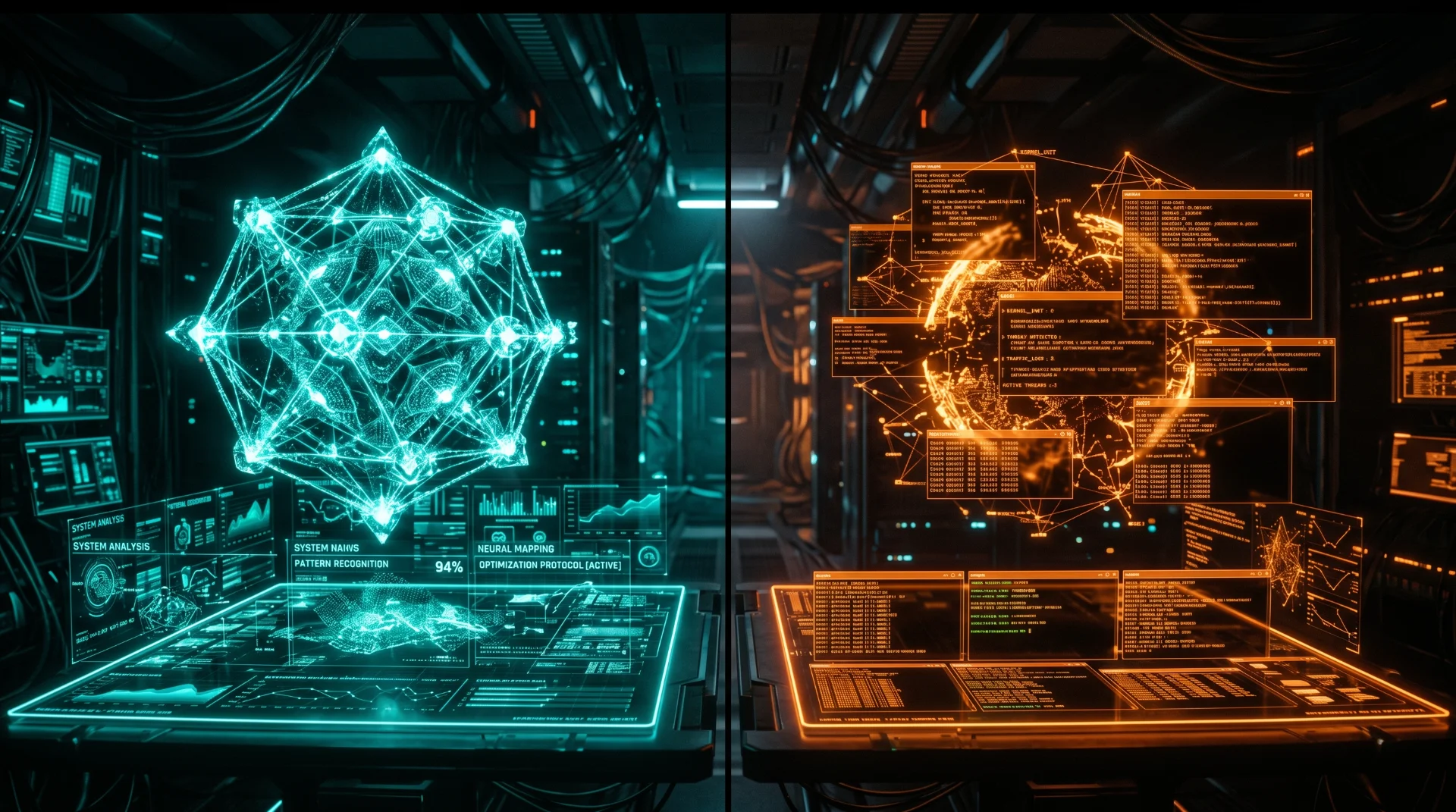

The defining battle of AI in 2026 is no longer about who can generate the best poetry or pass the bar exam. The new battleground is the desktop. Both OpenAI and Anthropic have aggressively pushed their models beyond text generation, equipping them with the ability to navigate graphical user interfaces (GUIs), execute terminal commands, and automate complex workflows natively on your machine.
But their approaches to desktop control are fundamentally different. Anthropic has focused heavily on broad GUI automation and safety via its "Computer Use" API, while OpenAI has deeply integrated ChatGPT into operating system ecosystems with seamless screen awareness and developer tooling.
If you're a developer building agentic pipelines or a consumer looking to automate your daily tasks, which ecosystem should you invest in? Let's break down the capabilities, execution models, and security profiles of both.
I. The Execution Models
The core difference between the two giants lies in how they "see" and "interact" with your computer.
Anthropic's "Computer Use" API (Claude)
Anthropic took a bold approach with Claude's Computer Use feature. Instead of relying solely on API hooks or terminal access, Claude is trained to navigate your computer visually, much like a human does.
It receives screenshots of your desktop, analyzes the UI elements, calculates exact X/Y pixel coordinates, and simulates mouse movements, clicks, and keystrokes to operate any software. This means Claude can interact with legacy applications, niche software, and websites that have no traditional APIs.
OpenAI's Desktop Integration (ChatGPT)
OpenAI's approach is deeply integrated with the OS (particularly via their macOS and Windows desktop apps). Rather than manually calculating mouse coordinates, ChatGPT relies heavily on deep application hooks, accessibility APIs, and direct terminal/shell access. It utilizes robust tool-calling to execute Python scripts, run bash commands, and hook into specific apps (like VS Code or Terminal). While it does use screen-reading capabilities, its primary vector for action is code execution rather than simulated mouse clicking.
II. Head-to-Head Capability Comparison
Let's look at how they stack up across key automation vectors.
Desktop Automation Capabilities
Chart data for "Desktop Automation Capabilities": GUI Navigation (Mouse/Keyboard): 92 Score (Out of 100), 65 Score (Out of 100); CLI & Shell Execution: 85 Score (Out of 100), 96 Score (Out of 100); Context Awareness (Screen Reading): 88 Score (Out of 100), 94 Score (Out of 100); Complex Multi-Step Autonomy: 91 Score (Out of 100), 87 Score (Out of 100); Speed & Latency: 74 Score (Out of 100), 92 Score (Out of 100).
Anthropic’s Surprise Double Launch Directly Targets OpenAI and Google’s AI Dominance
GUI Navigation: The Winner is Anthropic
If your workflow requires an AI to open a specific desktop app, click on drop-down menus, fill out forms in a legacy ERP system, and export a PDF, Claude is currently unmatched. Its visual-spatial reasoning allows it to map out interfaces it has never seen before and operate them with eerie accuracy.
CLI & Code Execution: The Winner is OpenAI
If you are a developer looking for an agent to traverse your codebase, run build scripts, debug errors in the terminal, and manage git repositories, OpenAI's execution environment is faster and more native. ChatGPT's ability to seamlessly drop into a terminal environment and execute tool-calls makes it the superior choice for raw engineering tasks.
III. Security and Sandboxing
As discussed in our recent post on The Security Risks of Giving ChatGPT Access to Your PC, desktop control introduces massive vulnerabilities.
Support our research
Independent analysis fueled by you.
Anthropic's Safety-First Design: Anthropic's implementation forces developers to build their own sandboxes. Because Claude uses generic tool-calling to request screenshots and dispatch mouse coordinates, the actual execution happens in the user's environment. Anthropic strongly encourages (and provides templates for) running Computer Use entirely within Docker containers. They also implement stringent safety classifiers that prevent Claude from interacting with high-risk UI elements (like OS security settings).
OpenAI's Integrated Risk: Because OpenAI's desktop apps run natively on the host OS with the user's permissions, the barrier to entry is lower, but the risk profile is arguably higher for average consumers. While OpenAI has implemented guardrails against destructive terminal commands, the native integration means a successful prompt injection could theoretically have deeper access to the local filesystem than a containerized Claude instance.
Security & Implementation Comparison
| Feature | Anthropic | OpenAI |
|---|---|---|
| Action Vector | GUI Simulation | Native OS Hooks |
| Sandboxing | Dev Docker/VM | Native OS Perms |
| Visual Processing | Screenshot Mapping | Continuous Vision |
| Fallback Behavior | Halts & Asks Human | Auto-reexecutes code |
Table data for "Security & Implementation Comparison": Action Vector (Anthropic: GUI Simulation, OpenAI: Native OS Hooks); Sandboxing (Anthropic: Dev Docker/VM, OpenAI: Native OS Perms); Visual Processing (Anthropic: Screenshot Mapping, OpenAI: Continuous Vision); Fallback Behavior (Anthropic: Halts & Asks Human, OpenAI: Auto-reexecutes code).
IV. The Verdict: Which Should You Use?
Choosing between Anthropic and OpenAI for desktop control isn't about which model is "smarter"—it's about the nature of the work you want to automate.
Choose Anthropic (Claude) if: You are automating non-technical workflows, interacting with closed-ecosystem apps (like creative software, legacy databases, or complex web portals), or if you need the highest level of isolation by running the agent in a dedicated Virtual Machine or Docker container. Claude is the ultimate "Virtual Employee" sitting at a virtual desk.
Choose OpenAI (ChatGPT) if: You are a developer looking to supercharge your local environment. If your tasks involve terminal manipulation, script writing, file system reorganization, and deep IDE integration, ChatGPT's speed and robust native tool-calling make it the superior "Pair Programmer."
Both companies are iterating at breakneck speed. As we move deeper into 2026, expect the lines to blur as Anthropic improves its speed and OpenAI enhances its visual-spatial GUI capabilities. But for now, the dividing line is clear: Anthropic clicks the buttons; OpenAI writes the scripts.
The Security Risks of Giving ChatGPT Access to Your PC
Engineering
The Future.
No spam. Only high-signal AI dispatch.