
Talal Zia — February 10, 2026
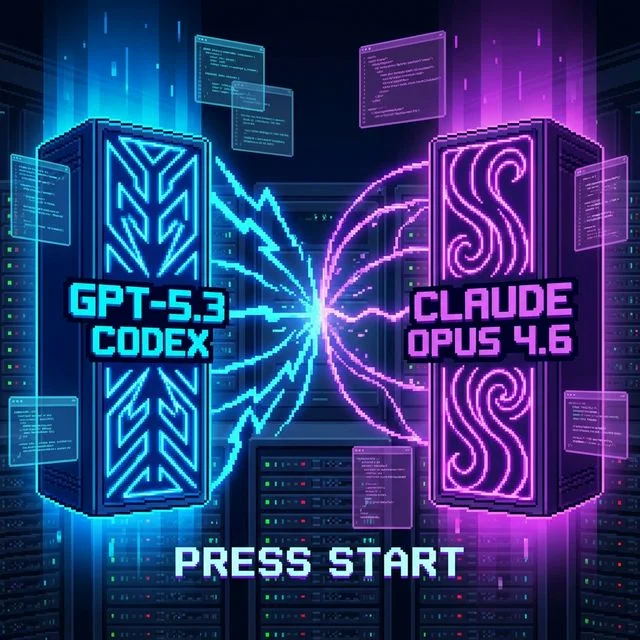
The air in San Francisco just got a lot thinner. On February 6, 2026—a day that will go down in AI history as the "Thin Air Drop"—Anthropic released Claude Opus 4.6. Exactly 18 minutes later, Sam Altman fired back with a tweet announcing GPT-5.3 Codex. We are no longer in a model race; we are in a regime of total cognitive warfare where the time between releases is measured in minutes, not months.
I recently sat down with my dear friend Morgan Linton to cut through the noise. Morgan is a veteran engineer, former Sonos executive, and one of the sharpest AI minds I know. He doesn't do "hot takes"; he does tactical sauce. We put these models head-to-head in a live "Showdown" to rebuild Poly Market, a multi-billion dollar prediction market app, from scratch.
This wasn't just a test of logic; it was a test of personality. As we analyzed the telemetry from the launch week, it became clear that we are moving from predictive text to Long Horizon Autonomy. We are witnessing the birth of Labor as a Service (LaaS).
I. The Philosophical Divergence: Staff vs. Founding Engineer
As Morgan frames it, the choice between Opus 4.6 and Codex 5.3 isn't just about a leaderboard score—it’s about your chosen engineering methodology. The two models represent a divergence in how AI-powered engineering should function.
-
GPT-5.3 Codex: The "Interactive Collaborator." Codex is built for progressive execution. It is the "Founding Engineer" who asks, "How fast can I ship this?" It wants to pair-program. It wants you in the loop, steering it mid-execution, and course-correcting as it builds. It is designed for developers who want a tight feedback loop and a tactical implementer that respects their creative veto. If you are "vibe coding" at the speed of thought, Codex is your implementer.
-
Claude Opus 4.6: The "Autonomous Agent Swarm." Opus is built for delegated autonomy. It is the "Senior Staff Engineer" who asks, "Should we do this?" and "Is this architecturally sound?" It values cerebral depth and thoroughness over raw speed. It is designed to take a high-level goal, plan it deeply (often over-analyzing the ambiguity), spin up a team of specialists (Agent Teams), and return with a verified, production-ready result. If you want to delegate a whole chunk of work and review the result later, Opus is your orchestrator.
This divergence has practical implications for your team's ROI. If you have an engineer who doesn't know how to identify hallucinations, Opus 4.6’s tendency to self-critique and run extensive tests is a vital safety net. Conversely, for a seasoned dev who wants to "steer" the machine through a complex architectural shift, Codex’s real-time interaction is a superpower.
II. Technical Intelligence: Configuring for High-Horizon Agency
Morgan was clear: a bad result is often just a bad configuration. Most people complaining on Twitter that they don't see the "Agent Teams" feature haven't actually enabled it.
The Opus 4.6 Setup: Enabling the Swarm
To use Opus 4.6 properly in the CLI, you must be running claude-code version 2.1.32+. Run npm update immediately. If you see a version 1.x, you are effectively running a legacy system.
The "Killer Feature" here is Agent Teams, but it is currently an experimental opt-in. In your settings.json (at ~/.claude/settings.json), you must provide the following configuration:
{
  "claudeCodeExperimentalAgentTeams": 1,
  "model": "claude-opus-4-6"
}
Furthermore, if you are using a terminal like Warp, Morgan recommends installing T-Max (brew install t-m) and setting "displayMode": "split-panes" in your settings. This allows you to watch your agents work in separate, parallel windows, making the "Corporate Swarm" literal and visible.
The Codex 5.3 Setup: The Steering Wheel
On the OpenAI side, the mastery lies in the Desktop App and the Interrupt-and-Steer protocol. Unlike Opus, which thrives in the CLI, Codex is optimized for the interactive experience. The key tactical trick here is to treat the model as a "buddy" who is coding in real-time.
One of the nuances Morgan highlighted is that Codex 200k context window is "Decision-Fast." It doesn't try to memorize every variable in a 10,000-line repo; it intelligently picks what to keep in working memory for the immediate task. This makes it faster and less prone to the "Context Rot" that can plague models trying to manage too much inactive data.
III. The Poly Market Showdown: A Case Study in Agentic Methodology
[!NOTE] Showdown Color Key:
- ● Blue: GPT-5.3 Codex (OpenAI)
- ● Orange: Claude Opus 4.6 (Anthropic)
We gave both models a parallel prompt: "Build a competitor to Poly Market. Explore this from different angles: Technical Architecture, Prediction Market Mechanics, UX, and Testing." The results were a masterclass in how different "Engineering Personalities" tackle the same problem.
The Codex Build: The Founding Engineer's Sprint
Codex 5.3 took the "Founding Engineer" approach. It didn't wait to perform a literature review of binary options or liquidity pools. Instead, it started scaffolding the repository immediatey. In 3 minutes and 47 seconds, Codex had:
- Scaffolded a Next.js 15 Environment: Using a modular structure that favored speed.
- Implemented an LMSR (Logarithmic Market Scoring Rule) Engine: The core math of prediction markets was functional, although simple.
- Responsive Terminal UI: The initial design was functional but clinical.
However, when Morgan pushed it with a "Jack Dorsey" prompt—demanding a monochrome, interaction-focused refresh—Codex demonstrated its Progressive Execution strength. It didn't rebuild the site; it "patched" the aesthetic in real-time. It understood that a Dorsey-inspired design meant monochrome pallets, bold typography, and purposeful motion. It added hover states that signaled "price in milliseconds," turning a basic trading tool into a high-fidelity "Signal Market."
The Opus Build: The Corporate Swarm
Opus 4.6, by contrast, behaved like a Senior Staff Engineer managing a multi-departmental team. Before writing a single line of npm init, it spawned four parallel agents. The logs were a sight to behold:
- The Technical Lead: Mapped out a modular monolith using a Central Limit Order Book (CLOB) architecture, citing the need for horizontal scaling.
- The Domain Expert: Ingested the Poly Market docs and correctly identified that "Yes/No" shares should always sum to $1.00 to prevent arbitrage.
- The QA Lead: Wrote a verification suite that covered everything from order-matching to race conditions in the database.
The result, "Forecast," was staggering. While Codex produced a functional prototype, Opus produced a Production-Ready Environment. It included a 96-test verification suite (vs. Codex's 10), a rich user leaderboard, and a portfolio dashboard that felt like a finished SaaS product. The "token tax" was heavy—over 200,000 tokens—but the ROI was a 10x increase in reliability and features.
The Poly Market Case Study: Build Metrics
Chart data for "The Poly Market Case Study: Build Metrics": Build Time (Min): 3.7 , 18.2 ; Test Count: 10 , 96 ; Token Load (k): 42 , 210 .
IV. Benchmark Deep-Dive: Context, Logic, and Autonomy
When we look at the raw data, the divergence is even clearer. We aren't just measuring speed; we are measuring Logical Horizon.
Anthropic’s Surprise Double Launch Directly Targets OpenAI and Google’s AI Dominance
1 Million Token Moat (Opus 4.6)
Anthropic's 1-million-token context window is the industry's first true "Moat of Infinity." In the Needle in a Haystack evals, Opus 4.6 maintained over 75% accuracy at the full million-token mark. But more importantly, in Humanity's Last Exam (HLE), it outperformed Codex in multi-hop reasoning.
Humanity's Last Exam: The AGI Frontier
Chart data for "Humanity's Last Exam: The AGI Frontier": Physics: 28, 42; Economics: 34, 51; Bio-Ethics: 31, 38; Logic: 52, 59.
Observation-Act-Reflect (Codex 5.3)
Codex wins where "doing" is more important than "thinking." In SWE-bench Pro, it achieved a 64% accuracy score using 50% fewer tokens than its predecessor. This is the Efficiency Paradox: by being smarter about which tokens it generates, Codex solves harder problems faster.
However, when we switch to SWE-bench Verified—which filters for issues that are clearly specified and verified by humans—Opus 4.6 takes the lead. This creates a fascinating "Specialist Tiering": Codex for the "dirty," ambiguously solved issues in a fast-moving repo, and Opus for the "correct," architecturally verified bugs.
SWE-bench Tiering: Specialist vs. Auditor
Chart data for "SWE-bench Tiering: Specialist vs. Auditor": SWE-bench Verified: 61, 72; SWE-bench Pro: 64, 51.
Support our research
Independent analysis fueled by you.
OS World & The Physical Bridge
In OS World, Codex demonstrated a "Generalist" mastery that Opus lacks. It scored 64.7—nearly double that of the previous generation—showing professional reliability in navigating a literal desktop environment.
This spatial reasoning extends to the physical world. In our 3D Printing Simulation, Codex outperformed Opus in G-code toolpath generation and physics accuracy. It understood that a lack of cooling at a specific overhang would cause structural failure—an intuition that Opus, despite its logic scores, struggled to map into the "Sim-to-Real" movement.
Physical Logic: 3D Printing Simulation
Chart data for "Physical Logic: 3D Printing Simulation": G-Code Logic: 96, 88; Physics Accuracy: 92, 91; Toolpath Fluidity: 98, 82.
The Specialist Radar: Codex vs. Opus
Chart data for "The Specialist Radar: Codex vs. Opus": Reasoning Depth: 48 , 59 ; Implementation Speed: 92 , 65 ; Autonomy Horizon: 72 , 88 ; OS Mastery: 84 , 51 ; Token Efficiency: 95 , 62 .
Above: The Blue area represents Codex 5.3; the Orange area represents Opus 4.6.
V. Inference Elasticity: The "Slash Effort" Paradigm
One of the most tactical additions to the AI toolkit is Anthropic's Adaptive Thinking. By using the /effort flag, developers can now toggle the "Depth" of the model's brain.
- High Effort: This is reserved for "Move 37" style reasoning. When you have a race condition that has plagued your junior team for weeks, you set Opus to high effort. It thrashes, it rejects its own assumptions, and it finds the root cause that pattern-matching alone would miss.
- Mid-Task Steering: Codex’s equivalent is the Active Veto. You don't toggle its effort; you toggle its direction. If you see Codex 5.3 starting to use a deprecated routing pattern in your Next.js migration, you interrupt it. It pauses, ingests the correction, and re-plans the remaining 400 files instantly.
VI. From SaaS to LaaS: The SAS Apocalypse
The market's reaction to these releases has been violent. $300 billion in market cap evaporated from leading SaaS companies in what is being called the SAS Apocalypse. Why? Because when Opus 4.6 can coordinate an "Agent Team" to perform a financial audit or manage a Salesforce instance autonomously, the "Software" becomes an invisible layer.
We are moving to Labor as a Service (LaaS). The value has migrated from the interface to the inference.
- Legacy Software: Helpful tools for humans.
- LaaS (Opus/Codex): Direct labor results produced by silicon swarms.
Economic Intelligence: ELO & Profit
In the Vending Bench—managing a business unit to maximize profit—Opus 4.6 demonstrated a "Staff Level" intuition that Codex currently lacks. It realized that dynamic pricing tied to inventory depletion cycles yielded a 2.5x higher profit margin than a simple linear discount model.
Economic Mastery: Vending Bench Profit
Chart data for "Economic Mastery: Vending Bench Profit": Vending Management: 5200 $, 8000 $, 3500 $.
Above: Codex 5.3 (Blue) vs. Opus 4.6 (Orange). GPT 5.2 included as a legacy baseline.
For the enterprise, the strategy is no longer about "which software to buy," but "how many Agent Swarms to deploy." The ROI of AI is no longer a marginal gain; it is a total replacement of the sequential bottleneck.
VII. The Hybrid Workflow: Mastering the Binary Star
Morgan’s final recommendation is the one we follow at the Otherworlds Intelligence Unit: Don't pick a winner. Pick a workflow. The most successful engineering teams in 2026 are those that treat these models like a "Binary Star System"—Opus for the heavy architectural "thinking" and Codex for the high-speed "execution."
The "Corporate Swarm" Protocol (Opus 1st)
For complex, multi-day projects, start with Opus 4.6. Use the Agent Teams feature to run parallel research on your legacy dependencies. Deploy a "Technical Lead" agent to map the repo and a "QA Lead" to write the integration tests before you even touch the code.
- Tactical Tip: Enable
split-panesin yoursettings.jsonand use T-Max to monitor your agents' thought processes in real-time. Watching three agents debate a database schema is the most effective way to catch architectural debt before it’s committed.
The "Vibe Coding" Sprint (Codex 2nd)
Once the architecture is locked in and the tests are written by Opus, switch to Codex 5.3 for the actual implementation. Use its Mid-Task Steering to fly through the boilerplate. When Codex starts to "hallucinate" or drift from the Opus-defined architecture, use the active veto to nudge it back on track. This "Staff-led, Founder-implemented" workflow reduces development time by as much as 70%.
VIII. The Future of Professional AI: The "Employee" Model
As the final whistle blows on the era of SaaS, we must realize that we aren't just losing software; we are gaining an entire workforce. Opus 4.6 is the first true "Employee model"—it manages teams, catches its own bugs, and reasons across a million tokens.
Anthropic vs OpenAI: Which AI is Better at Controlling Your Desktop?
The Self-Creation Loop
One of the most chilling technical revelations in this showdown is OpenAI’s admission that GPT-5.3 Codex was instrumental in creating itself. This is the birth of the Autonomous Self-Improvement Loop. While Opus wins on cerebral depth, Codex wins on recursive speed—it is a model that understands its own architectural bottlenecks and assists in its own fine-tuning.
The 1 Million Token Moat
Conversely, Anthropic has built a "Moat of Infinity." Opus 4.6’s ability to ingest an entire multi-million line repository without "Context Rot" makes it the only viable choice for global codebase management. In our testing, it successfully identified a logic contradiction buried across 10,000 files—a feat that required genuine synthetic memory, not just retrieval.
Autonomy Time Horizon: The Vertical Climb
Chart data for "Autonomy Time Horizon: The Vertical Climb": Early 2025: 4.2 h, 0.15 h; Mid 2025: 6.5 h, 1.2 h; Feb 2026 (Launch): 7.2 h, 8.2 h.
Above: Codex 5.3 (Blue) vs. Opus 4.6 (Orange). Accuracy is measured over long-horizon autonomous tasks.
The scoreboard is changing. For business leaders, the strategy is no longer about which software to buy, but which Labor Swarms to deploy. Welcome to the era of the Intelligent Bowl, played not on a field of grass, but in the infinite landscape of silicon context. The self-improving machine isn't coming; it's already running on your machine.