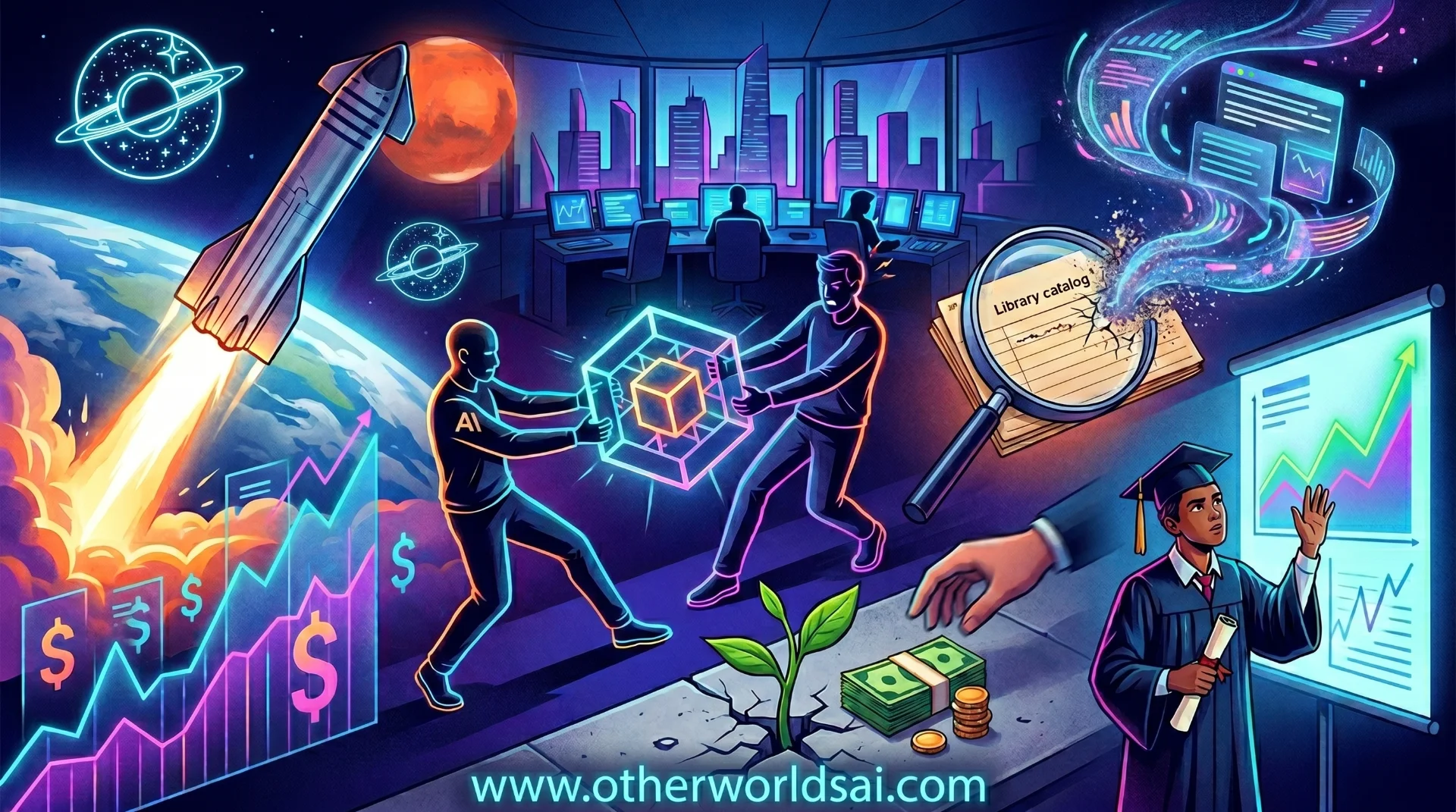

SpaceX IPO, Anthropic's $300M Power Move, and the Week Big Tech Changed the Rules:
Inside Big Tech’s New Developer War: Why Anthropic Just Bought OpenAI’s Favorite Tool.
From SpaceX's historic S-1 filing and a $28 trillion TAM to Anthropic acquiring Stainless, Google killing traditional search, and a $20M buyout rejection — the biggest tech stories of the week, analyzed.
This Week in Tech: The Stories Reshaping the Industry:
It was the kind of week that reminds you why the technology industry never sits still. From a long-awaited IPO filing that dares to put a price tag on Mars, to an AI company quietly removing a critical developer tool from the open market, to a startup founder walking away from a $20 million buyout — the biggest stories of the week converged into a single, unmistakable signal: the rules of the game are being rewritten in real time.
TechCrunch's Equity podcast hosts Kirsten Korosec, Anthony Ha, and Sean O'Kane spent the week dissecting every major development, from the SpaceX S-1 filing and its extraordinary financial projections to the Google I/O announcements that may signal the end of the search engine as we've known it for two decades. What follows is a comprehensive breakdown of every story, what it means, and why it matters.
SpaceX IPO Filing: The S-1 That Wants to Price in Mars:
The SpaceX S-1 has finally arrived, and it reads less like a traditional IPO filing and more like a manifesto. After years of speculation about whether Elon Musk would ever take his rocket company public, the filing is now here — and the story it tells goes far beyond launch vehicles and Starlink subscriptions. This is a document that asks investors to believe not just in a business, but in an entire vision of humanity's future in space.
The headline numbers are staggering by any measure. SpaceX's S-1 filing identifies a $28 trillion total addressable market — a figure that encompasses not just commercial satellite launches and broadband internet, but the full scope of what a multiplanetary civilization could eventually require. The filing runs to 36 pages of risk factors alone, a scope that reflects just how many unknowns sit between SpaceX's current operations and its stated ambitions.
"The valuation target embedded in the filing would make SpaceX's IPO the largest in American history — dwarfing every previous public market debut."
Perhaps the most audacious element of the filing is Elon Musk's compensation structure. Rather than conventional performance milestones tied to revenue or EBITDA targets, Musk's pay package is explicitly linked to the establishment of a Mars colony. It's a compensation plan that has no precedent in the history of public markets — and it raises a question that the Equity team spent considerable time wrestling with: does any of this math actually connect to reality?
The Starship program sits at the center of the entire SpaceX investment thesis. Without a fully reusable heavy-lift launch vehicle operating at the cost efficiencies SpaceX projects, much of the TAM calculation collapses. The S-1 is candid about this dependency, which explains why those 36 pages of risk factors exist — SpaceX is essentially asking public market investors to fund the completion of the technology that makes the business case viable.
For IPO investors and market watchers, the SpaceX public offering represents something genuinely unprecedented. Starlink's growing revenue base provides a real, scalable business underneath the Mars narrative — but underwriters and institutional investors will need to decide how much of the valuation premium reflects operational reality versus the Musk premium that has historically defied conventional analysis.
NanoClaw's $20M Rejection: Why One Founder Bet on Independence:
Not every big story this week involved billion-dollar valuations and public markets. In one of the more quietly fascinating startup decisions of the year, the creator of NanoClaw turned down a $20 million buyout offer — and then raised a $12 million seed round instead. It's the kind of move that raises eyebrows in an era when early exits are often celebrated, and it says something revealing about how founders are thinking about independence versus liquidity in the current AI-driven startup landscape.
The NanoClaw product positions itself as a secure alternative in its category, and the decision to decline acquisition underscores a growing conviction among certain founders that the value of controlling your own roadmap — especially in a fast-moving AI-adjacent market — can outweigh the certainty of an immediate exit. Taking the $12 million seed instead means a longer, riskier road, but it also means no acquirer dictating the product direction at a critical moment in the technology's development.
The math behind the rejection deserves scrutiny. A $20 million buyout offer for an early-stage startup is significant — especially when the alternative is a $12 million seed at an undisclosed valuation. For the decision to make financial sense, NanoClaw's founders need to believe they can build to a valuation substantially above $20 million. Given the current climate around AI security tooling, that's a defensible bet — but it is still a bet.
Anthropic Acquires Stainless: A $300M Move to Control the Developer Stack:
Anthropic's acquisition of Stainless — the SDK development startup used by OpenAI, Google, and Cloudflare — is the week's most strategically consequential deal, even if it generated less breathless coverage than the SpaceX filing. Valued at approximately $300 million, the acquisition does something that goes beyond adding technology to Anthropic's stack: it removes a critical tool from the open market and from the hands of Anthropic's most formidable competitors.
Stainless built developer tooling that made it dramatically easier to build and maintain SDKs — the software development kits that allow developers to integrate AI capabilities into their own products. The fact that OpenAI and Google were among Stainless's customers before the acquisition is not incidental. It is the entire point. By acquiring Stainless, Anthropic has simultaneously gained a capability advantage and created a strategic headache for the companies that relied on that tooling.
"Taking a tool off the table matters as much as the $300 million price tag — this is as much about competitive disruption as it is about product development."
The acquisition reflects a broader trend in AI platform competition: the battle is increasingly being fought at the developer tooling layer, not just at the model level. Whichever AI platform makes it easiest for developers to build on top of its infrastructure wins enterprise adoption at scale. Anthropic's acquisition of Stainless is a direct play for that developer loyalty — and a signal that Claude's roadmap extends well beyond the model itself.
For the broader AI developer ecosystem, the Stainless acquisition raises important questions about consolidation. When foundational developer tools get absorbed into competing platforms, the open, interoperable ecosystem that allowed AI startups to flourish becomes more fragmented. OpenAI and Google will need to find alternatives — or build their own — which adds engineering overhead at a moment when every advantage matters.
Google I/O: The Death of Search as We Know It:
Google's I/O announcements landed with the weight of a company that knows its core business is under existential pressure. The search engine that has defined how billions of people access information for more than two decades is being fundamentally redesigned around AI — and Google's own framing of the announcements was unusually candid: search as you know it is over.
The AI-powered search makeover Google unveiled at I/O is not a minor interface refresh. It represents a shift in the fundamental model of how search works — moving from a system that returns links for users to evaluate, to one that synthesizes answers directly, drawing on the web as a data source rather than presenting it as a destination. For users, this could mean faster, more convenient access to information. For the open web, the implications are far more complex.
The publisher and content creator economy has reason to be concerned. Traditional search drove traffic to websites, sustaining the advertising and subscription revenue models that fund journalism, independent publishing, and the broader content ecosystem. If AI-powered search synthesizes answers without driving clicks, the economic foundation that incentivizes web content creation weakens significantly. Google's I/O announcements accelerate a transition that was already underway — but the pace is now considerably faster.
For advertisers and marketers, Google's AI search overhaul signals a new battleground for visibility. SEO strategies built around traditional ranking signals will need to evolve as AI-generated overviews reshape what appears above the fold. The companies that understand how to optimize for AI-mediated search — and how to appear in synthesized answers, not just blue links — will hold a significant competitive advantage in the next era of digital marketing.
When AI Hype Met the Graduation Stage: Students Push Back:
In a moment that captured something important about the cultural mood around artificial intelligence, commencement speakers who chose to lean into AI themes at graduation ceremonies in 2026 found themselves facing something they didn't expect: pushback from the students in the seats. In an era where every major tech announcement gets framed around AI transformation, a generation entering the workforce decided to make their feelings known in real time.
The commencement AI backlash is more than a social media story. It reflects a genuine tension between the top-down enthusiasm for AI among investors, executives, and technologists, and the ground-level anxiety among people whose careers are being reshaped by that same technology. Graduating students — many of whom are entering job markets already being disrupted by AI automation — aren't necessarily opposed to the technology. But they appear to have little patience for the celebratory framing that treats AI transformation as unambiguously good news for workers.
For technology communicators and executives, the commencement backlash is a signal worth taking seriously. The gap between AI enthusiasm at the executive level and AI anxiety at the individual worker level has been well-documented in survey data — but seeing it play out publicly at graduation ceremonies suggests the disconnect is becoming more visible and more pronounced. How the industry chooses to address that anxiety, rather than simply talking past it, may shape the pace of AI adoption as much as any product announcement.
The Bigger Picture: What This Week's Stories Tell Us About the Tech Industry:
Taken together, this week's major technology stories reveal an industry at an inflection point. SpaceX's IPO filing is the most dramatic expression of a broader dynamic: the most ambitious technology bets are getting bigger, more expensive, and more dependent on public and private capital flowing toward long-duration, high-uncertainty projects. The SpaceX S-1 asks investors to price in a Mars colony; in a less dramatic but structurally similar way, every major AI infrastructure investment is asking for the same kind of faith.
Anthropic's acquisition of Stainless illustrates how competitive dynamics in AI are hardening. The early period of open collaboration and shared tooling is giving way to a phase where platforms compete for control of the developer stack, and where acquisition is used as a tool of competitive disruption as much as capability building. The AI industry is maturing — and the consolidation that comes with maturity is well underway.
Google's I/O announcements and the student commencement backlash tell a connected story about the gap between technology's current trajectory and society's readiness to absorb it. The technology industry is moving fast enough that its announcements are outpacing the public's ability to process the implications — and the friction that creates is showing up in increasingly visible ways. The companies that learn to move fast and communicate honestly about tradeoffs will be better positioned than those who mistake announcement volume for genuine trust.
Final Takeaways: Signals to Watch:
The SpaceX IPO, when it prices, will be a referendum on how much the public markets are willing to pay for a story about the long-term future of humanity. The outcome will tell us something important about investor appetite for transformative-but-distant bets — and may set a template for how other deep-tech companies think about going public in the years ahead.
Anthropic's Stainless acquisition should be watched as closely as any model release. Developer tooling is the invisible layer that determines which AI platforms win enterprise adoption — and Anthropic just made an aggressive move to control more of it. How OpenAI and Google respond will shape the competitive dynamics of the AI platform wars for the next several years.
And Google's search transformation is the story with the longest tail. The shift from link-based to AI-synthesized search will take years to fully play out — but the direction is now unambiguous.
Every publisher, advertiser, marketer, and content creator will need to grapple with what it means to exist in an internet where Google no longer primarily sends traffic to your website, but instead answers questions on your behalf.
May 2026 • TechCrunch Equity Podcast Recap • 12 min read
Support our research
Independent analysis fueled by you.